Robert McDougall Snr
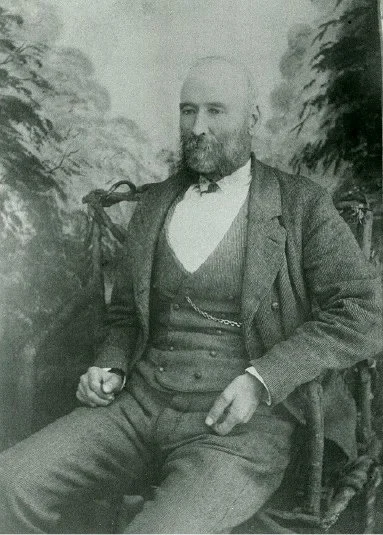
Robert McDougall was born in Glasgow in 1829[1] to Andrew McDougall and Jean (née McFarlane).
About 1849, like other young men and women of his age group, Robert left home and sailed to the United States. It is not known what he did there, but he returned in 1851. What becomes apparent, is that he thought his real future was overseas. The economic situation in Scotland in the early 1850s was not great for the low and middle-class families, so it is understandable why so many emigrated.
It was stated in his Obituary published in the Lake County Press, 18 November 1915 that Robert arrived in Melbourne, Australia in 1853 on the ship “Champion of the Seas”. However, that ship was not launched until 1854 and the maiden voyage was from Liverpool to Melbourne between October 1854 and 26 December 1854. Pure conjecture, but maybe he left Scotland in 1853 and worked in Liverpool for a short while. Certainly, he was on this 1854 voyage as evidenced by the Passenger List:

Sourced from: https://prov.vic.gov.au/archive/3AF6D5EF-F96C-11E9-AE98-9DD57D8DEA70?image=200 last accessed 18 December 2023
Whilst in Australia, Robert engaged in gold-mining in various locations. He arrived right in the middle of the “rush”. As he landed at Melbourne, it is most likely he went to the Ballarat/Mt Alexander, Maryborough/Bendigo fields which had “rich pickings”, for a while anyway.
The Rush to New Zealand
1861 and word got around that there were “rich pickings” to be had in a newly discovered goldfield in Otago. Apparently chasing gold, Robert sailed to Dunedin in August 1861 where he joined in with thousands of other gold prospectors in the Gabriels Gully gold rush. He also tried the Wetherstones goldfield as well.
He cannot have been there long as he travelled back to Glasgow, Scotland, where he met his wife to be, Elizabeth Paterson and they married on 12 June 1862 at Bridgeton, Glasgow. Robert was described on the marriage entry in the Register as a gold miner and Elizabeth as a domestic servant.[4] Elizabeth was aged 23, so born about 1838.
Elizabeth’s parents were George Paterson, a coal miner and Elizabeth Morrison. Nothing more is known about them and like Robert’s parents, they had died before the marriage of Robert and Elizabeth.
Whilst they were in Glasgow, their first child, also named Robert, was born in 1863, however an official record of this birth cannot be located to date. The date is recorded on his headstone as being 4 March 1863 and also on a handwritten family record that indicates Robert Jnr was baptized by the Rev. J R Watson at Christ Church, 796 Crow Rd., Glasgow.
The next year they sailed for New Zealand and arrived at Macetown.[5] It was when they were at Macetown that Robert set up as a storekeeper, though wanderlust seemed to still be in his blood as he travelled to South America and back to Australia before returning to the Arrow. It was probably a quick trip and maybe Elizabeth stayed behind at Macetown as their next child, Andrew, was born in New Zealand on 15 May 1865.
They started raising cattle at 12 Mile, Arrowtown but then Robert entered into a partnership with William T Smith as storekeepers. They were to have stores in Arrowtown, Cardrona, Macetown and Motatapu. Robert moved to Cardrona in 1871, about the time that store was purchased, and the rest of the family moved over in 1872. Robert and William had purchased the store from the widow of R Patterson who had recently deceased.[6] On 9 April 1877, the partnership was dissolved, and Robert retained the Cardrona store.[7] He was appointed the Postmaster on 1 August 1872 for an annual fee of £11. Another important business owned by the McDougalls was the coal mine located up near the top of the Crown Range Pass.
The McDougalls had another connection to business in Cardrona. Elizabeth’s brother, Gavin, had also come out from Scotland. His son, James Dunlop Paterson, Elizabeth’s nephew, owned the Cardrona Hotel for many years until he died in 1961.
Robert was voted in as a councillor to the new Lakes County Council after the elections on 22 December 1876[8] and the partnership was dissolved with Robert retaining the Cardrona store.
The Pembroke Move
Earlier in 1876, Robert had applied for Crown Grants for a number of properties in the township of Pembroke. Of special importance was the Crown Grant dated 12 June 1876 to Block 9, Sections 29, 30 and 57. These sections were on Ardmore Street where the Wānaka Four Square Store stands today (2025) and the next two sections towards the Lake. This location was to be central to his store business and other activities. He did purchase Section 31 from the Estate of George Barker on 19 March 1885 which completed the total area for the store, not that it took up all of that area.
There is little doubt that Robert saw the potential for commercial business in Pembroke. Cardrona was slowly losing population numbers and businesses, as the miners left town because of the gold takings reducing. But his priority was to build new home in May 1877 in Pembroke.[9]
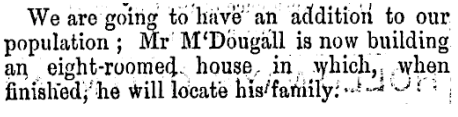
The house still exists in McDougall Street (though some modifications have occurred since 1877) and is very visible with the giant Wellingtonia Sequoia trees, planted by Robert, on the section.
The New Store
Having completed living arrangements for his family, the next step was to build a general store building. In April 1879 it was reported that Robert was “having large general Storekeeping premises built on the rising township of Pembroke, Lake Wanaka. The building is of timber and measures 40 x 20 feet. The contractor is Mr Edward H Thomas. On completion of this building, Mr McDougall purposes (sic) building another very commodious stone store as the requirements of the district demand more storage accommodation.”
The stone store never eventuated, however there is an interesting subsequent history to the land on which Robert built his store. It was principally built on Section 57.
Robert now had two stores to manage – the Cardrona Store and the Pembroke Store. Robert left his eldest son, Robert Jnr, aged just 14, in charge of the Cardrona store. On 1 October 1883, Robert Jnr was appointed Postmaster at Cardrona for an annual fee of £5, less than half of what his father had been enjoying. On or about 1 October 1883 a partnership was formed between Robert Snr and Robert Jnr and named “R McDougall and Son”.
The Pembroke store business thrived and in 1883 it became the Post and Telegraph Office, having taken over this operation from Celia Russell at the Wanaka Hotel (not without some disquiet from some locals).
In 1885 he briefly opened a new store up on the Criffel Gold Field, but the initial business did not continue, so it was closed, as did other businesses that ventured up to the field.[10]
By the turn of the century, the age of the wooden Pembroke store was showing through. The attached bakery had suffered a fire in 1888, though it had been rebuilt. In 1904, Robert’s sons, Andrew and Peter, demolished the old store and built a new one, marginally closer to the Lake, on Section 29.
Robert was aging, though he was still very active in the community and still a Lakes County Councillor when he sold the Pembroke business of R McDougall and Sons to his son Peter. Peter appears not to have been the businessman that his father was, and by April 1913 was adjudged bankrupt. Robert had been astute enough to take a Caveat over the land and buildings to secure the liability Peter must have had to his father, so that when David Jolly from Cromwell purchased the business and property from the Official Assignee, Robert was in a position to retain part of the land in exchange for him releasing his Caveat. Sections 29A, 30A and 31A were subdivided off on 27 March 1914. This land was in turn sold by Robert’s Estate to Helen Mackay and was where the Dunedin-Wanaka Motor Services Ltd was established (and later became Mansons Motors Ltd).
Note that it was D A Jolly & Sons that built the existing store (operating under the Four Square trading name) in 1927 to replace the store built in 1904.
Shipping
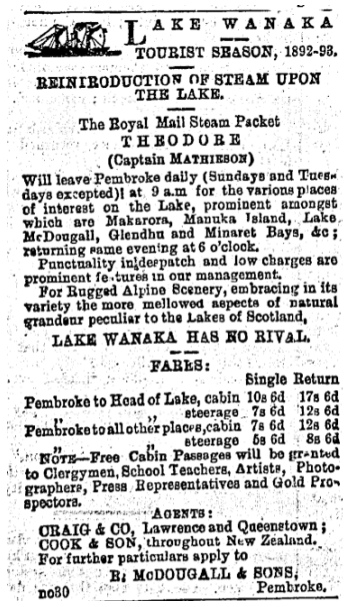
With increasing numbers of tourists and demand for shipping on the Lake, Robert ventured into shipping on the Lake using the trade name ‘Wanaka Steamshipping Company’. About May 1892 he purchased the paddle-steamer the SS Theodore that had been plying the Lake since 1883. The vessel had previously sunk at the jetty in 1891 but was repaired. The Theodore was finally laid up and grounded about 1905 where it disintegrated over time before being removed altogether between 1910 and 1914.
William Allan put up his steamship, SS Makarora, for sale in 1906 as he intended leaving the area. Robert purchased it, possibly as a prospective replacement for the Theodore. It sank on 27 April 1909 and that was the end of Robert’s commercial interest in shipping on Lake Wānaka.
Councillor McDougall
In January 1914, Robert gave notice to the Lakes County Council that he would not be standing again in the coming October elections. This meant that having been first elected in 1876, he was a councillor for more years than most other councillors.
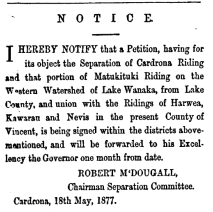
It had not taken him long to make his presence known to the other councillors. In April 1877 he presented a petition to have the Cardrona Riding (and adjacent Ridings in the Upper Clutha), separated from the Lakes County and included in Vincent County.[10.5] Robert, as Chairman ofthe Separation Committee, led the presentation of the information, to the Lakes County Council and The Governor of New Zealand. It was noted that rates being collected from the Cardrona Riding far exceeded the expenditure by the Council on facilities in the Riding (when have we heard that argument repeated?). The petition was unsuccessful.
In October 1877, Robert proposed to the Lakes County Council, that £40 and £30 be granted to purchase books for the “Wanaka (Pembroke) and Cardrona Libraries” respectively.[11] It was approved by the Council, unconditionally for the “Pembroke Public Library”, but with a condition on the Cardrona grant, that the Cardrona Library had to first declare itself a public library.[11.5] It is difficult to believe that Robert McDougall operated entirely on his own, to promote a motion at Council for funds for the Libraries, which leads to the premise that a Pembroke library group (committee) already existed in 1877. Cardrona formed a library committee very quickly in early December 1877. Pembroke did not have to form a Public Library as it was already in operation, but not from a specially built building until 1882/3.
Another major achievement was the creation of the Lake County Forestry Nursery at Spotts Creek. He started work on this is 1878 and despite strenuous opposition from the Lake County Council, he won out and proved that it could be a profitable project. Bill Studholme was appointed the manager. At one stage it was reported they had over 25,000 seedling trees in the ground.
Robert was a very active councillor and missed very few meetings despite his age and having to travel over the Crown Range to attend.
Service to the Community
He had a remarkable career in service to his community and was well respected, most of the time. Whilst he may have sued clients for non-payment of accounts, he was generous in providing credit to miners and others who could not afford to buy essential goods. There was one, at times intense rivalry between Robert and William Monteith. It was reported that “their personal animosity grew to such an extent that finally, topcoats off and waistcoats popping, they laid into each other with walking sticks and riding whips. Soon exhausted, the two shopkeepers continued their battle in Court with mutual charges of assault. A wise magistrate awarded each man equal damages and costs.”[12]
The list of Robert’s involvement in the community was extensive and includes:
Providing a joint guarantee of £200 for two years to obtain a competent schoolteacher for the district and working on the school committee
Member of the Wanaka Islands Domain Board
His efforts to get roads for wheeled traffic built
Effort to have the four islands in Lake Wānaka vested in the Wanaka Domains Board
Advocate for the Central Otago Railway
Strong advocate for the breaking up of the large Runs
His generosity towards deserving new settlers to enable them to establish a home
Coroner
Obtaining funding to form tracks and improve Manuka Island (now known as Mou Waho). It involved him donation 25% of the cost and having to find another 25% before the General Survey Office would provide the balance (£50)
Participating in many local bodies and community activities
Registrar of Births Deaths and Marriages
Such was Robert Snr’s standing in the Community he has been called “King of Pembroke” and “Father of Pembroke” but that is probably taking matters a bit far as there are others who also contributed quietly in the background to the establishment and welfare of the Pembroke community.
His Family
Nine children were born to Robert and Elizabeth:
Robert born at Glasgow, Scotland in 1863
Andrew born at Macetown in 1865
Jean born at Sunnyside, Dunedin on 1 April 1867 (from a family record, no registration details can be found). A Jean McDougall appears on the Electoral Rolls for 1893 and 1896 at Pembroke. It appears she may have married a Hugh McEldowney, on 16 August 1898 but he died on 17 December 1898. It then appears that she began a relationship with John McLennan (no record of a marriage can be found but their child, Margaret Elizabeth, was born in 1907). Jean died in 1939 and is buried in the Northern Cemetery, Dunedin.
Janet born Arrow Flat in 1869
Peter born at Arrow Flat in 1871, married Blanche Russell on 11 August 1892
Alexander born at Arrow Flat in 1873
John born at Arrowtown in 1876
Allan born Cardrona in 1878 (died 1910)
Annie born 1882 at Pembroke (died 1886)
All of these children contributed to the Upper Clutha Community – Andrew as Captain of various lake vessels and other business activities, John at Tarras, Peter working in the store and the Wanaka Hotel, Robert Jnr as partner and then owner of the store in Cardrona. Like his father, Robert Jnr became a valuable and important member of the Cardrona community.
Robert died in Pembroke on 13 November 1915 aged 86. Elizabeth, who was a capable supporter for her husband and her children, lived at Cardrona with her eldest son, Robert Jnr, after the death of her husband. She died on 8 April 1924 at Frankton Hospital. They are both buried in the Wānaka Cemetery.
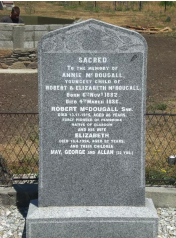
Whilst there are two additional children named on the Headstone in the Wānaka Cemetery, (May, born 1895 and George, born 1897), that is an error.[13]
The aforementioned history of Robert McDougall Snr is but a summary and does not cover everything that he was involved in.
Addendum: Recently we discovered some writings of Bob Norman (1900-1996). Included was this story from his childhood at school (written in 1996!):
“Mr. and Mrs. Robert McDougall lived up by the school creek on the road to Mt. Barker, (Old Mac we used to call him) and every day he would ride a black pony over to his store across the Pembroke Flat to his office in the top store. He was 85 and we thought “heavens that are old” (sic). We saw him every day going home for dinner, and one day a red deer, it must have been a stag, went across the flat heading for Mt. Roy and Taddy Goodall, as we called Maud Goodall's younger sister, came running into school and told Miss Murdock that she had just seen Old Mac's pony going across the flats with sticks on his head.”
[1] Family records state it was on 16 October 1829.
[2] https://en.wikipedia.org/wiki/Champion_of_the_Seas accessed 18 December 2023.
[3] https://prov.vic.gov.au/archive/3AF6D5EF-F96C-11E9-AE98-9DD57D8DEA70?image=200 accessed 18 December 2023.
[4] Statutory Register Marriages 644/3 – 1862 Marriages in the District of Bridgeton in the Burgh of Glasgow, No. 99
[5] The report of Elizabeth’s death in the Otago Witness, 6 May 1924, Page 31 suggests Robert came back to New Zealand by himself and Elizabeth followed later, unlike other newspaper articles on this couple. Note that their next son, Andrew, was born on 15 May 1865.
[6] Ray O’Callaghan, Cardrona 150 Years in the Valley of Gold, (Tidy Design Ltd, Wanaka, 2012), 44. Also, Notice, Lake County Press 29 September 1872, page 3.
[7] Dissolution of Partnership, Lake Wakatipu Mail, 3 May 1877, page 3.
[8] F W G Miller, Golden Days of Lake County (2 ed, Whitcombe and Tombs Ltd, Christchurch and elsewhere, 1949) page 275.
[9] Lake Wanaka, Cromwell Argus, 22 May 1877, page 7.
[10] Advertisements, Business Notice, Cromwell Argus, 6 October 1885, page 3.
[10.5] Notice, Lake Wakatip Mail, 24 May 1877, page 2.
[11] Example is “Lake County Council” in the Lake Wakatipu Mail, Issue 1037, 11 October 1877, page 3.
[11.5] Prior to the Cardrona grant, only a book club had been in existence – Lake County Press, Cardrona, 13 December 1877, page 2.
[12] Aspiring Settlers, John H Angus (John McIndoe, Dunedin, 1981) pages 66-67 McIndoe.
[13] Source: Catherine Little of Wānaka, a descendant. George in fact is a son of Andrew and Florence McDougall as per his Death record at Births Deaths and Marriages. There is no record of May at Births Deaths & Marriages.