
William Barr Allan and Mary McIvor
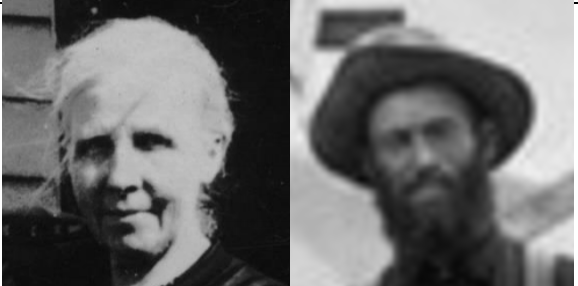
This couple are best known for the Commercial Hotel (1885), William building, owning and operating the SS Makarora and building the Pembroke Boarding House that subsequently became known as the White Star Private Hotel.
William Barr Allan was born 1854 Lanarkshire Scotland, died 1924, Pembroke, New Zealand. Mary McIvor was born 1861 Ballarat, Australia, died 1946, Timaru, New Zealand. The two married in 1882 in Invercargill, New Zealand.
William Allan (born 1854) – his parents and siblings.
William Allan Snr (1824 - 1910) married Mary Barr (c.1821-1859) in 1842 at Carluke in Scotland and had 5 children who survived to adulthood: Mary (1842-1918), Thomas (1847-1925), Janet (1852-1923), William (1854-1924) and Jane (1858-19xx). Mary (Barr) Allan died in 1859. The eldest daughter Mary emigrated to New Zealand and in 1866 married Robert Raynbird in Dunedin. She was followed to New Zealand by her father and four younger siblings in 1869. William Allan Snr married Ann Elizabeth Hellyer (1847 St Saviour, Jersey - 1934) in 1880. They lived in the North East Valley, near Dunedin and had four children; Florence Matilda (1881-1932), Robert Philip (1882-1972), John Hellyer (1884-1959), and Elizabeth May (1886 - 1952).
Mary McIver (born 1861) – her parents and siblings.
John McIver (c.1819–1869 NZ) and Margaret McDonald (c.1840–1896) were married in 1858 Vic. They lived near Ballarat before emigrating to New Zealand in 1864 with their two daughters Christina Catherine (1859 Lethbridge Vic. – 1924), and Mary (1861 Ballarat Vic. - 1946). After arrival they resided in the Cromwell area and had two additional daughters, Flora (1867 – 1960) and Margaret (1868 – 1892). After her husband’s death, Margaret (McDonald) McIvor married Thomas Henry Graham (1841-1919) in 1873. They had at least one child that lived to adulthood: Jane (1875-1905). (Note the surname McIver became McIvor in New Zealand records).
William Barr Allan and Mary McIvor – Their Story.
At the age of about 17, and just a few years after his emigration to New Zealand, William was in the Pembroke region, working as a wood cutter on Pigeon Island (now known as Mou Waho) and rafting on local rivers. By 1881, when William was 27 years of age, he launched the cutter Endeavour on Lake Wānaka; a boat built by Asher Smith and William, with the latter the sole owner.
In June 1882, William and Mary were married in Invercargill and over the following 22 years they had nine children: William (1882–1961), Florence Mary (1884-1970), Maud (Meda) Catherine (1886 - 1963), Margaret Beer (1888-1973), Thomas Henry (1890-1916), Edna Vera (1894-1973), Ina Hessie (1899-1933), Alexander Ivan (1902-1962), and Flora Hazel (1904-1927).
1882 - 1906 Pembroke region.
Partnership with William Silvester
The newly married couple initially lived in Dunedin then were relocated to Cromwell the following year with William going into partnership with William Silvester. The business included the cutter Endeavour, a house on the Glendhu roadside of Lake Wānaka and ownership of Block III Sections 18-22 in Pembroke and at a later date the adjoining sections 15-17. William used the cutter to transport wood from Makarora to build a hotel located at the southern extremity of Lake Wānaka, which became known as the Commercial Hotel. The hotel premises had 16 rooms, with an intention to complete more bedrooms and a billiards room. William became the publican licensee, opening the hotel in July 1885. He celebrated the event by holding a free ball in the Olympic Hall, with over 200 people attending.

In the following year, the partnership between William Allan and William Silvester was dissolved. The assets of the partnership, put up for public auction on 25 June 1886, included the Commercial Hotel on 8 sections of land (15 - 22 Pembroke), stable, horses and buggies, and the 10-ton cutter Endeavour. At the auction, William Allan purchased the hotel and associated items and William Silvester purchased the cutter. Five years later, in 1891, William sold the Commercial Hotel to William Sachtler, a hotelier originating from Dunedin.
Trading vessels on Lake Wānaka
At the time William sold the Commercial Hotel, he was already sailing his cutter Surprise on Lake Wānaka. Within a year he was using the cutter to deliver goods to Wānaka Lake dwellers. The business faced competition from the other large trading vessel on the lake, the PS Theodore. In addition to the tourist trade William had customers wanting cargo services including the supply timber for dredges, and transporting farming equipment across the lake.
About July 1892, William announced that “he will shortly place a steamboat on the lake.” The original plan was to raft the cut timber for the vessel down the Wilkin and Makarora rivers to be loaded onto the cutter Surprise at the head of the lake. Seven thousand feet of totara planking for the steamer had been cut by October 1893. Asher Smith, who had built the Theodore was to jointly build the new steamer with William.
William had also decided in May 1894 to build a new cash store adjacent to his home in Tenby Street, Pembroke. The need to manage the new store possibly prompted his decision to change the building site of the steamer to Pembroke, specifically along the lake shore alongside Beach Rd (now known as Lakeside Rd). Even those plans were interrupted when on Sunday 23 September, William and Mary’s house was destroyed in a fire with some damage to the new store as well.
The construction of the steamer was slow due to other work commitments, but by October 1895 the framework of the steamer was completed and at the end of 1896, the planking and lining had been completed. Another of William’s activities at this time was gold mining in partnership with Adam Aiken. In 1896 they applied to the Otago Mining District Cromwell for a Special Claim. The 15 acres of land associated with this claim was “Nevis and Kawarau Rivers”. The claim was proposed to be a 21-year lease funded with a capital investment of £3000 and to be worked using dredges. In Sept 1899 a reporter of the Otago Witness was of the opinion that William Allan’s claim had the potential to be profitable but was using inadequate dredging equipment making it difficult to realise that status.
Asher Smith died in April 1899, missing the completion of the SS Makarora. The steamer was launched in January 1900. The carpentry and shipwright work on the vessel had mostly been completed by William. It was 80 ft long, with a beam 14 ft, and depth of hold 7 ft 6 in, and carried 10-12 tons of stones as permanent ballast. The lake level was very low so William organised 20-30 local men to assist him to convert the boat into a virtual sledge and with the aid of the men pulling on attached chains, the boat was slid into the water. The boat was christened by William and Mary’s eldest daughter (Florence) and the flag displaying the name of the vessel was raised by Captain Hedditch.

Part of the Makarora framework and the workers, taken probably about 1895.
By December 1900 the SS Makarora was ready to take passengers on excursions. Captain Hedditch had captained the vessel previously and did so on that first trip and Tom Craig was the engineer. Over 100 passengers, including families with children, were taken to Stevensons Island where they disembarked to enjoy refreshments, sporting activities for the children and short walks on the island. The first trade load for the steamer was 18,000 ft of Makarora red pine, weighing 55 tons.
An end of year excursion on Lake Wānaka was offered for a number of years by both the SS Makarora and PS Theodore, with travellers coming from as far away as Cardrona and Cromwell. The excursions in the 1902/3 festive season included trips to Mou Waho allowing time for passengers to have picnics on the island before the return journey back to Pembroke.
In December 1901, a year after William had commenced using the SS Makarora for passengers and commercial loads, he sold the cutter Surprise to Messrs Buckley and Perry, who planned to relocate it to Lake Hāwea. William sailed the cutter down the Clutha River to Albertown[1], where it was placed on sleigh using rollers to allow it to be transferred the 9 miles overland on an undulating road to Lake Hāwea.
In addition to the slowing of trade on the lake for steamers, there was opposition from local residents for businesses offering commercial services on Sundays. In February 1903, 24 residents of the Pembroke district sent a letter to the Cromwell Argus voicing their objections against Sunday excursions of the steamers on the lake. Possibly in an attempt to increase passenger trade on his vessel, in December 1904, William applied to the Wakatipu Licensing Committee for a licence to sell alcohol on the steamer (packet licence), but it was refused. Additionally, the tourist trade significantly reduced that year.

The completed SS Makarora
In early 1906 William made a decision to leave Pembroke. The decision would seem to be an acknowledgement that a business based on using trading vessels on Lake Wānaka to service the tourist and commercial transport industry was no longer viable, especially when there was more than one operator. Advertisements were placed in the local papers listing his possessions to be put up for auction on 17 February 1906. These possessions included dwellings, furniture and the SS Makarora. The Wanaka Steam Shipping Co, owned and operated by Robert McDougall and the major competitor to William’s lake transport business, purchased the SS Makarora. That company also owned the oil launch Tilikum, which was to be used for tourist trade, and the SS Makarora to be used for timber and heavy cargo trade. In April 1909 the SS Makarora was returning to Pembroke from a trip taking passengers to Minaret Station and Makarora, when it lost power about four miles from the head of the lake. The vessel drifted and was eventually driven ashore at Rough Gully by the winds, breaking up and sinking.
1904-1924 the Pembroke Boarding House
In 1902 the Hedditch family moved to Wanganui ending an association with Pembroke that had lasted 34 years. In 1904[2], Mary purchased the land from Captain Hedditch. Earlier in 1894, the Allans had their home in Tenby Street destroyed by fire and their adjoining store damaged, but rebuilt on the same site later that year. In 1904 William and Mary dismantled the new home and moved it to the new property (on Ardmore Street) where they rebuilt it. They also added on rooms out the back for boarders and that became the Pembroke Boarding house. The transfer to Mary did not take place until 1906 but the reason for the delay in registration is unknown.
In 1924, William died and Mary sold the property to Dunedin Wanaka Motors Ltd (principally established by Helen and Horatio Mackay) which as part of the White Star group, wished to have an accommodation house for their clients. Mary had previously moved to Carisbrook, Dunedin[3]. The house then became known as the White Star Hotel.
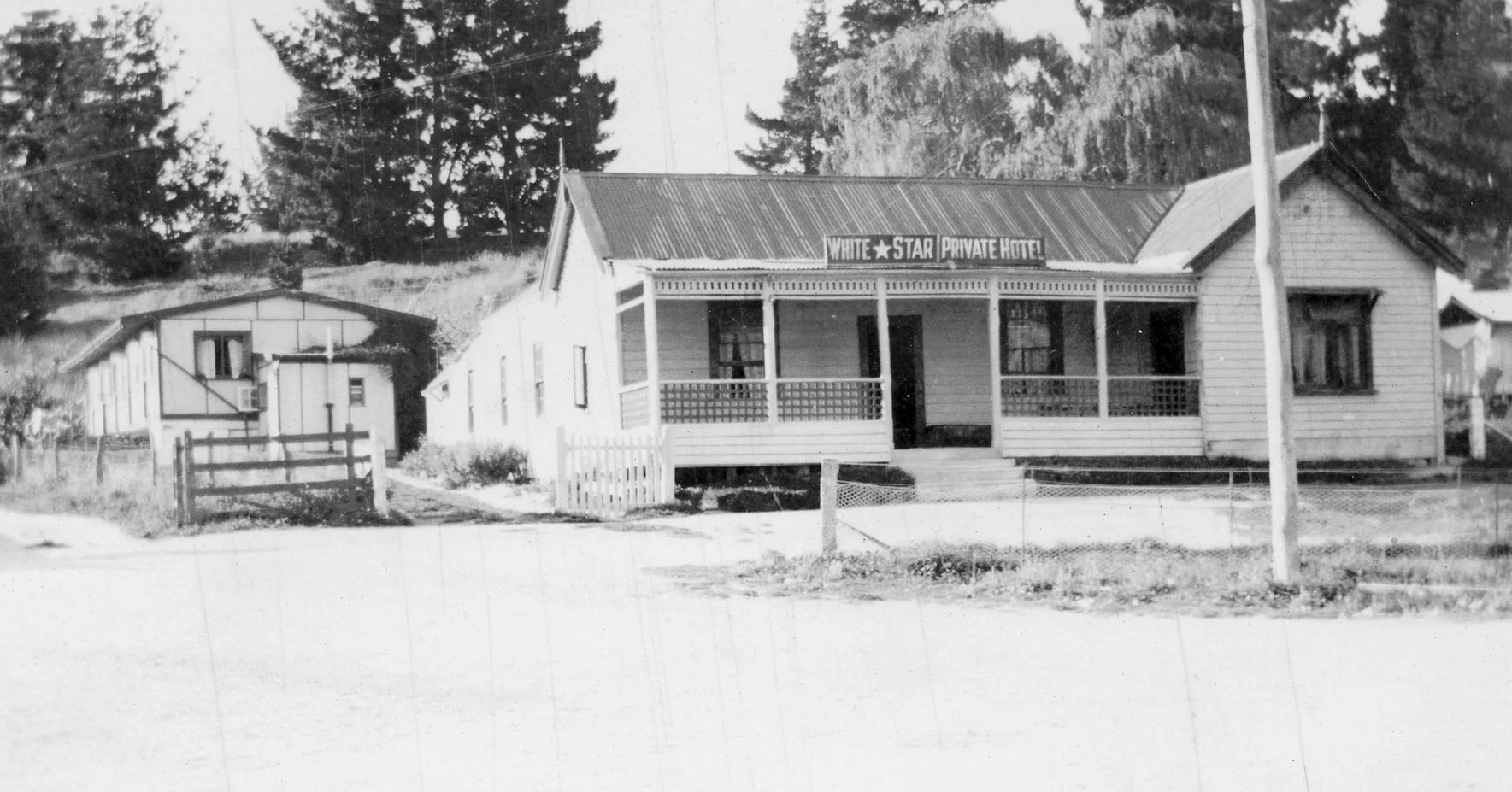
This was the home and boarding house that William and Mary moved to this site in 1904. You can see the boarding rooms down the left side. This photo is dated c.1926-1935
1906–1911 Te Anau / Naseby / Dunedin.
In January 1906 William announced that after having lived in the Pembroke area for about 35 years he was planning to take up an appointment in Te Anau to look after Government interests in that area. Mary remained behind to manage the disposal of their property including their furnished boarding house and store, before joining her husband. An auction that included the Boarding House property was held on 17 February 1906 but there is no evidence that the property was sold and of course, Mary remained as the registered owner until she sold the property in 1924. Maybe the Boarding House was rented or leased out to another party. The local community attended a send-off for Mary and she was given a silver teapot and some money in the form of sovereigns.
In December 1907 William, (still referred to in the advertisement as “William Allan of Pembroke”), was granted a temporary transfer of a publican’s licence for the Marine Hotel in Port Chalmers from Donald Morrison, which was assigned in 1908. In October 1909 William applied for his License for the Marine Hotel be transferred to Edward McKewen.
In December 1909 James Walker applied to the Licensing District of Tuapeka to have his hotel licence at the Victoria Hotel Naseby transferred to William. Three months later, on the 22 March 1910, by which time the Allan family were in residence, there was a fire at the hotel. An Inquiry was held on 29 April into the circumstances of that fire. The inquiry found that there was evidence of arson, but no blame was laid as the culprit for the fire could not be proven.
On 6 May 1910 William applied for a license again in Naseby for the Victoria Hotel. It is not known if the location of the hotel was at the same site as that for the previous licence. William’s father who lived in the Dunedin area, died on 14 May 1910 at 85 years of age and his sister, Mary Raynbird, also died in 1910. By August 1910, William was transferring the licence of the Victoria Hotel to Walter Hall Webb. The death of two of his immediate family members may have been related to why he relocated to Pembroke at the end of 1910.
1911 – Back to Pembroke.
In early 1911 William was engaged by the Presbyterian Church to erect a picket fence on the frontage line of the church and paint the building. Later, the Lake County Council awarded him a tendered contract in February 1912 to extend the wharf at Lake Wānaka, which he completed in October 1912.
In 1912 William took over the sawmill at Makarora, which gave hope to the locals that it would improve the supply of timber to area at that time. In September 1912 the Vincent County Council awarded him the tender for the renewal of the wharf at Makarora, which was completed by Feb 1914. For the next few years William was engaged by the County Council to undertake gravelling work at Makarora under contract 697 which was completed by Jan 1916.
By April 1915 the Allan family had moved back to Pembroke as their children, Lex and Florence, were enrolled at the Pembroke School in December 1915. Thomas Henry Allan, the second eldest son of William and Mary Allan, had his army medical examination for enlistment into the Twelfth Reinforcements during WWI. His Military Records show he was reported “Missing in Action” on 1 Oct 1916 and then declared “Killed in Action” on that date, less than a year after his enlistment.
The Deaths of William and Mary
William Barr Allan at 69 years of age, died suddenly on 27 November 1924, whilst working as a painter at John Faulks’ house. In an obituary, it was said that he had been a man with “an unfailing energy and kindly disposition. He was one of the finest type of pioneer, generous and straight - forward.” He was buried in the Pembroke Cemetery.
Mary died on the 21 June 1946, 22 years after her husband William. She died at 85 years of age in Timaru from heart and lung issues. At the time of her death she had seven living children, 2 sons and 4 daughters. One daughter, Flora, had died at 23 in 1927 and as previously mentioned, her son, Thomas, had died in action overseas in WWI in 1916, at the age of 26. Mary was buried at Andersons Bay Cemetery in Dunedin.
Their Property Ownership in Pembroke Township.
It is interesting that whilst William is recorded in many texts as being owner of all the properties, but in fact most were registered in Mary’s name. Reasons are unknown.
Block III.
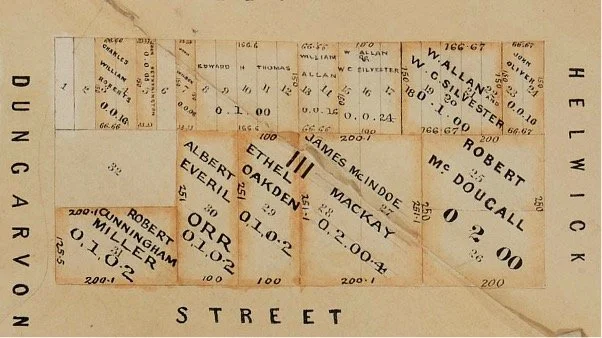
This Block is located along the lakefront between Helwick and Dungarvon Streets.
In 1883 and 1885, William and his partner William Silvester, received Crown Grants for the land that started from next to where the Kai Whakapai Eatery and Craft Beer Bar is located, down to halfway between Helwick and Dungarvan Street. This was where the Commercial Hotel was built and includes two sections in 1890 that were personally owned by William Allan. The lot were sold in 1891 to William Satchler.
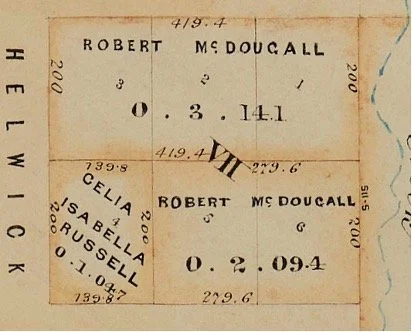
Block VII
These 3 sections are on the lakefront from Helwick St, to where the Speights Ale House is located. William purchased them from Robert McDougall Snr’s estate in 1917. In turn they passed to the Public Trustee in 1926 from William’s estate.
Block IX – Ardmore and Hedditch Streets.
Mary purchased Sections 58 and 59 in 1906 from Elijah Hedditch (though we think she was in possession of same in 1904). In 1924 she sold them to Dunedin Wanaka Motors Ltd. In 1883, William purchased Sections 60 and 61 from William Stewart then sold them to Robert McDougall in 1886. In 1929 She purchase Sections 60 and 61 and sold them to Cecil Collings in 1937. In 1924 Mary obtained a Crown Grant to Sections 87 and 88 (access from Hedditch St) and sold them to Dunedin Wanaka Motors Ltd in 1926.
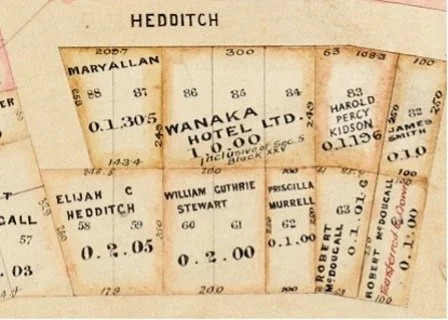
Block XLV – on the Corner of Tenby and Roche Streets
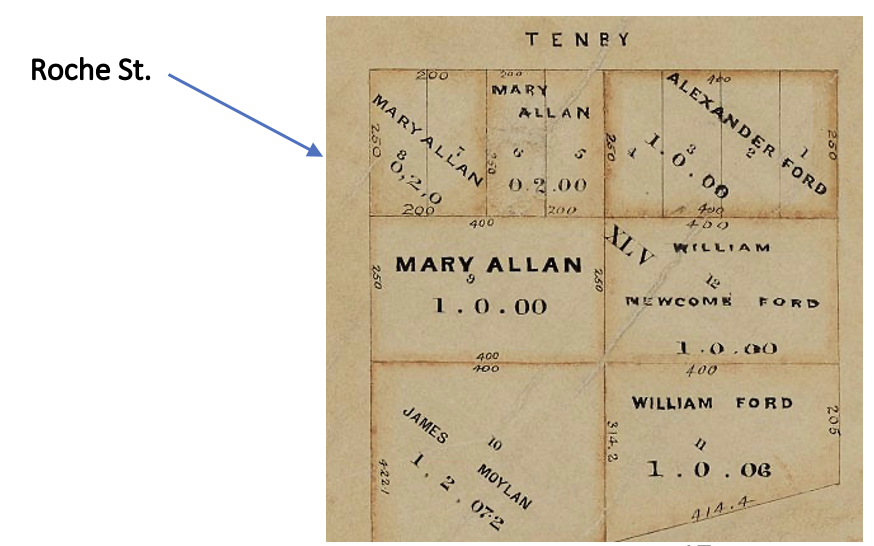
These properties are located on the corner of Tenby and Roche streets.
Mary received Crown Grants for Sections 5 and 6 in 1895 and then gifted them to the Otago Presbyterian Church in 1906. At various times over the period 1888 thought to 1928, Mary became the owner of Sections 7, 8, 9 and 10. Ultimately, she sold these to Charles Ironside.
[1] Now known as Albert Town.
[2] Transfer was not registered until 1906 but Otago Witness reported that in 1904, William Allan started to shift his house onto the property – ‘Lake Wānaka’, (5 October 1904) ,Otago Witness, 35
[3] In Thomas Henry Allan’s Military Records, her address as next of kin and beneficiary of Thomas’ estate in 1921 and 1922, is recorded as 44 Walter St, Carisbrook, Dunedin.
