Ardmore Street
The way down to the Wānaka lake front has, certainly from the 1860’s, been down a track, called a dray track in the early days. It was formed by travellers following the same track month after month down a sloping side of a hill. It was not formed as a road as we know it today.
Note that originally Ardmore St only extended as far as Bullock Creek. The road along the lake front was then known as Dungannon Street

This is Ardmore St about 1900. The two buildings are the original Post Office (next door to today’s Caltex petrol station) and the first Library on the lake side of the MACPAC store (the old Fire Station).
In 1939 engineers were set to work to improve Ardmore St and eventually in 1940 funding was approved (£4,294-4-2d) but ”it was regretted that approval of the M. H. Board cannot be granted under existing conditions…”. And then they were delayed again because of a proposal to raise the lake! On and on it went until in 1961 when work started at last. It was a large change to the profile of Ardmore St.
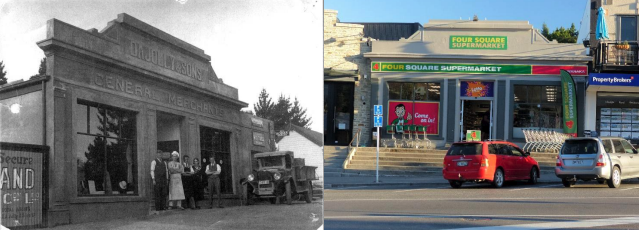
Same shops, but notice the road level compared to today – a set of steps to get to the doorway!
No more parking in the centre of the street and no grassed ‘hump’ in the middle of the street, but it was sealed at long last The junction of the streets at the bottom of Ardmore Street also changed for the better.
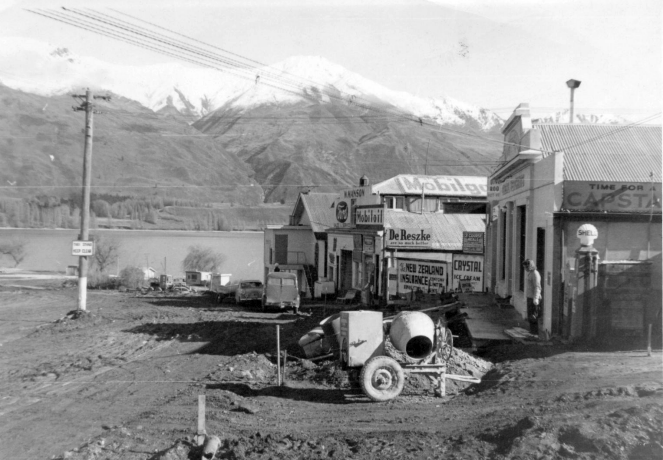
Work starts! Notice the power pole that was in the middle of Ardmore Street, and is that the storekeeper looking down at the change in levels and wondering how customers were going to enter the shop??
A few years later…
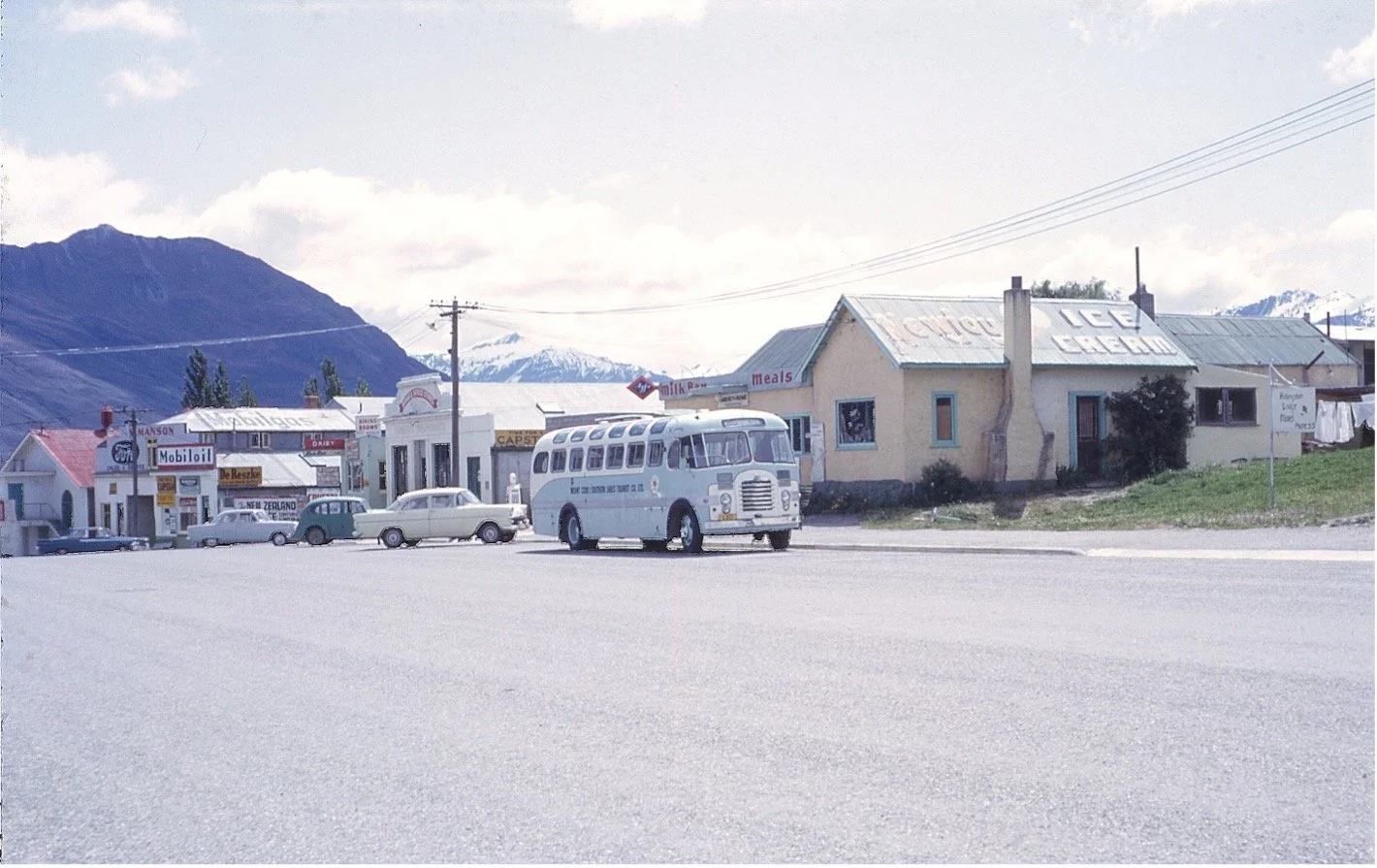
A very innocuous glimpse into the past about 60 years ago. The car behind the bus looks a bit like a Holden FB c1961, which helps us date the photo.
This photo tells a story about Wānaka, and possible explains why Wānaka has very few old commercial buildings – in fact only one! Can you spot it and name it? The location is on the upper part of Ardmore Street and all but one of the buildings in the photo no longer exist.
Starting from the left, the first building was the Wanaka Hall. It was opened in 1924. It replaced the Olympic Hall which was owned by the Wanaka Hotel across the street. The Wanaka Hall was financed solely by the inhabitants of Wānaka and the surrounding district. It was replaced by the Lake Wānaka Centre in 2000 which was across the street about where the original Wanaka Hotel had been erected in 1868.
Next door is Mansons Garage. It was also opened in 1924 but was then known as the Dunedin-Wanaka Motors, part of what was to become the White Star group of businesses.
The next building just behind the little green car was the dairy and dining rooms. It is the youngest structure in this photo.
Following on is the Wanaka Store, which is now known as the Four Square store and the oldest existing commercial building in the commercial centre of Wānaka. It was built by D A Jolly & Sons and opened in 1927 on the site of the original McDougall & Sons store, established in 1879. The current store is largely unchanged from 1927 except it no longer sells petrol.
The building to the side of the Mt Cook & Southern Lakes Tourist Co Ltd bus had a varied life. It started life as the house of William and Mary Allan in Tenby Street. It was moved to this site in 1910 and opened as a boarding establishment. After William’s death, his wife, Mary, sold the property in 1924 and it became the White Star Hotel, accommodating tourists brought to the town by White Star buses and motor cars. After a chequered period, including closure, it became an accommodation house and subsequently store and the first site of The National Bank of NZ Ltd.
Redevelopment of the area has only left the Four Square store standing and even the road level has dropped - you now need to climb steps to enter the Four Square Store.
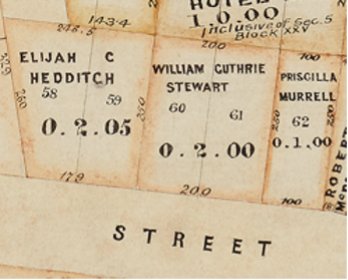
Sections 58 - 62 Ardmore St
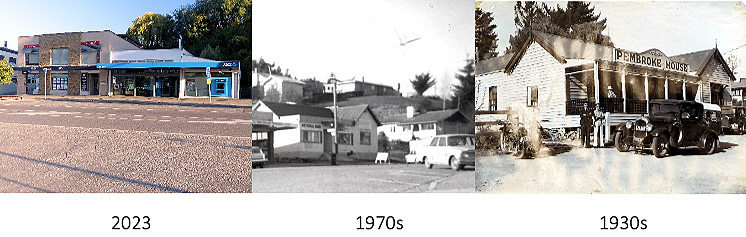
Looking at the 2023 photo we see the building housing Aspiring Law and Bayleys Real Estate. This is represented on the above map as Sections 58 and 59. A Crown Grant was granted to Elijah Charlton Hedditch (aka Captain or Charles Hedditch) on 15 August 1876. He was an original partner in the Wanaka Hotel with Theodore Russell who had married his sister, Celia. He was also very well known as captaining boats on the lake and guiding log rafts down the Clutha. In reality he was one of the founders of Wanaka. He built a home on the property, said to be the first residence in Wanaka, that was “surrounded by trees”[1]. In March 1901, as the congregation came out of the local church, the house was discovered to be on fire. A large amount of sewing, the sewing machine and the piano were saved, but the house was destroyed.
In 1902 the Hedditch’s moved to Wanganui ending an association with Pembroke that had lasted 34 years. In 1904[2] Mary Allan, wife of William Allan who had built the Commercial Hotel and the steamer ‘Makarora’, purchased the land from Captain Hedditch. Earlier in 1894, the Allans had their home in Tenby Street destroyed by fire and their adjoining store damaged, but rebuilt on the same site later that year. In 1904 they dismantled the new home and moved it to the new property where they rebuilt it (this is the building in the other two photos). They also added on rooms out the back for boarders and that became the Pembroke Boarding house.
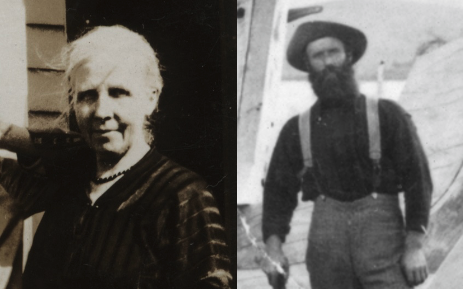
Mary Allan (1930s) and William Allan (about 1895)
In 1924, William died and Mary sold the property to Dunedin Wanaka Motors Ltd (principally established by Helen and Horatio Mackay) which as part of the White Star group, wished to have an accommodation house for their clients. Mary moved to Dunedin. The house then became known as the White Star Private Hotel. In 1927 Dunedin Wanaka Motors Ltd went into liquidation and was purchased by Wanaka Motors Ltd, essentially the same owners but Horatio Mackay was not a director. In 1936, NZ Railways Bus services purchased Wanaka Motors Limited which included the motor garage further down Ardmore St and the hotel. It was renamed and leased to others until 1944 when it was sold to Wanaka Hotel Ltd. They immediately closed the hotel thereby reducing competition for their own business. Eventually it was modified into a shop and later on, The National Bank of NZ Limited also conducted an agency before they opened as a branch. Later, the bank moved to a new building two sections along (now part of the ANZ Bank building).
Moving along to Sections 60 and 61, W G Stewart, a runholder (Makarora Run) was granted the land in 1878 and he sold it to William Allan in 1883. Three years later, Robert McDougall purchased it and in 1911 it was owned by his son Andrew. Subsequently it had a number of owners, including Cecil Collings. If I am reading the map correctly, this was subsequently the location of the Holiday Inn house, which had a variety of uses including an art gallery. The car garage, nearer the street (see photo below), was converted into a small ice cream shop.
The buildings were demolished recently.

[1] Lake Wanaka, Otago Witness, 27 March 1901, P29
[2] Transfer was not registered until 1906 but Otago Witness reported that in 1904, William Allan started to shift his house onto the property – Lake Wanaka, Otago Witness, 5 October 1904, P35
Ardmore St - Early History of the South Side
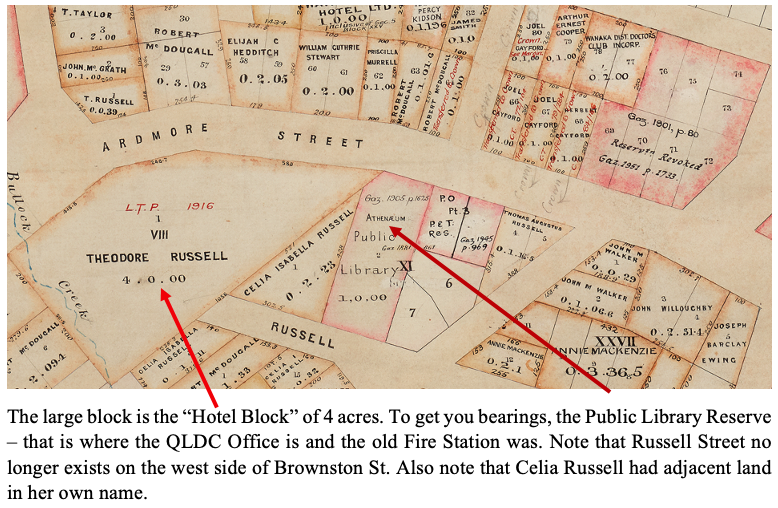
This is where Wanaka started in terms of buildings and commerce. The map is cut from an 1864 Records Map, it has been added to over time and the detail did not exist in 1864.
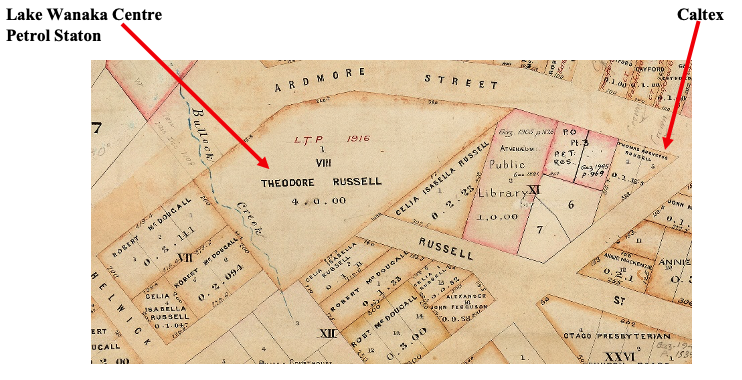
In 1864, all of the land to the right of Bullock Creek (and beyond) was described as Rural Land, as opposed to Town Land that applied to the land for the town first surveyed by John Connell in 1863. In 1866 Rural Land had to have a minimum area of 50 acres (no subdividing!).[1]
First on the Scene - A Man With a Vision
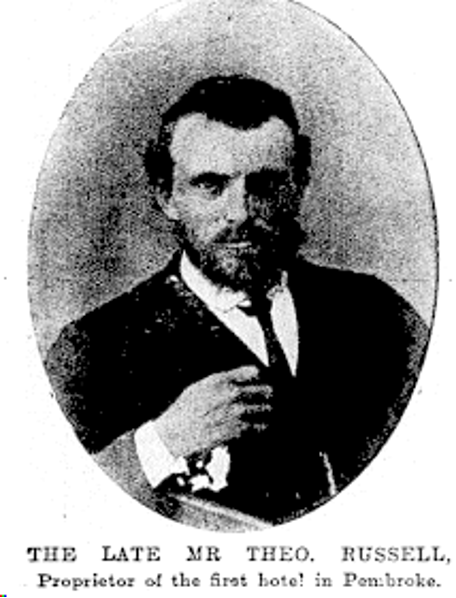
Born in Hobart, Tasmania in November 1843, Theodore Russell had a profound effect on the establishment of Pembroke during his short life. He was the eldest child of the marriage of Henry James Russell and Sally Powers. Most of Theodore’s early life was spent at various locations in Tasmania until his parents moved to Dunolly, in the Victoria goldfields, sometime between 1858 and 1860[2]. It is reported that about 1862, Theodore (aged just 19), left Dunolly and headed for the Westcoast (NZ) goldfields. The source of this information, the Cyclopaedia of NZ 1897-1907, can be unreliable and there is no supporting documentation, however the timing of subsequent events in the next 5 years tends to support this. During his short-lived visit to the West Coast, he met Elijah Charleton Howell Hedditch, three years his senior and also a native of Hobart, Tasmania. Like many gold prospectors, news of the gold discovery at Cardrona caused them to find their way to that location.
Nothing is known of their activities in Cardrona until 1866 that was about when Theodore and Elijah (more commonly known as Charles or Captain) became major shareholders in what was reputedly the richest goldmine in Cardrona, the Gin and Raspberry. It appears they were canny enough to take the early profits, sell their shareholding, and seek other opportunities nearby in Pembroke.
George Hassing reported that Theodore and Charles were very capable boatmen and raftsmen. They engaged in rafting timber down Lake Wānaka and thence down the Clutha River to the likes of Bendigo, Cromwell.
During this, say, 1865-67 period, Charles’ two sisters, Celia and Emily came to the area and on 21 September 1867, Theodore married Celia. The marriage was registered at Queenstown. Somewhere around this time the idea of building a hotel came to the fore. Note that there were no other commercial buildings in Pembroke at that time.
It is not known what conversations, if any, that Theodore and Charles may have had with the authorities about consent to build a hotel on the then land designated Rural Land. Maybe they just “squatted”. No doubt the timber was all sourced from Makarora or the Matukituki. The exact date it opened is unknown but we do know, that it appears it opened about 1868 as evidenced from newspaper advertisements. Not only was it a hotel but also a store and that was extended to a Post Office on 1 January 1873 when Theodore was appointed the Postmaster.
Charles and Theodore operated the hotel in partnership until 1 January 1869 and it was then operated by Theodore’s younger brother, Thomas, in partnership with Charles. But Charles went off to Tasmania where he married his wife, Florence in April 1869. Maybe Celia managed the hotel. Theodore occupied himself in building a little cutter of 22 tons he named the Isabella, that appears to have been completed about October 1869.[3] By January 1870, evidence shows that Theodore was the sole proprietor of the Wanaka Hotel, Charles was the new owner of the Isabella (was it exchanged for his share of the hotel?) and Thomas is believed to have joined the miners at Cardrona.[4]
Back to the land – when Theodore was about 25 years of age he started the battle of trying to get title to the land and he never really saw that being achieved. He died when he was 33 years of age on 14 November 1877 during a log raft trip down the Clutha to Cromwell. He died of enteric illness at Perriams, Lowburn.
He initially claimed 12 acres which may well have consisted of all the frontages on Ardmore Street up to Brownston Street. He even offered to have the land surveyed at his cost, but the Vincent County Council kept declining his requests. However, perhaps hurried along by the introduction of a new land category in the Wastelands Act 1872 named Suburban Lands, he should have at least had knowledge that Crown Grant was created in his favour on 25 May 1876, but only for four acres. The actual Crown Grant was not issued until 27 June 1878.
In 1888, the land and buildings were transferred to Theodore’s wife Celia. In reality she had been running the Hotel for most of its existenc. Celia passed away in 1905 which led to the title being broken up into three new titles.
The subdivision is difficult to describe in words so here is a couple of maps – before and after:
Subdivided, the plan looks like this:
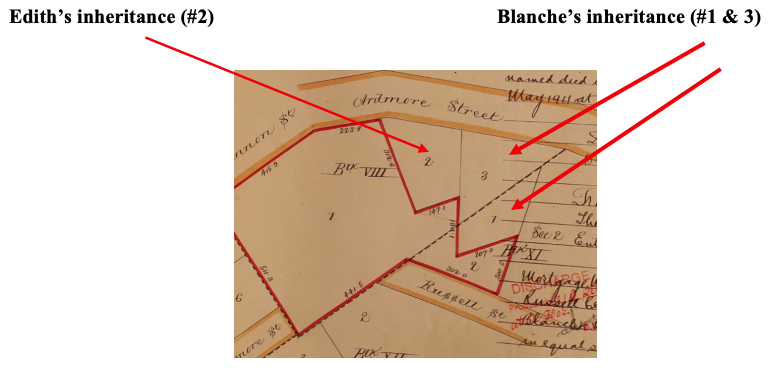
Celia’s daughter, Edith May, was bequeathed the Manager’s House (described as the “Cottage) that was being built in 1903 surrounded by approximately one acre of land. She sold it in 1911 when she moved to Lowburn. Various hotel managers used the house until 1942 when it was transferred to Bill Anderson. The house was moved down to where the Pembroke Village Mall is, but about 1982, to enable the Mall to be built, it was moved to 63 Hunter Crescent where it was still standing in 2023.
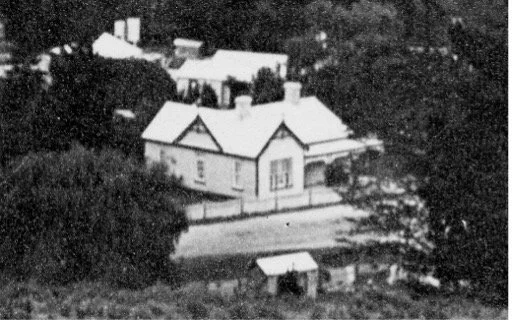
Edith’s cottage. The Hotel was a short distance down the street to the right.
To the left of the above photo was Blanche’s inheritance. Blanche had married Peter McDougall, son of Robert McDougall Snr but he was adjudged bankrupt and he and Blanche sold the property in 1914 and left town. There was a small house on the property which became of some importance to Wanaka as being the Doctors House.
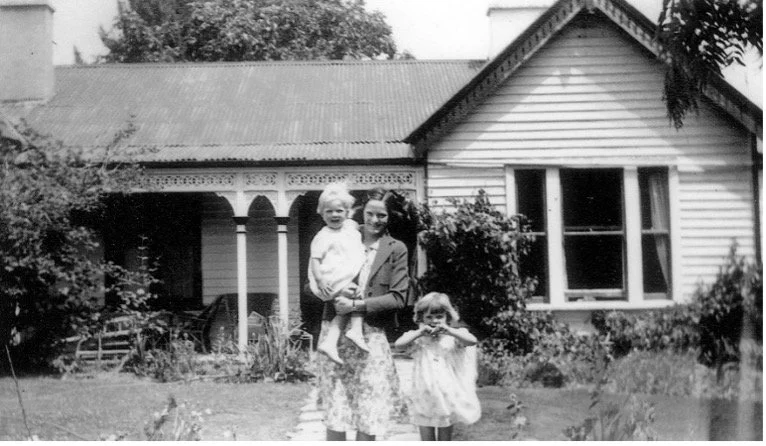
What was Blanche’s home and then became the “Doctors House”
In 1947 the ‘Doctors Club’[5] disbanded and on 1 May 1950 the ownership of the land and house was gifted to The Royal New Zealand Society for the Health of Women and Children (Central Otago Branch) Incorporated (became the Plunket Society).
Roll on now to the 1960s and Bill Manson who operated the motor garage across the road wanted to purchase the land where Edith’s cottage originally stood. He wanted to build a new motor garage and actually purchased the property in early 1961. But the Tourist Hotel Corporation wanted to build a new hotel (the previous Wanaka Hotel was destroyed in a fire in 1958) and they would need that property themselves. After negotiations with THC, Bill Manson and the Plunket Society, it was agreed that :
THC would purchase Lot 2 from the Mansons
The Mansons would purchase Lots 3 and 1
Mansons would agree to adjust their new land to allow for a small block to be owned by the Plunket Society
THC would pay all costs and a sum of money to build new rooms for the Plunket Society. The sum set for the new building and fencing etc was £2,100.[6]
Everybody was happy! The THC opened the new hotel in 1964, Bill Manson built his new garage and the Plunket Society had new rooms
The Library Reserve
Next door to the Plunket Rooms we now see the QLDC offices and next door to that at 49 Ardmore Street, is the Macpac store. The land they sit on was originally created as a Reserve for a Public Library in 1880. Somewhere in Wanaka, a library already existed under the watchful eye of volunteers. There is a record of one existing in 1877 but no record of its location. Maybe it was at the Wanaka Hotel or someone’s private residence. In any case a library was built and opened in 1882/1883 – just a very small building! Note that there are other publications stating that the Library was opened in 1887 but they are incorrect and there is documented proof of it!

The First Library Building – 1882/3 to 1967
The old Library building was replaced in 1967 where the current QLDC Council office is located. That building was added to out front later on, to accommodate some Council staff and there were plans to add more room for the Library, however it was decided to build a brand-new dedicated Library at Bullock Creek Lane (the current site of the Library). After this new Library was opened in 2003 (and incorporated the Upper Clutha History Society Archives Room), the Ardmore St building became the QLDC office. In 1965, Wanaka got its first Fire Station all built with voluntary labour. Prior to that, fire-fighting equipment was stored at Manson’s Garage. When the current Fire Station in Ballantyne Road was opened, the old Fire Station, was occupied by the retailer, Macpac.
[1] The Otago Wastelands Act 1866.
[2] Sister Emma was born in Tasmania 8/8/1857 and next child, Eliza, was born in Dunolly on 20 Jan 1861
[3] Unititled, Cromwell Argus, 26 October 1870, Page 4
[4] For more information on Thomas, see a following article titled “And at the other end from where we started”
[5] The ‘Doctors Club’ was a commonly used short version of the Wanaka District Doctor’s Club, a local organisation formed to obtain the services of a doctor for the area.
[6] Minutes of the Upper Clutha Branch of the Plunket Society dated 12 June 1961
The Top of Ardmore
We started off with the land eventually owned by Theodore Russell and we end with the land first owned by his younger brother Thomas Augustus Russell. Thomas joined his brother in Pembroke about 1868, but he is little-known amongst the early pioneers of the Upper Clutha.
Thomas was born on 11 September 1847 at Saltwater River, Tasmania, just over 100k from Hobart. It had a coalmine and two penal settlements but there is no indication discovered, that Thomas’ parents were inmates! The family moved to Dunolly, Victoria, about 1858/60 where Thomas would have completed his education and commenced working (labouring?). It is probable that his brother Theodore invited him to come to Pembroke and that he arrived about 1867. Electoral Rolls suggest he went to Cardrona to work as a gold miner, likely on the Gin and Raspberry mine as Theodore was a part owner and was living in Cardrona at the same time.[1] We know he worked in partnership with Charles Hedditch from 1 January 1869 carrying out the business of the Wanaka Hotel but this was for a relatively short time, maybe just for 12 months as by January 1870, all advertisements only mention Theodore as the proprietor. It is believed that Thomas re-joined the miners at Cardrona.[2] His next move was to return to Dunolly, Victoria where he met and married Fanny Maria Cater on 9 Dec 1876. Thomas returned to Pembroke with his new wife in 1877 (probably early in the year). Thomas was employed as a sawmiller and their first child, Henry Charles was born on 15 Oct 1877.
Their children were:
Henry Charles b. 15 Oct 1877
Thomas Russell b. 1879 (died 1900)
Clarissa (aka Clara) b. 1881
Frederick William b. 1889
Edith b. 1894
Clarissa lived with her mother to near the time of Fanny’s death and was then placed in the Lorne Hospital in Invercargill until she passed away in 1957.
Where the family was living in Pembroke is unknown for sure. There was a property on what we know as Lakeside Road in Thomas’ name at one stage. Maybe there was a house on that property. However, on 15 July 1886, Thomas was given a Crown Grant to the land on the corner of Ardmore and Brownston Streets where the Caltex Petrol Station now stands. The Grant was issued on 16 April 1888 and on 20 July 1891 it was transferred to his wife Fanny “for her sole and separate use”. Although not 100% sure, it appears they may have lived in a small cottage on the property. Thomas was working as a gold miner in the Hydraulic Co.’s claim at Cardrona but he was not a well man during the few years before his death on 13 May 1899, aged just 52. He is buried in the Wanaka Cemetery as is his wife, who died at Cromwell on 22 November 1926 leaving an estate assessed at £424.
Fanny’s Estate Executors were James Perrow and Charlton Elijah Ewing. In 1932 they sold the corner plot to Don McLeod, the local Mail Contractor and it was not until 1967 that Lot 2 was purchased by Hugh James Ross and Lot 1 by Bryan Willis Sadler. Sometime between 1932 and 1967, part of the land was vested as a road.
[1] NZ Electoral Roll 1868-1869
[2] NZ Electoral Roll 1871-1872