
History of Luggate
The great terraces and escarpments around Luggate township are the flood remains of the great rivers which carried away the glacial material from New Zealand’s “Ice Age.”
The Luggate Creek is named after Luggate Water, a small stream in Berwickshire, Scotland. The township is named after the creek. In 1863 Bill Smitham was the mail contractor from Clyde to Albert Town who noted that crossing of the Luggate Creek, especially when in flood, was at times difficult. As late as 1908 the coach driver, Bob Walker, took his horses separately, and escorted his passengers over the foot bridge. Then, with great difficulty, he dragged the coach through the stream.
Other creeks in the area have interesting names: Dead Horse Creek is named after J.G. Wilson. In early days, he stopped to give his horse a drink in the creek, when it suddenly reared and dropped dead. Sheepskin Creek – Miners who did not wish it to be known threw the skins into the creek from sheep they managed to capture for some mutton. And Poison Creek after cattle who were poisoned by the Tutu (plants) growing in the hills.
Luggate Creek became a favoured mining area. By the early 1870s there were several parties, including some Chinese working there. In the 1880s and 1890s men worked up the Luggate Creek at Mid-run. In 1884 Halliday and Beattie discovered gold high up on Mt. Criffel, and the best wash-up the party retrieved, was 111 ounces in 10 days. Their major problem was lack of water so had to rely on thawed snow, conserving it in dams.
Luggate became a village when Harry Maidman from Cardrona built the first hotel in 1869. It was situated in a sheltered corner and a popular stopping place on the trip from Cromwell to Wānaka. The hotel owned 16 acres across the road. Maidman erected saleyards and held stock and implement sales in the late 1870s when farming was just starting. In 1881, Thomas Trevathan took over the hotel and built a new stone building in 1885 from stone left over from the flour mill.
In 1881, well-known carrier Peter Mackintosh and Thomas Anderson built the three-storied Flour Mill. The stones were driven by a turbine worked from a race from the Luggate Creek. The mill was made of local stone mined at Queensberry. The old mill still stands today in the back of a transport company’s yard.
The Luggate School was established in 1885 with thirteen pupils, and that year a working bee transformed the old hotel into a schoolhouse. Students came from all around the immediate area, with some pupils having to cross the Clutha on the Luggate punt. The school closed in June 1950 and pupils have travelled by bus to Wānaka since then.

Hindon Church being dismantled for transport to Luggate, 1931
St. David’s Presbyterian Church was originally built in Hindon in 1926. It became redundant in 1931. Cut into sections it was railed to Cromwell, carted to Luggate and re-erected. In 2011 it was sold to raise funds for an extension of St. Andrew’s Church in Wānaka, and is now privately owned.
The original hall was built as a woolshed and when it was replaced by the Memorial Hall in 1954, it was returned to its original use. Apparently, the floor used to bounce up and down when dancing, due to poor foundations, and the cracks in the floor were fatal to high-heeled shoes. This wonderful community asset closed in 2017 due to earthquake risk. It was replaced by the Luggate Memorial Centre / Whare Mahana, which opened in December 2022.
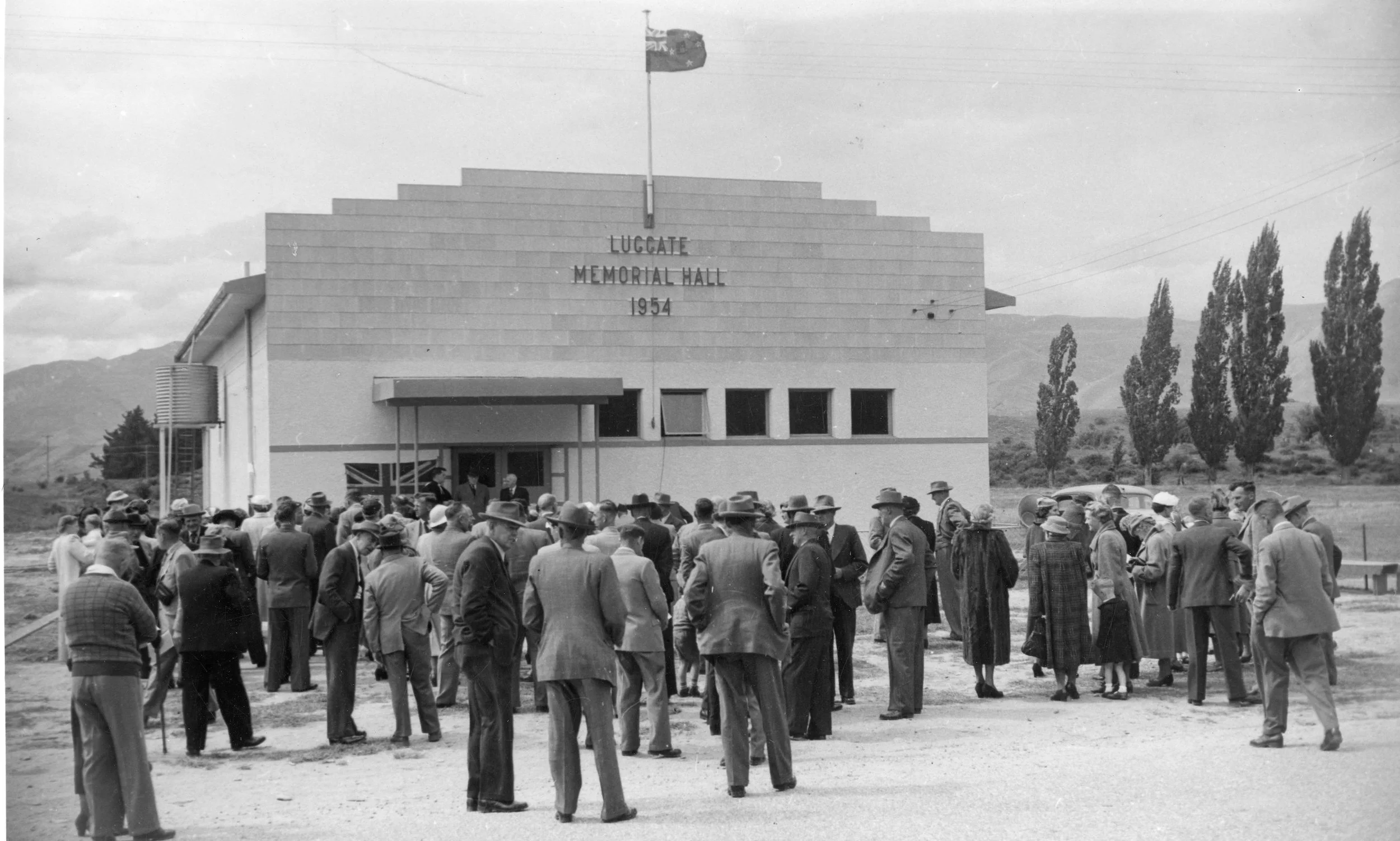
Luggate Hall opening day, 21 June 1997
Sources: Luggate Stan Kane, Wanaka Story Irvine Roxburgh, 125 Years of Schooling Ken Tomlinson.
