
Movies in the 1930s
In the early 1930s a new form of entertainment and a reason for socialising, arrived in Pembroke (Wānaka) – the movies.
Of course, they were somewhat different from what we see on the big screen or TV, some having no sound-track. But then again some have become icons, such as It happened One Night, King Kong, The Wizard of Oz. In the 1950s I can recall going to the Saturday afternoon matinee sessions in Oamaru to watch the real old timers like Charlie Chaplin, Laurel and Hardy, the Marx Brothers and others. Even with no sound-track, we laughed our heads off. It cost 6d return on the bus, 6d to get in the front row seats (the cheapest) and 3d for a Nibblenook icecream at half time.
Wilson and Beatrice Hull brought the movies to Wānaka. They lived in Alexandra though it might appear that they spent a lot of time “on the road” bringing the movies to the Central Otago towns and villages.
Saturday night was movie night at Pembroke. One week they would do Hāwea on Friday then come across to Wānaka, and then the next week it was Tarras on Friday then across to Wānaka. Later on, the movies may have only come town every second Saturday.
The Hulls had a busy week. Beatrice had to do the door sales and then play the piano for the silent films. Wilson did all the setting up of seating and the projector etc.
They had their own truck, equipped with a diesel-powered generator before the days when electric power was connected to the towns (1939 for Pembroke). In any case the Pembroke Hall was connected to the Wānaka Hotel and there was a generator behind the garage next door.
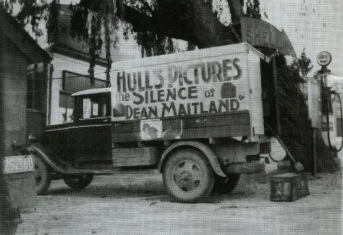
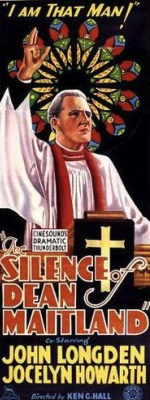
The 1934 film “The Silence of Dean Maitland” signwritten on the truck was playing that night. It was a 1934 Australian film based on a 1886 novel. The film was apparently one of the most popular Australian films of the 1930’s.
But it wasn’t always “beer and skittles” for the Hull’s. Their 1938/30 truck, with generator, was commandeered by the Army because they wanted to use the diesel-driven generator for “war work”.
The trip up the Cromwell Gorge would often be dangerous with rockfalls or muddy and slippery in wet conditions. If it was impassable in the Gorge, they would back up to where the road crossed the railway track, and then drive up the track to the next crossing.
At one stage a projection room was added to the Hall to make life a bit easier for the projectionist. The Hulls ceased their business in the 1950s.[1]
Acknowledgement is made to the various authors of the booklet “The Hall”, and the Editor, Philomena Sheehan for some of the aforementioned information.
[1]The Hall – Wānaka Hall 1923-2000, Peak Press, 2001