
The great Irish myth!
John Aitken Connell was the surveyor who in 1863 surveyed the first streets and sections in Pembroke (Wānaka), Newcastle (Albert Town), Gladstone (Lake Hāwea) and Wakefield (near Bendigo). It is common to read a book on local history and be confronted with the statement that he was born in Ireland and named the streets of Pembroke in 1863 with Irish placenames. Those statements are incorrect.
John Aitken Connell (it appears he used the name ‘Aitken’ as his first name), was born in Glasgow, Scotland, to James and Jessie (née Douglas) Connell on 9 February 1840.[1] His father was a Doctor of Laws, but best known for his work in mathematics and teaching thereof. He died in 1846 when John was just 6 years of age.
On 2 December 1858 Connell sailed from London, heading for New Zealand on the sailing ship Excelsior. It arrived in Auckland on 17 March 1859.[2]
There are no records found as to what Connell did between arriving in Auckland and arriving in Dunedin. Connell’s descendants have wondered if he was employed by the well-known firm of Connell and Ridings, Auctioneers, Commission Merchants, Real Estate Agents and Surveyors in Auckland. One principal was a William Connell, who died in December 1859 aged 53, but there is no record found connecting him to Aitken Connell.
We do know that he started advertising for work as a qualified surveyor in the Otago Witness on 1 December 1860. Then on 10 January 1863 we find this advertisement in the Otago Daily Times:
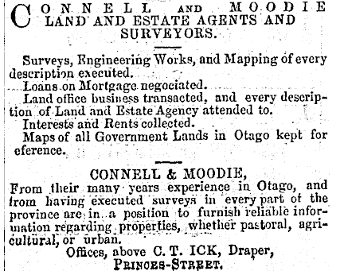
Principally they were involved as Land and Estate Agents and Surveyors[3] in arranging purchase of land and in lending money. Surveyors were in demand around this time as inland Otago opened following the discovery of gold. The original firm contracted to the Provincial Council undertaking surveying work from time to time.
Connell and Moodie eventually merged with others to became part of the Perpetual Trustees Estate and Agency Co of New Zealand Ltd., which eventually became part of Pyne Gould Corporation.
On 1 February 1871 John married Mary Monica Jones, and they had a family of nine children. Every child had John’s mother’s maiden name, Douglas, as a second name – females included!
His legacy to the Upper Clutha has been his surveying of the area, especially the Albert Town and Wānaka settlements in 1863. Unfortunately, his descendants, in a family history published in 2013, are well off the mark, i.e. “...the towns never amounted to much.” [4]
He undertook various business activities, including national politics and ended up in Auckland after a short sojourn in Melbourne, Australia. His health was reported to be “indifferent”[5] and on 21 August 1891, he was discovered in his hotel room, deceased, with a bullet wound to his head and a revolver alongside. He was just 51 years of age. Incidentally his mother also committed suicide in 1860.
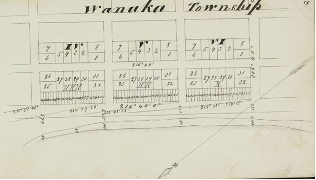
But why have people come to the incorrect conclusion that he was born in Ireland? It was because the streets of Pembroke (now Wānaka) that he surveyed, were all named after places in Ireland. But it was not he who named the streets, but someone of ‘influence’, probably back in the Otago Provincial Council Surveyor’s offices in Dunedin. Connell’s notebook of the 1863 survey does not mention the name of any streets at all but does use the name “Wanaka Township”! The paper attached to the notebook cover does record his name and the names of the towns he surveyed, but that cover is almost certainly attached later and is not in Connell’s handwriting. He was just a contractor to the Chief Surveyor for the Provincial Council, John Turnbull Thomson, in undertaking the survey.
It is not the only occurrence of various authors coming to incorrect conclusions when describing the history of Upper Clutha places. Examples are:
Pembroke being named after the Duke of Pembroke. The official records state that it was named after Sydney Herbert, second son of the Earl of Pembroke. Sydney was an important UK politician and the Colonial Secretary for a time. He was never the Earl.
Queensberry being named after the Duke of Queensberry. It was named after Queensberry Hill in Dumfriesshire.
However, when we look at the four settlements surveyed in 1863 by Connell, there is a certain “political” connection apparent to the naming.
Newcastle (now Albert Town) – the 5th Duke of Newcastle, Henry Pelam-Clinton, had been Chief Secretary for Ireland, Secretary of State for the Colonies, Secretary of State for War and the Colonies. Perhaps importantly, he was Secretary of State for the Colonies from 1859 to 1864.
Gladstone (eastern end of Lake Hāwea township) – William Ewart Gladstone was one of the longest serving Members of Parliament and Prime Minister for over 12 years. In the period 1859 to 1865, he was the Chancellor of the Exchequer under Lord Palmerston.
Wakefield (near Bendigo) – Edward Gibbon Wakefield is the probable candidate. A politician very involved in the establishment of New Zealand principally by immigrants from the UK and he was a director of the New Zealand Company. He died in 1862.
It is suggested that Connell would have little influence on the naming of these proposed settlements and the street names.
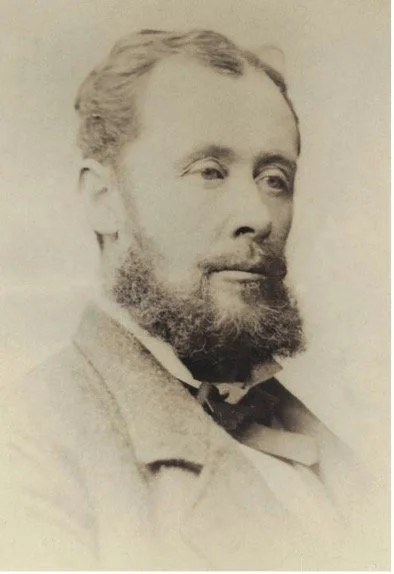
John Aitken Connell 1840-1891
[1] 1840 Parish Register of Births 644/1 Glasgow p656.
[2] Passenger List, The New Zealander, 19 March 1859 (a transcription) found at www.yesteryears.co.nz/shipping/passlists.excelsior.html , accessed 6 Nov 2024.
[3] Advertisements, Otago Daily Times, 21 June 1864, p2 as an example.
[4] https://issuu.com/bigtimeproductions/docs/connellfamilytreebook accessed 25 October 2024.
[5] Suicide of Mr Aitken Connell, New Zealand Times, 8 September 1891, p2.