
The Smithy
In the late 1800s, no self-respecting village or town would be without a blacksmith, not only to shoe the main means of transport, horses, but also make ploughs and other iron equipment. Some extended to the making and repair of wheels.
Cardrona had its own blacksmith in John Willoughby (who later became the publican), John Hardie was the blacksmith at Albert Town and sometime around 1880/1, Joel Cayford and his wife Louisa arrived in Pembroke. Joel was a Blacksmith/Farrier by trade.
He had served with the Imperial Cavalry, 12th Royal Lancers in England before he was discharged on 10 November 1876, aged 27. Four months earlier, on 22 July 1876, he married Louisa Clara Hunt at Folkestone. A month after his discharge, they boarded the “Northampton” at Gravesend, England and set sail on 17 December, bound for Nelson, New Zealand. Their first child, Gertrude, was born on board, just off the coast of Tasmania on 12 March 1877. The first port of call was Nelson, but their ultimate destination was Cromwell.
On arrival in Cromwell, Joel went into partnership with his brother Richard who had arrived a little earlier on a different ship. He had purchased a blacksmith shop named the Veterinary and Shoeing Forge at Cromwell from a Mr Arlidge on 23 January 1877. The partnership did not last long, and on 13 November 1877 it was dissolved and the business sold to James Richards.
Richard went off to Hāwea Flat where he established “…a blacksmith’s shop, store and public-house.” It is not known for sure what Joel did, though there was a family story that he may have rode as a gold coach escort for a while. Joel and Louisa (and child) did move to Pembroke in 1880[1] where he commenced business as the Wanaka Shoeing Forge and Smithy “…under the legendary Willow tree….”
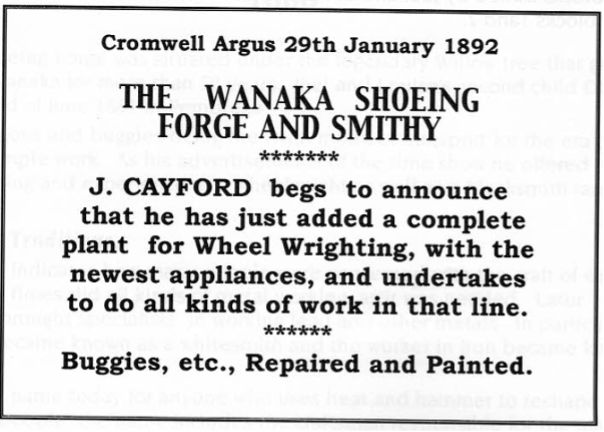
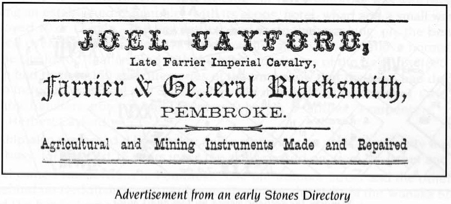
Joel only rented the land and building for the smithy. As the land was held by Celia Russell, owner of the Wanaka Hotel across the road, it is presumed, in the absence of any other records, that probably Celia Russell arranged for the building to be constructed as an adjunct to her hotel business (her husband, Theodore Russell died in 1878). In fact, the land on which the Smithy was located was owned by the Russell family right through until about 1920 (Theodore Jnr inherited it in 1905).[2]
For certain, Joel was there on 16 November 1881, as it is recorded that he was the “hero” that night in saving “the Wanaka Hotel, and perhaps the whole of Pembroke, as mounted on the roof of the building, wood and iron flew shattered into fragments from the sturdy blows of his ponderous sledge-hammer.” The buildings included the “capacious stables, lofts and outbuildings” of the Hotel.[3] This fire has not been recorded in many early history writings of Pembroke.
Joel became closely involved in the local community, becoming an inaugural member of the Wanaka Islands Domain Board, one of the first members of the Wanaka Jockey Club and later the Secretary, and on the School Committee. Louisa was known locally as the “village tooth puller.” The village forceps were held at the Smithy and according to a family history, “…it was to Louisa the villagers went if they required the services of a non-professional dentist. Tradition was that the patient would purchase a bottle of whisky then proceed to drink the lot. When suitably subdued, Louisa would pull the offending tooth.”[4]
In 1892, Joel paved the floor of the blacksmith shop with blocks of wood like a pavement and erected a wheelwright’s establishment at the rear of his shop.[5]
Their children, Gertrude, Olivine, Joel and Bede all went to school at Pembroke. It was reported that their attendance could be irregular depending on how much they were required at home! They and their subsequent siblings also attended Hāwea Flat school after July 1895.
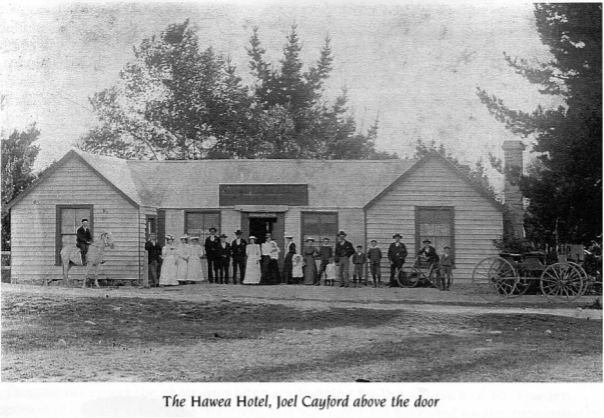
In 1894 Joel purchased the Hawea Hotel and blacksmith shop from the widowed Eliza Dowling, Joel’s sister.[6] He sold the blacksmith business to James (Mack) Templeton in April 1895.[7] Joel and Louisa operated the Hotel and Smithy until about 1905 when they moved to a farm at Kakanui, just south of Oamaru. Joel died in Oamaru on 12 September 1911 and Louisa died in 1932.

The Ardmore St. Smithy between 1895 and 1898. Left to Right: Thomas & James Templeton, horse, unknown, Asher Smith, Tom Mangan, John Faulks.
Mack Templeton, contrary to what has been reported in other publications, only operated the Smithy until about August 1899 when he sold the business to Theodore Russell Jnr.[8] Mack apparently had aspirations to go sawmilling however we do know that he was the engineer on William Allan’s SS Makarora sometime after it was launched in January 1900.[9] Theodore had no aspirations to be a blacksmith, so he immediately advertised for an employee and James Perrow took on the job. Two and half years later, on 20 July 1903, James purchased the business from Theodore and started working on his own account.[10] James was a popular man in Pembroke and participated in many social and sporting activities.
Eventually, James identified a new opportunity to establish a new store on the corner of Helwick Street and Ardmore Street, next to the now closed Commercial Hotel. The hotel had been purchased by Theodore in 1909 and immediately closed. James sold his Smithy business to Theodore in August/September 1910.[11] Theodore had been the landlord since 1905.[12] Once again he sought a new blacksmith and John William Powley purchased the business.[13] He in turn sold the business in early 1914 to George Norman.
George operated the business until 1922 when he and his wife moved to Australia to work for a Mr William Sylvester, a previous resident of Pembroke.[14] It is thought that is when the Smithy business in Ardmore Street ceased altogether as shortly afterwards (1923), the land and buildings were purchased by Horatio and Helen MacKay with the intention of erecting a new motor garage that eventually became owned by the well-known Manson family.
[1] NZ Electoral Rolls, Otago, Wakatipu, 1880-1881.
[2] Probate and Will of Celia Isabella Russell, Probate Records 1904-5, p1/04, p14/05, p360-375.
[3] Hawea and Wanaka, Otago Witness, 26 Novemeber 1881, p14.
[4] Bradford, England to Otago, New Zealand, Val Cayford, published 2000, Dunedin, p46-58.
[5] Lake Wanaka, Otago Witness, 16 June 1892, p20.
[6] Lake Wanaka, Otago Witness 1 November 1894, p24.
[7] Lake Wanaka 25 April 1895, p22.
[8] Country, Otago Witness, 17 August 1899 p34.
[9] Lake Wanaka, Otago Witness, 18 February 1903, p31; Note: Mack eventually went to Albert Town in 1905 and set up his own Smithy and at the same time was the puntsman employed by Vincent County Council.
[10] Advertisements, Cromwell Argus, 15 Sept 1903 p5.
[11] Wanaka Notes, Lake County Press, 27 October 1910, p4.
[12] On the death of his mother Celia Isabella Russell in 1905, Theodore inherited the land and buildings occupied by the Olympic Hall and the Smithy.
[13] Wanaka Notes, Lake County Press, 5 March 1914, p5.
[14] Wanaka Notes, Cromwell Argus, 12 June 1922, p4.