
Through the eyes of a child
Have you ever wondered what it was like, living in the Upper Clutha in the late 1800s? Well, here is an absolute gem of the memories of Emily Ross nèe Elliott, who lived in Queensberry as a child. It is important, as very little has been written about the early history of the Queensberry area. Only the order of a couple of stories has been changed from the original document. Emily passed away aged 97 on 23 January 1978.
What follows has been reproduced from three copies, all different in some small amount of detail, that were created from the narration by Emily, recording her early life in Queensberry. Spellings, grammar and structure are mostly unchanged. The story largely follows the history of the area, only differing by some omissions and interpretation of events as could be expected given the passing of years. Emily truly had a good memory, as was acknowledged by her mother.
The footnotes have been added to clarify some items. For example, many of the creek names Emily used have changed over the years or as residents arrived and changed the creek name, to their name. One or two creeks have all but disappeared with the passing of time and the effect of farming the land.
Through the Eyes of a Child
TALES AND A HISTORY OF QUEENSBERRY AS NARRATED BY EMILY ROSS NÈE ELLIOTT, PROBABLY IN THE EARLY 1970s
“My name is Emily. I was born at Bannockburn on 23 April 1883, the fourth child of George and Harriet Elliott. When I was five years old, my family shifted to Queensberry. My father worked there as road surfaceman for many years. I went to school at Queensberry and after I left school, I stayed helping my mother until I left at the age of 19 or 20, to work in Alexandra.
I have always had a good memory. Although it is so many years ago now, I can still remember clearly, many of the people who lived at Queensberry and some of the incidents that happened there so long ago. They are only small incidents, but life itself is only a series of small incidents like these.
There were six other families living in Queensberry beside ours. There were two hotels in operation – Woodhouse’s Hotel[1] and Holden’s Hotel[2]. The latter also ran the Post Office and the stables where the coach horses were changed as it passed through.
The landmarks I remember were – Gravelly Gully, Woodhouse Gully (Kidd’s Creek), Mills Gully, (Kings) the Eighteen Mile Creek (Creek beside the school)[3]the Nineteen Mile Creek (beside Smith’s) and Poison Creek.
Cobb & Co’s coach came from Dunedin two or three times a week, carrying passengers and mail and the returning one passed through the following day. All the supplies came by wagon from the railhead at Lawrence. The wagon which was pulled by an 8-horse team, took a week to travel up from Lawrence. They travelled slowly, delivering all the key supplies to the shops between Lawrence and Pembroke.
My mother and father were married in England and came to New Zealand soon after. They landed at Port Chalmers and came to Bannockburn where an uncle of my Father already lived. Four days after they arrived at Bannockburn, my eldest brother was born on 27 January 1878[4]. A very short time later, the disastrous flood[5] of 1878 occurred. Years later, my mother told us that she and a neighbour went one day to where they could see the river in flood. It was filled with debris of all kinds. She saw tables and chairs and even a baby’s cradle swept past. She never forgot that sight.
One incident I remember at Bannockburn was when, with my mother and a neighbour, I watched a funeral procession go by. I was about four years old then and I remember the black plumes above the horse’s heads which moved up and down as the horses moved by. The funeral was that of Mrs Angel[6], the Bannockburn hotel keeper’s wife and it was probably going to the Cromwell cemetery.
When my father was appointed road surfaceman by the County[7], nothing was supplied for him. Before we shifted to Queensberry, he went there and lived in a tent[8] while he built the first two rooms of our house. He built the walls of sod, and the iron for the roof, the windows, and the T & G boards for the floor must have been brought up on the wagon. The windows were the kind with many small panes of glass.
My mother and my four brothers[9] and I came up and we lived in those two rooms while my father built the rest of the house. When it was finished it was a good size but it had no floor coverings except the sacks we used for mats. There was a big fireplace in the kitchen and a kerosene tin and a large kettle on the open fire provided our hot water. We had a camp oven for making bread and doing the cooking. Later on, we got a coal range with a boiler on the side. For fuel we had wood which my father cut and dragged home from on the hill. It was mostly manuka wood.
There had been an old road along the bottom of the hill before we came and I remember playing on the clay banks of the cutting of this old road. The new road went along the other side of our house. At first there were no fences around the property. Later when my father could afford the money and the time, he fenced it in. We had a horse and a cow and kept a pig and hens and some ducks.
My Father was very good at growing plants and he had a very good garden. He also planted fruit trees. We had a large apricot tree which grew very nice apricots; peach, plum and apple trees, currant bushes and gooseberries. The peaches were grown from peach stones. If anyone gave us a peach to eat, we carefully kept the stone and took it home to plant it. The plums had to be grafted as they were useless otherwise. The apple trees came from a Mr Tamblyn who came around taking orders for them.
To begin his work, my father bought a wheelbarrow and a pick and shovel and that was all he had in the beginning. After a while he bought a horse to ride to work and later, a dray. Almost the only wheeled traffic on the road was the coach and the wagon and the road had to be kept in good repair for them. After a storm there was always repair work needed in Gravelly Gully and Mill’s Gully and my father would enquire from anyone passing through, the state of the road further on. His work as road surfaceman took him from Lowburn to Alberttown[10]. If he was working near our home, he walked to work. If it was too far to walk, he rode the horse or took the horse and dray.
When he worked in the Alberttown area, he stayed with friends there. His wages were 8/-[11] a day, and he was the highest paid county employee at that time. He worked six days a week. If he was working from home, it would be very late when he got back. He would try to organise his work so that he would be working near home, when there was much work to do in the garden. Sometimes he would tell mother to get the boys to thin the carrots or do other jobs in the garden, when they came home from school. Only in this way could he keep up with the work. He never worked in the garden on Sunday. That was the only day on which he got a rest.
We children always ran to meet father when he was coming home. No matter how tired he was, he always got off the horse and put us up for a ride. Once when he was opening the gate and I was sitting on the horse, it shook itself and it shook me off. That frightened me and I was always a little afraid of horses afterwards. After that I always said I didn’t want a ride and held my father’s hand instead. Years later, after I left home, I learned to ride properly.
My mother, like all the other women, always wore a long dress that came right down to her ankles. In summer it would be a light material and in winter a heavy material and it would be lined for extra warmth. There were no woollen jerseys or cardigans then. Flannel petticoats provided extra warmth. I can remember one dress which my mother wore on special occasions. It had a frill at the front at the lower edge of the skirt, and right up the front were frills each one of less width until the one at the waist was only a few inches long. Those were the days of small waists and my mother would have her corset laced very tightly when she wore her best clothes. Her hair was so long that she could sit on it and she wore two plaits wound around her head.
There were seven children in our family and I was the middle one. William, Edwin[12],and Fred[13] were older than me and Robert[14], Annie[15] and Elizabeth[16] were younger[17]. I remember once that my mother told my eldest brother to go out and meet the coach because Granny Barr was coming on it. My brother’s reply was “Huh! Another baby”. (Granny Barr was the midwife and lived in Bannockburn). My father woke me the next morning and told me to get up and be very quiet because I might wake my new baby sister. That was when my sister Annie was born. The midwife was always known as “Granny".
My mother must have worked hard with seven of us to bring up. She made all her own bread and the yeast to make it with. We skimmed the cream off the milk and made our own butter too. To make the yeast, my mother would boil some hops in water, with some sugar and salt and mix in a little yeast from the last batch. She strained it and bottled it. She made bread two or three times a week. We had a bucket which was kept especially for making bread in. Mother put in flour and malt then the yeast and warm water. She mixed it all up, covered the bucket with a cloth and some other covers and left it overnight near the range where it was warm. During the night it would rise and in the morning she put it into tins and cooked it. At first she cooked in a camp oven putting embers on the top to make the cooking even. Later on we had a coal range.
Making lunches for my father and children who were going to school needed a lot of bread. We bought our flour in large sacks. When my father was working in the Luggate area, he would bring home a sack of flour in the dray from the flour mill at Luggate. Sometimes if we were out of bread, we children would come home from school for our lunch. It was really too far to walk home and back at lunch time and seldom did it. Sometimes when my father went to Cromwell he would bring home some baker’s bread. We liked it because it was a change from the home-made bread.
My mother realised that I had a good memory. When my father was going through his accounts and he asked my mother if she could remember something, she would say, “Ask Emily”. Once when I told him some item that he had bought from Cromwell on a certain day, I said, “I can remember because of the lollies that you brought that day. They were Jubes.” He usually bought boiled lollies and occasionally ‘conversation’ lollies. Usually our groceries came on the wagon from Bowies store in Cromwell. They were put off at our gate.
I can remember many times running along the road behind the coach etc. To keep up, we would hang on, but if the horses trotted and went too fast we had to let go.
I am very fortunate that my childhood memories are happy ones. Our parents never raised their voices to us and we were never knocked about. I can remember my Mother telling my brothers to go to bed but they did not go. She would say, “It won’t be this in the morning when you have to get up.” Finally my father would look up from his paper and say “Boys, you heard what your mother said.” Gradually, one by one, they would disappear away to bed.
There were two Chinese miners working in Gravelly Gully. They used to come to our house to buy eggs. Once, my mother sent me out to count out the eggs for them. The price they paid was 2d[18] a dozen!
There was a family name Vlietstra living on the road to Luggate. Once when Father was working up there, Mrs Vlietstra offered him some black currants if us children would go up and pick them. Father took us up on his way to work next day. There was a very large patch of currants and we must have got tired of picking them because I remember my brothers running about between the rows. At first I was frightened they would get into trouble, but later I joined in too. Our father picked us up on his way home. We had a meal at Vlietstra’s at mid-day. They had a family of two girls and three boys, I think.
A gold dredge was built on the river directly below our place. I went with my family to the launching. I remember Mrs Morris, the wife of the Doctor at Cromwell at the time, hurling the bottle and saying “I christen you, The Maori.””
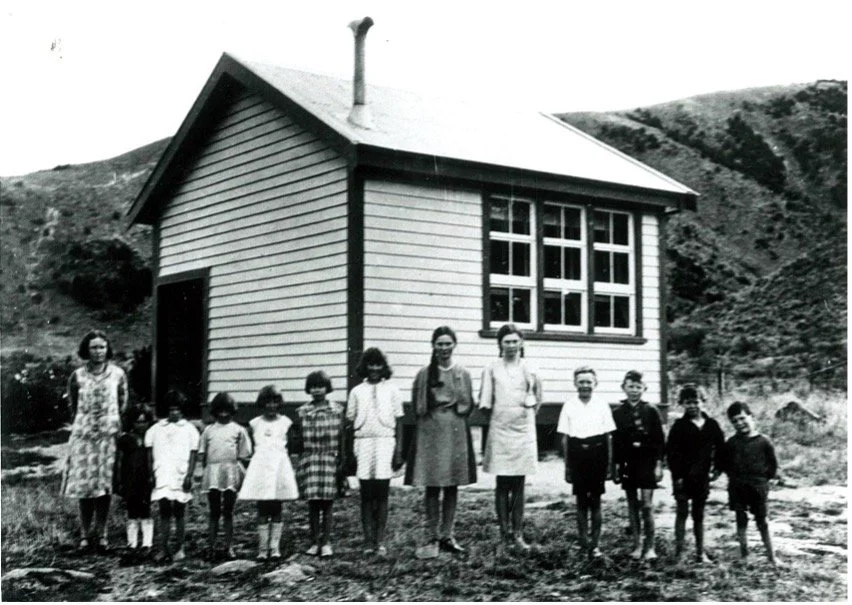
Queensberry School, 1931.
“When we arrived at Queensberry there was no school in the district. My three oldest brothers walked up to Andersons and drove from there to the Luggate School with the Anderson children.
My Father set about to collect money to build a school. He collected all around the district and also went to Tarras and Bendigo collecting for it. I think he would have crossed the river in the chair and walked, or perhaps had the loan of a horse to cover the district. When we lived at Bannockburn, he had worked with the miners at Bendigo and he knew them all and the people of Bendigo. I remember a dance being held at Holden’s barn also, to raise money. The floor was clear in the middle and the people sat on bags of chaff laid around the walls. They had items as well and my father sang a song.
I started school at Queensberry[19] as soon as it was opened. The first school teacher at Queensberry was Miss Hitchcock. She came from Dunedin and she was there for only a short time. I think she found it too quiet. The next teacher was Miss Wardell (we called her ‘Waddle’) and she stayed for many years. Her name was Elizabeth Wardell and I think she was one of the first teachers to go through Teachers Training College in Dunedin. Her parents lived on the main street in Cromwell in a house near the bridge on the river side of the street. The door of their house opened right on the footpath. She had a younger sister and brother, Barbara and Joe and sometimes they would stay with her for a few days at Tobin’s place.
I remember the first Arbour Day after the school opened, we all planted a tree. My father gave me a little blue-gum tree to plant. I don’t know where he got it. He must have grown it himself. He aways took an interest in that tree and in later years, he always told me if it was growing well.
I remember also a little cave in a rock on the hill behind the school. It was just big enough to hold two small girls and Alice Holden and I would go there to eat our lunches. The path to it was very narrow and if we had slipped we would have fallen on the rocks below. Agnes Clark sometimes came to the cave with me, but she was bigger and there really wasn’t enough room.
There was quite a stream of water in the Eighteen Mile Creek beside the school. Around it and up the gully there were many native trees (as there were also in Mill’s Gully). At lunch time we would sometimes eat our lunch in the shade of these trees. It was lovely there beside the stream. Afterwards we would cross the road and throw stones into the pool on the other side and watch the rings made by the stones in the water. We also sailed paper boats under this culvert and watched them come out on the other side. The teacher showed us how to make paper boats. There was a bush growing beside the stream with a supplejack growing on it. It had a flat top and two or three children would sit up in it at lunch time.
We girls always wore dresses to school. In summer they would be made of cotton material and in winter, a heavy material with lining. We would also have a flannel petticoat. We had no jerseys or cardigans in those days. We always wore boots to school, even in summertime. The roads were too rough to go barefoot. My father said I must wear boy’s boots to school because girl’s boots were lighter and wore out too easily. I was most upset about that at the time. However, when another child taunted me for wearing boy’s boots, I retorted that I liked them because I could kick anything I liked. Fortunately they left it at that, because if they persisted I would have thrown stones at them. That was my favourite way of retaliating and I was continually getting into trouble for doing it.
The Anderson children were the only ones that did not walk to school. They drove a horse and a spring cart. There was no horse paddock at the school then and the horse was tied to a fence while they were at school. At playtime or lunchtime it was taken to the creek for a drink. It was fed with chaff in a nosebag.
Miss Wardell left Queensberry after I left school, about 1895. The next teacher was a Miss White.”
[1] This refers to the Liverpool Arms Hotel at Kidds Gully.
[2] This refers to what we know as the Queensberry Inn built by Thomas Anderson.
[3] Now called Schoolhouse Creek.
[4] William Charles, 27 January 1878.
[5] The Great Flood that started about 26 September 1878 and extended for a number of days. It damaged many Upper Clutha settlements.
[6] Probably Margaret Angel, aged 55, who was interred on 11 April 1888 in the Cromwell Cemetery.
[7] Vincent County Council.
[8] He applied for a 10 acre plot adjacent to the road at “Seventeen Mile Creek.”
[9] 1888
[10] An old spelling – now known as Albert Town.
[11] Eight shillings is 80 cents in decimal currency. 80 cents in 2021 currency has the buying power of about $172 so if George worked eight hours, his pay was about $21.50 per hour. But remember he spent many hours travelling, lived a long way from a settlement like Cromwell and had to provide all his own tools and transport.
[12] BDM records his birth-name as William Charles, born 27 January 1878.
[13] Frederick James, born 1881.
[14] Robert John, born 1887.
[15] Harriet Annie, born 1889.
[16] Elizabeth Mary, born 1892.
[17] Edwin is named as a brother but cannot be identified on BDM records.
[18] Two-pence, which in 2022 currency is two cents.
[19] First named the Wanaka Road School. Opened 1889, a new school built in 1925/6 and the old one demolished. It was added to maybe in the 1950/60s and finally closed in 1964.
[the following is Emily’s story continued, split into relevant topics]
QUEENSBERRY PICNICS
“We had some wonderful picnics at Queensberry and we looked forward to them all year. They were always held on Boxing Day in a paddock straight across the road from Holden’s Hotel. The women must have worked hard for them because I remember all the cold meats and sandwiches and cakes etc. spread out on tablecloths on the ground. The children would have their meal first and then the dishes would be washed and the adults would have theirs, sitting on the ground around the tablecloths talking and eating. There were two coppers to heat the water. One clean for making tea and the other one with hot water for washing dishes. Afterwards we had races and games. Everyone in the district came and also the people from Luggate. It was always a wonderful day for us.
On New Years Day it was Luggate peoples turn, and we all went up there for their New Years Day sports. My Father took us up in the spring cart and he took us to the Luggate Hotel for dinner before going to the sports. That dinner at the hotel was our father’s Xmas treat for us. Tom Trevathan was the hotelkeeper at Luggate and Mrs Trevathan would keep a special table for us where we could all sit together. It was a wonderful day for us. Those two days were the highlights of our year.
There was a family of Collins lived near the hotel and one of the children, Mabel Collins ran in the same races as I did at the sports.”
A CLOSE CALL WITH THE MAIL
“We walked up to the Post Office at Queensberry[1] once a week to collect our mail. It was usually a Saturday. If Father was working up that way, he would bring it home with him during the week.
When it rained the streams rose very quickly and the road became impassable for a time. Mills Gully was a particularly bad place for flooding. One Saturday when I walked to the Post Office for the mail, the day was fine and sunny. There was a little water in Mills Gully and I crossed by stepping on the stones. When I came back with the mail, the day was still fine but the creek was a raging torrent. The hot sun had melted the snow on the mountains and this was the result. I wondered what I could do and finally decided I would climb along the wires on the fence and cross safely that way. I managed to do just that. Unknown to me, I was being watched by a man, a shepherd on the Mt Pisa Station by the name of Anderson. He crossed the stream with his horse and told me he had seen what I did and that I must never do that again. He said I could have slipped and been caught in the wire of the fence where I would never have got free. When I got home, I told my father what he said and Father said that if it happened again, I must wait on the other side and he would get to me when he came home from work. If the creeks rose during the day while we were at school, someone would come for us in a dray. The teacher was always careful to watch for any sign of a rise in the creek. We had a stone in the creek that we used to measure the rise of the water. If the water covered it, the teacher would close the school and send us home.”
QUEENSBERRY FAMILIES
Clark Family (Sam Clark)
The Clark Family lived between Gravelly Gully and Woodhouse Creek[2]. There was a large family of children – mostly boys. The names that I remember were Bob, Charlie, Tom, Agnes. Agnes was in the same class as me at school. Before the school was built at Queensberry, the Clark children went to school at Lowburn. They stayed with relatives there.
Woodhouse family
The Woodhouse Family owned the hotel at Woodhouse Creek, moved out not long after we arrived at Queensberry. The hotel had been a licenced one but for some reason it no longer had a licence. The Woodhouse family moved to Bannockburn taking with them their belongings and furniture and the iron off the roof of the hotel.[3]
After they left, I remember us children playing about in the empty rooms without a roof.
Mills Family
“George Mills Snr was still a single man when we first arrived in Queensberry. He married a woman from Dunedin by the name of Cairns (or Kearns)[4]. When they arrived back to Queensberry there was a ‘tin-canning’[5] which my parents took part in.
Mrs Mills told my Mother that she had a son in Dunedin whom she was bringing up to live with them. He duly arrived and was known as Jack Mills. He went to the Queensberry School with us. I remember him dawdling to school and us calling to him to hurry up, that he was getting behind. He yelled back that he didn’t care if he was getting behind or getting before!
George Mills came to my Mother one day and told her that he had to go to Dunedin on business. He could be away for several days and he was worried about his wife who was expecting a baby soon. He asked Mother is she would make sure that Mrs Mills was all right. I had to go down to the Mills’ place twice a day and say to Mrs Mills, “My Mother wants to know if you are all right?” One day Jack Mills arrived up at our place and said to my Mother “My Mother says you are to come down straight away or she will die.” My Mother was doing the washing at the time. She took off her apron and put on a clean one and went away. She arrived back a long time afterwards, very tired and with a headache. She had arrived a Mills’ place and found Mrs Mills and the baby lying on the floor. Granny Small came down on the coach the next day and she stayed with Mrs Mills for about two weeks (That was about the usual time that a midwife stayed after a birth). That baby was names George and he was the eldest of the Mills children.
I went to Mills’ place and looked after George when he was a very small boy while his Mother was cooking for the harvesters.”
Tobin Family
“The Tobin Family lived in a house on the North side of the Nineteen Mile Creek. Mr and Mrs Tobin were younger than my parents and their children - Ada, Fanny, Jack, Nellie and Frank were much younger than me.[6]
Mr Tobin was not a very energetic man. Part of his income came from England so he was not independent on the farm for a living. His wife was a big woman and she liked to live well.
The school teachers all boarded with this family in the early days.”[7]
Jack Miller
“Living across the road from Tobins was a bachelor named Jack Miller.”
Kirbys
“Mr and Mrs Kirby lived in a little lean-to cottage just south of Holden’s Hotel and Post Office.[8] It was on the hill side of the road and little of it is left now.
They were an elderly couple and Mrs Kirby was a good friend of Mother. She had the first spinning wheel which I had seen. It was she who taught me to knit.
When I walked up to the Post Office to collect our mail, I would also collect Kirby’s mail and take it to them. Sometimes Mrs Kirby would say as I was leaving “Tell your Mother I will be down to see her on Tuesday. If she has any mending that needs doing, I will do it for her. I will be down about 10 o’clock.” She would come down and do the patching and sewing. Usually she patched the trousers and shirts whilst Mother cut out the patches or did some darning. She would stay for lunch and go home in the late afternoon.
Mrs Kirby had a son and a daughter by a former marriage. They were much older than me but I can remember them quite well. Their names were George and Ida. Ida disappeared one day and could not be found. I can remember there was talk that perhaps she had gone to visit someone at Tarras as she sometimes visited a family there. There was talk also that someone had seen her going towards the river, but she could not be found anywhere. Sometime later her body was found in the river at Beaumont. At the inquest the coroner made the comment that from the position of her body – spread-eagled – it would appear that she fell from a great height. The general opinion was that she fell from the chair while crossing the river. No one really knows of course because no one saw her. She was about fifteen years old when she died.”
Holden Family
“The Holden family lived about halfway between the Nineteen Mile Creek and Poison Creek. They ran the Hotel, Post Office and the stables (now Stalkers).[9]
There was quite a large family of children. The ones I remember best were Annie, Jack, Maggie and Alice. Alice was the youngest and she was in my class at school.
Maggie was the eldest and I was very fond of her. I was always pleased if I saw her when I went for the mail. Sometimes she would ask me to come into the kitchen and wait while the mail was sorted.
She later married a man name W Kane and went to live at Cromwell or Lowburn.
One day when I was at home washing the floor my father came in and said to my Mother “Do you know what has happened? Maggie has had twin babies and she died.” I was very upset at that news but I tried not to show it. As far as I know the twins survived.”
John Anderson’s Family
“John Anderson and his wife and family lived further north than the Holdens – nearer to Poison Creek.
There were seven children – Mary, Lizzie, Alf, Bella, May, Bob and Louie. Mr Anderson helped his wife at her confinements and they did not have a midwife.
Once when a baby was born he came down and asked Mother to come up. I do not know what was wrong but the baby only lived for a short time.
The older Anderson children drove to school at Luggate before the Queensberry School was built.
The flour mill at Luggate belonged to Tommy Anderson[10] who was a brother of John Anderson.”
BIRDS
"I was always interested in the birds and loved to watch them. When I came home from school, my Mother would give me piece of bread to eat and I would go to the hill behind our house and watch the birds. Once I watched a pair of birds making a nest. They were green linnets or goldfinches. The male bird was bringing the straw etc and the female bird was building the nest. She was very clever at putting it all together but one stick she just couldn’t fit in. In the end she took it and threw it out of the nest. Later on the male bird brought the same stick back to her. She promptly took it and threw it out again scolding him as she did so. It was really fascinating watching them. I would leave some crumbs for them and go and hide behind a bush and watch while they ate them. My Mother would call to me and I would have to go and help her.
There was a lot of Maori hens[11] around in the early days. In the evenings we would hear their cries like ‘Koeee’ as they came down from the hill. My brothers would rush outside to chase them away. We did not like them because they killed our hens if they got the chance. My Father made a cage for the hens and although they roamed about freely during the day, at night they were always shut in.
The men of Mt Pisa Station laid poison bait for rabbits and the Maori hens ate the bait and very few of them survived.
On the hills around our place and the school, we would often come upon a little pile of stones all about the same size and all white stones. Our teacher and our parents told us they were from the gizzards of the Moa. We also found parts of skeletons of Moas and once I saw the complete skeleton of one. It was on the hill between our house and Mills Gully and it was a perfect skeleton with the bones of the head, body, legs and feet all complete and in place. They had never been disturbed.”
SWAGGERS
“There were many swaggers on the road when I was a child. We were very wary of them and would walk past them on the other side of the road. Our parents told us never to speak to them. If they said “Hello” to us, we were just to say “Hello” back to them and keep on going.
We never dawdled or hung around when there was a swagger about. Our Father said you could never tell what sort of people they were, and we must be careful. The same thing applied to the Chinese who were fossicking for gold in various places. I would go a long way out of my way up on the hill, rather than pass one on the road when I was by myself. We children understood clearly that no matter where we were, if a swagger was sighted anywhere, we must go home and be there in the house with our Mother. If we were up on the hill or just around the yard somewhere we always went inside the house. We were the only protection that our Mother had while our Father was away at work. Mother always kept a cup and a jug of milk and some water handy to the door, so that if a swagger asked for a drink, she could give it to him without turning her back. She never refused anyone anything eat, even if she was short of bread. I remember coming home from school and her saying that she did not have a scrap of bread left as she had six swaggers call in and ask for food that day. She had to make bread that night.
She never allowed them to stay. If they asked for a bed for the night, she said she had scarce enough for her own family and sent them on to some other place where she knew there would be a man at home. If they tended to hang about, she would send one of us children out to see if father was coming. They usually took the hint then and left.”
CHURCH MINISTRY
“The Presbyterian Minister and the Anglican Vicar passed through Queensberry on their way to Hawea and Pembroke. They rode up from Cromwell and came about every two weeks. They would visit the people either on the way up or coming back and they held a service each time in the Queensberry School.
My younger brothers and sisters were christened at our house during one of these visits. The children all seemed to be all christened at home in those days.”
FAREWELL TO QUEENSBERRY
“I left Queensberry about 1901 but my family lived there for several more years. Eventually they bought some land at Mt Barker and shifted up there. My Mother died about 1912[12] and my Father a few years later[13]. He died in the Dunedin Hospital. When I visited him in the hospital, he asked me not to grieve for him. He said he had had a beautiful vision. I did not ask him anything about it. He died very peacefully.
Mrs Kirby also died in Dunedin Hospital. I met Mr Kirby on the street and he told me that Mrs Kirby was in hospital and would not live long. We went to the hospital together and stayed with her all night until she died.
The Clark family left Queensberry and a family named Harding came to live there. The farm belonged to their son Charlie Harding. His parents and his sister Bella lived there with him.
I am not sure where the Tobins went. I think they may have gone to the North Island[14].
The Holden Family left Queensberry and the hotel stables and Post Office were taken over by the Scheib family. I remember the girls best – Iris and Violet Scheib. Vic and Eric were the two boys.
I do not know if there are any of my schoolmates still living. I think the original school was burnt down at some stage.[15] It consisted of only one room and a porch and a small coal shed at the back.
The bluegum tree which I planted is still there.”
[1] At the Queensberry Inn.
[2] Now known as Kidds Creek or Gully.
[3] About 1889. The exact location of this hotel is subject to conjecture, but likely to be where Anderson and Kidd built their hotels. Were the remains of Anderson’s Inn (mud walls) in such a condition it could be renovated to use once again? Kidd was reported to have built a new set of buildings but they were lost on the 1882 fire of his building.
[4] It appears to be Mary Cairns who married a George William Mills in 1892 (BDM).
[5] The custom of tin-canning was once widespread. Once a newly-married couple was settled in their new home their friends would arrive one night and make a deafening clatter outside by banging tin cans together until they were invited inside.
[6] Henry Tobin of Queensberry Farm married Isabella Underwood of Essex England, in Queenstown, on 19 Jan 1886 (BDM).
[7] The Tobins took over the Queensberry Inn and Henry was bankrupted in 1889 but quickly recovered.
[8] Now known as Queensberry Inn.
[9] This was from about 1890 to 1895.
[10] Tommy Anderson had built the Queensberry Inn but had sold out in 1880 before Emily arrived in the area.
[11] A ‘Maori hen” is a Weka.
[12] 31 October 1913 at Mt Barker aged 63 (Cromwell Argus).
[13] 20 Aug 1922 at Dunedin aged 70 years.
[14] Their names appear in the 1908 Electoral Rolls as living in Kilbirnie, Wellington.
[15] It did not burn down (Luggate School did in 1924) but was replaced by a new school building (very small) in 1925/6.