
Trouser Tales by Bob Norman
The following is a first-hand account of living in Wānaka, told by the late Bob Norman. There are times when he addresses the reader as “you”, and while we don’t know who this is referring to exactly, it is clearly one of his descendants since he refers to shared family members.
The text has received minor editing to correct spelling and grammar mistakes. Note that placenames have not been altered from the original, so Albert Town has been spelled as one word - Albertown - as it was originally, and there are no macrons for Hāwea and Wānaka.
I have just finished reading "Skirt Tales" and now I think that it is up to some man to write stories of the old days and call them "Trouser Tales".
In 1914 Mr Harry Barker took a six-horse light wagon, from West Wanaka where they then resided, along with Ernie Barker and me to get their furniture from Balclutha where they had previously lived, after selling Glendhu Station about 1908.
It was the first time I had ever been away from the Pembroke area (Now Wanaka).
The first night we stayed at a Mrs Anderson's place near the Queensberry chair[1], the next night at Cromwell, then Butchers Gully over from Clyde. I have forgotten from there on.
The 1st Word War had just started and they were building the railway line from Clyde to Cromwell, 13 miles [in] those days.
At that time all the grain was carted from the Upper Clutha to Clyde in eight-horse wagons.
On the way to Balclutha we came on a wagon just out of Clyde, which was stuck halfway up a short steep hill. It was one of the Drake boys with a ten horse wagon carrying a huge load of wheat, and luckily there were other Wagoner's on hand to help by hooking on a few of their own horses. Mr Barker also helped and when they finally managed to reach the top of the hill, I will never forget Mr Barker warning, "Young man you put on only ten bales next time."
The Drake boys had been letting everyone know of their ten-horse wagons, and the big loads that they had been carting from Hawea.
Bill Smith was gravelling the road nearby; he had travelled down there from M. Barker on his motorbike over the rough bumpy roads, and through the week, he would have been living in an old caravan near Clyde.
Near Balclutha I saw the ocean, and a tram, for the first time in my life.
The rest of the trip was quiet. Coming back I drove a one-horse four-wheel buggy with a wardrobe on it, following the six-horse wagon all the way back to Pembroke. I was only fourteen years old and did enjoy the trip.
I have lived to see the railway line to Cromwell come in, and then go out of existence.
After the First World [War], Dave Matheson and Billy Trevathan used to run a horse wagon to Cromwell, then a few years later they bought lorry, which they found more convenient.
Your Grandfather, J K Ironside, was butcher at Pembroke then, as had his father John Ironside been before him. I can remember your Great Grandfather killing beef in the slaughterhouse at "Tuohys" just off the Glendhu Road.
First he shot them, and bled them, and then tied a wire rope around their neck and dragged them with a winch to a concrete slab in the shed. Later, he carted them to Pembroke (Wanaka) to make those beaut’ sausages. When we were kids we used to take the bread and dip it into the hot fat that the sausages were fried in, just to get the flavour of the seasoning.
Tommie Goodall, Bill Trevathan, and Dave Matheson all had horse wagons at the same time, and Dave and Bill were first with a motor lorry which they bought between them.[2]
Les and I had bred pigs up the Glendhu Bay Road near Slaughter House Creek, and about 1926 we gave Dave Matheson a load of them to take to the Cromwell railhead (over the other side of the Cromwell bridge,) from where they were loaded onto the goods train, en route to the Burnside auction.

Team of horses up the Lindis Pass
How does the Clyde Dam affect the old bridge? It used to be a long drop down to the water, and is China Town still there? It was on the edge of the Kawarau River, just near where it goes into the Clutha; I remember how swift those rivers were, especially the Clutha.
My sister Bessie[3] got married to Joe Dunning shortly before I left New Zealand, and they went to live at Makarora. Joe borrowed the Tilikum and took their stuff up the lake to their home two miles up from the Makarora wharf. My Mum gave Bessie two ducks and a drake for a wedding present and they took them up in the boat in a crate. Ida[4] cried and said that they were her ducks. About four weeks later Ida came running up to the house saying, "Hurrah hurrah! The ducks are back." Mum wouldn't believe her and went out to the old cart shed, and they were sitting there as though they had never been away, the green-headed drakes with the two ducks! Bessie said that they had got away after one week, and as they could not fly it would have taken them the three weeks to swim down the lake about 38 miles, and then the hardest part would have been climbing a very steep cliff to get to the house. This proves that pigeons do not have to fly to get back home.
In 1927 I left for Aussie and so missed the Depression that you had in NZ. The one here was just about over. I did well in the country poisoning rabbits with oats and strychnine. They had never heard of it in NSW [New South Wales] and the owner of Burrenbong Station gave me 30/- a week as well as keep to stay, as the rabbits got scarce. It was on the McGuarry River 250 miles from Sydney.[5]
Your Dad was asking about "Kanaka Jack". He was before my time, but your Granddad told me a lot of people thought that Kanaka Jack was a Māori, but that he came from the North Pacific Islands.
A big firm here called Fairfax owned the main paper "Sydney Morning Herald" [and] also owned a big area of sugar cane growing land in Queensland. They employed large numbers of Kanakas as to cut the sugar cane for cheap labour and made a fortune.
I did come back home for a short time in 1929 to help Les Norman put in a sheep dip for Noel Scaife, over the Matukituki river from Barkers, West Wanaka, but then came back to Aussie again.
Allie and Emily were cousins and great mates, and one evening they walked down to the Hancock's farm together, there they pinched some apples stuffing them in their aprons and munching some in the twilight while walking back home. They did not want Emily's mum to know what they had done, so they hid the apples outside, but next day when they went to have another feed they were shocked to find that they were full of the codlin[g] moth, and they both felt quite ill at the thought. We used to go together with the Ironside family to collect firewood at Damper Bay; carting the driftwood which piled up after heavy rains, using two horses in a dray.
I remember when Mrs McPherson[6] drowned; Duncan was left up the river on his own with two carts, two horses and his wife's body.
Harry Barker took her body to Pembroke in a spring cart where Tom Templeton made the coffin; a huge crowd attended the funeral.
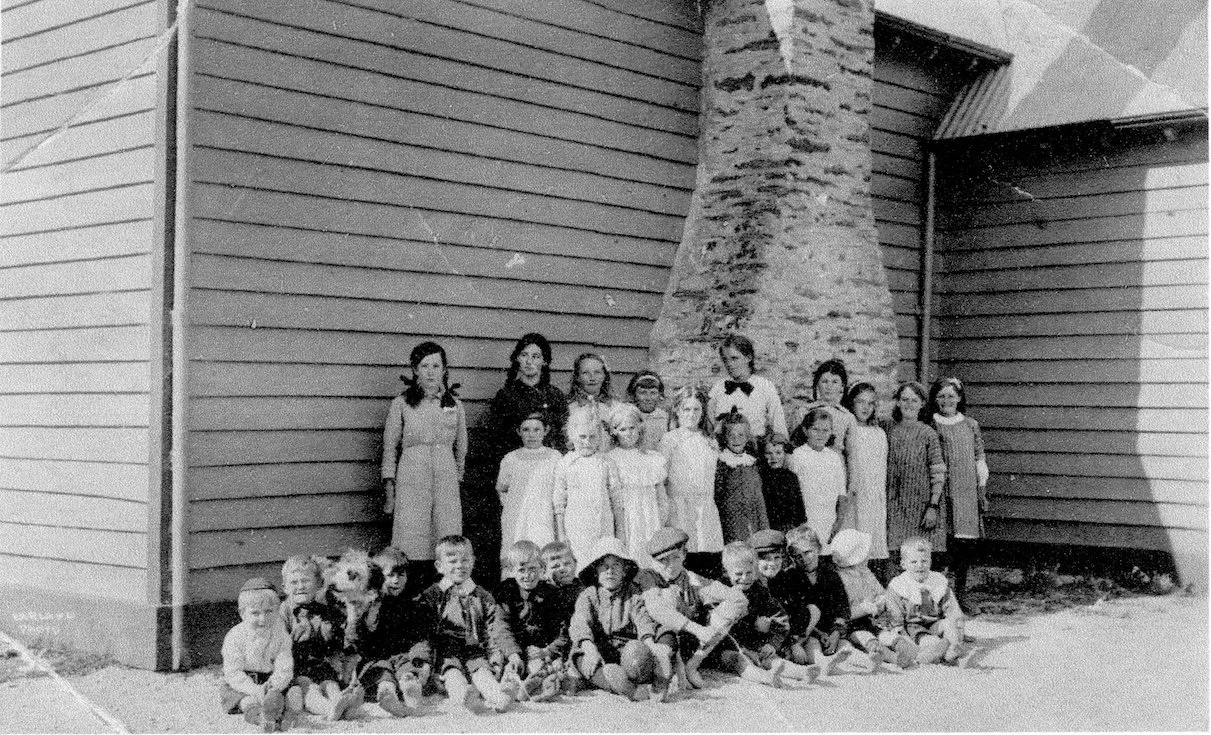
Pembroke School in early 1900s
When I was seven years old, Miss Murdock was the schoolteacher, then a Miss Curry, and as the school increased its roll she got an assistant Miss Gray who we called Bunny Gray. Miss Curry was an extra good teacher, the daughter of a Presbyterian Minister who was overseas on Missionary work. Miss Curry left the school to go back there with him about 1910. Mrs Gun kept the Post office, the baker Teddy Grogan (known for his good bread) was employed by the McDougall’s, as they owned the bake house.
Mr and Mrs Robert McDougall lived up by the school creek on the road to Mt Barker (Old Mac we used to call him), and every day he would ride a black pony over to his store across the Pembroke Flat to his office in the top store, he was 85 and we thought heavens that [is] old. We saw him every day going home for dinner, and one day a red deer, it must have been a stag went across the flat heading for Mt Roy and Taddy Goodall, as we called Maud Goodall's younger sister, came running into school and told Miss Murdock that she had just seen Old Mac's pony going across the flats with sticks on his head.
Alex McDougall married Mrs J Simmons who lived next door to Mr James Perrow just over the creek from Matheson's place (which belonged previously John Ironside' Senior).
George Ballentine (my Uncle) had a farm at Mt Barker and was married to my dad’s sister Mary and had five of a family: Billy, Burt, Fred, Emily and Grace.
Uncle George used to cut our oats with his Massey Harris binder when I was about 10. He also rode in picnic races at Mt Iron and Hawea races about 1905-6. The races were held one year at Mt Iron, next year Hawea Flat and the last races at Mt Iron 1910 and that was the last of the licensed bookmakers in New Zealand. Mr Johnston was the local policeman at the time.
I can recall breaking Mum's gold watch with a stone to get it open in 1904.
Does your father remember a carpenter called Mr Umbers? He built Noel Scaife's wool shed at West Wanaka
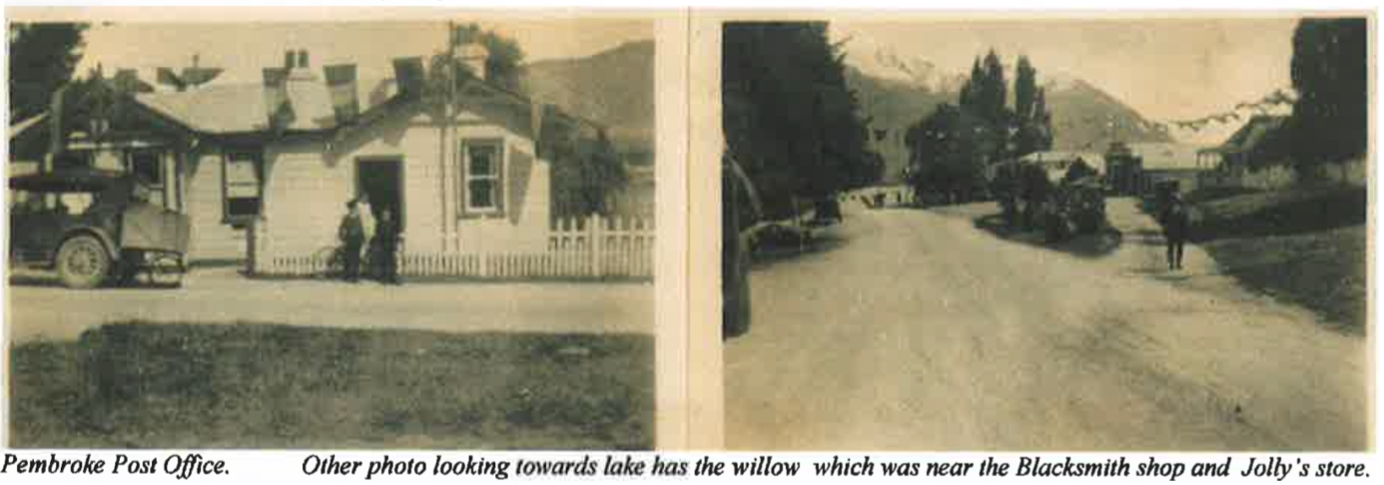
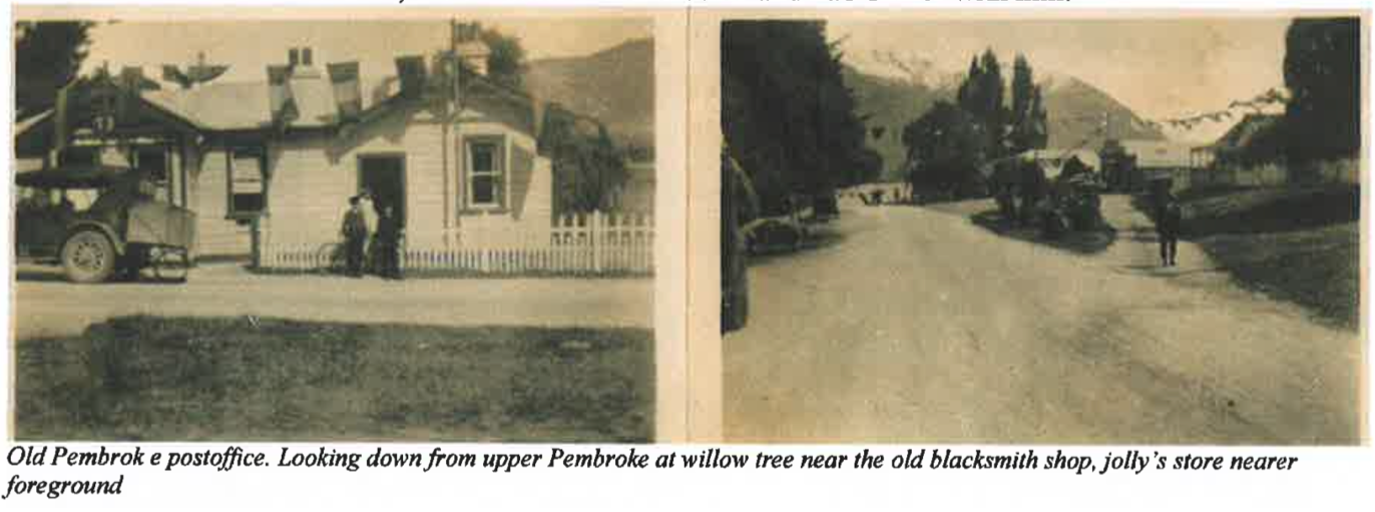
Pembroke, now Wanaka in the early 1900s
There were two grocer stores, Mr McDougall’s, (later Jolly’s) which was the top Store and Mr James Perrow's Store which was situated on the flat near the bottom jetty, and was burnt down one Saturday night. We were at a dance at Hawea Flat, and saw it about midnight on the way home. It was not insured at all so Mr Perrow lost the lot, but Dunedin Agents helped him start it up again. He used to have the Blacksmiths shop, and he sold it to Mr Powley who sold it to George Norman, and then it was closed up about 1925[7] when George went to Sydney.
In those days there was a big weeping willow beside the old Blacksmith shop opposite the pub,[8] and nailed on it were all the district's notices.
Mr Robert Turnbull was the Wanaka Station owner - a perfect gentleman and at the time, he employed my dad as a ploughman. Wattie Thomson was on irrigation, Andrew McKay head shepherd, Fred Turner Station cook, Mr Appleby groom, Mr Simons labourer, Davey Anderson rabbiter, and Bill Anderson labourer. The water wheel that cut his chaff in the barn, near Barn Pinch Hill wore out and Mr Tom Templeton built a new one.
Cars
I for one will never forget what Mr Turnbull did for Wanaka. He was to have the first motorcar and in style too with a chauffeur in uniform, a garage built specially with steps leading down to a pit, so that the car could be worked on when necessary.
The very first car I ever saw was in 1906, a two-seater one with a man, woman, and a little boy who was sitting in the middle wearing a Turk's hat with a tassel hanging down his back. I can remember this as though it was yesterday.
Mr Martin Cowan our teacher at Albertown, (where I first went to school) stood our class of about 8 children outside the old pub where Dot lives, and the car came from Pembroke, stopped in front of us, and Mr Jim Templeton came down from the blacksmith shop to put the car over the bottom punt. We stayed there until it had crossed to the other side of the river and it nearly got to the top of the hill, then it had to reverse to the foot of the hill where it started up again and this time went right up over the top. The driver must have had to change gear but he couldn't on the hill.
I still remember being in Mr Barker's new Ford car when he was showing Charlie Barker how to drive it, and when Charlie went to stop, it kept going slowly forward so Charlie pulled on the steering wheel and called out "Whoa!"
I cannot remember the Anglican Church being built, but Les and Allie could and told me that they were playing beside it, while the Pembroke carpenters were putting the piles in, then the Rev. Douglas Mitchell the Minister having it built said to them, “You must not play and laugh here, this is the house of God."
The last I saw of Mr Mitchell was when he held a service after the stained glass windows installed in memory of Arthur and Stan Scaife, killed in the First World War about 1917. During the Service he remarked "At least I have seen this Church, as I have wished to see it- and that is full!”
Strange how odd things will stick in your mind for over 70 years?
When I was about 4 years old Mr Mitchell visited our home, and I was on the floor playing with blocks, when a hen came into the kitchen. Mum said, “Hunt the chook out Bob” and I took no notice. The Minister then said, “Put the fowl out Robert.” I said, “Put it out yourself.” Mr Mitchell then said to my mum, “Spare the rod and spoil the child.”
School Days
At Pembroke School sometimes we played rounders, we used a tennis racket and tennis ball, also chibby one two three, and the boys played a bit of football, but very little cricket. Fred Ballantyne was the best at football and a fast runner. In mid-summer the boys would run down to the lake for a swim (no togs), and then we would eat our lunch and go back to school. The only buildings on the flat then were the Anglican Church, and Alex McCombe's hut near the cemetery. Mr McCombe said that he was about 100 years old and he said that in 1815 he had heard the guns at Waterloo. He came from Ireland and I do not know where he was when he heard them? He kept a pig and used to walk to the cookhouse at Wanaka Station for scraps for the pig. The scraps were put in kerosene tin, which he carried home on a stick across his back.
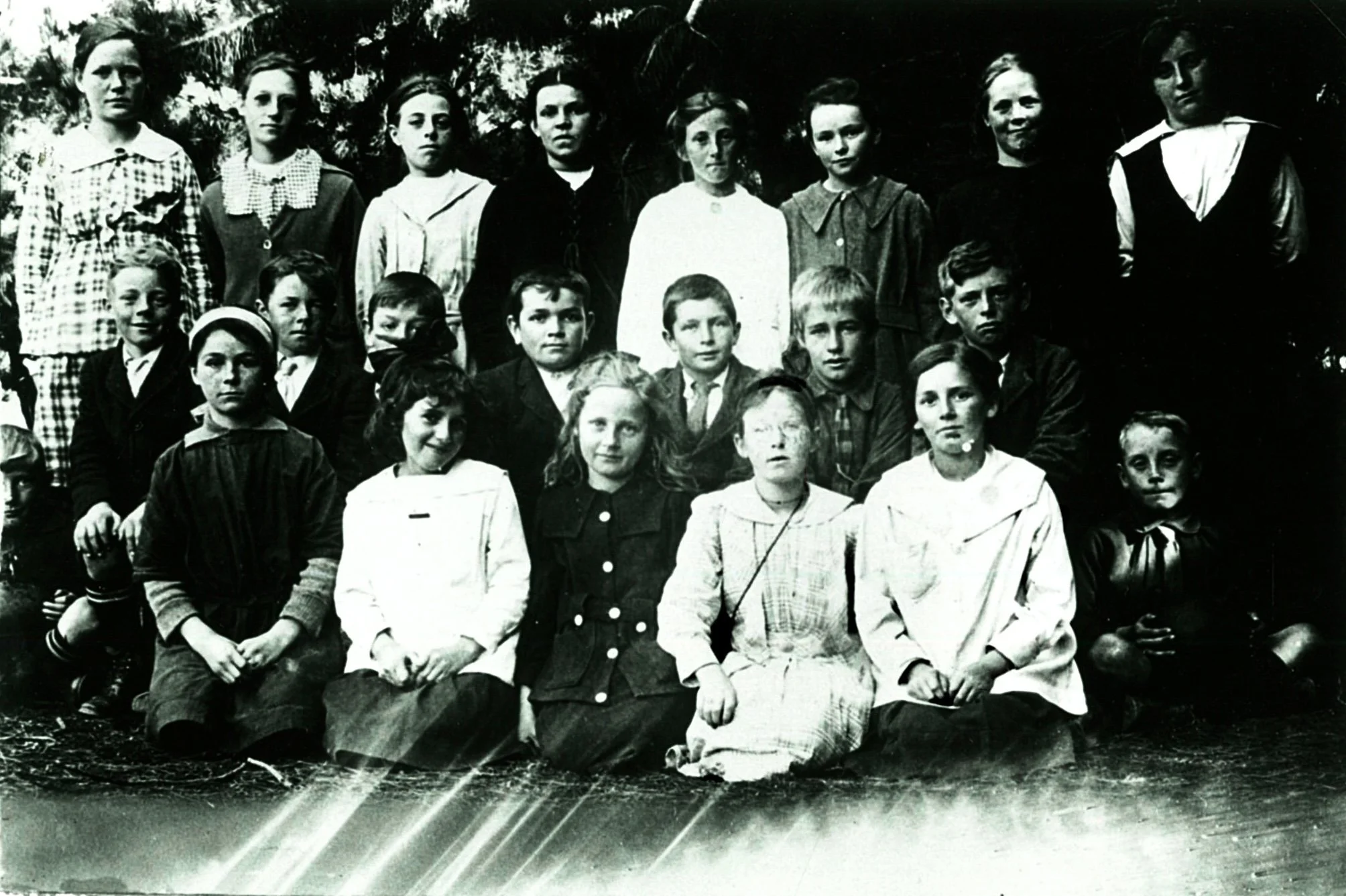
John & Jim Ironside middle row left, Mabel Barker 2nd front with Elsie Ironside middle front. c. 1915
One day Allie, May, Bessie, and I were walking home from school, and called in at the men's hut where Mr Turner gave us each a slice of bread. Home-made bread with butter and jam! This was about 1908 and I have never tasted bread as good as that since. Pembroke School was situated between Charlie Ironside's and McDougall's on the school creek with Mr Su Say in between. Mr Su Say worked for Mrs Russell the pub keeper who kept a lovely garden.
There was an open fireplace in the school, but I only remember it being lit on the odd occasion, though there was plenty of fir tree wood. The school floor was 6x1 pine, which in those days was usual, sawn from beech trees from the Matukituki and Makarora rivers and then brought down the lake.
At school for punishment, we were made to go up to the teacher's desk and were hit on the hand with a five-tailed strap. Dorothy Anderson came out with both hands behind her back, after being called out by Miss Curry the teacher. Miss Curry pulled Dorothy's hands out from her back to find one with a glove pulled halfway on one hand - Miss Curry quickly removed it. Good thinking perhaps - but a failure. The teacher's residence was across the creek, and at that time we had no trouble with the Creek flooding. Later, an irrigation scheme from the Cardrona Creek was put onto the Dogmatch Flat, which was a big job and employed a lot of men.
The Public schools at the end of the 19th century must have all been built to the same plan; the ones at Pembroke, Luggate, and Abertown were all alike, all solid gable with a porch of wood. The one at Albertown was closed about 1905 and then it was held in a big room of the old hotel, Mr Martin Cowan being the teacher in 1906 with about 20 pupils. The school pupils were the Morris's, Mary Collings, who lived in a white house above the top punt, the Hallidays, the McEwens (who rented part of old hotel) other pupils the Templetons, Bob Scott of son of Scott who owned shares in Maungawera Station, and me. Bob died while still of school age and so did Willie Halliday (Heck's brother) who was a ginger headed boy. They were known as the Jack Hallidays. The Roger Halliday family was at Mt Barker.
Mrs Ted Barker (Ernie and Charlie's mother) taught at the Cardrona School.
At Pembroke school my mates were ‘B’ and ‘T’. Our teacher was Miss Curry. One day ‘T’ was blowing a little wooden whistle, and ‘B’ said that it was his, and that he wanted it back. So ‘B’ was chasing ‘T’ to get his whistle back and to spite him. ‘T' swallowed the whistle. But I was determined not to let B. be beaten and kept following ‘T’ around for two days until he “did his business”, which was out in the paddocks in those days. At last I was rewarded with finding the whistle packed really tight in its smelly container, so I pried it out with a stick and soaked it in water for days, then boiled it up in a tin and there it was as good as new.
The little wooden pea in it still rattled around, I gave it back to ‘B’ but from then on no one else wanted ‘B’'s whistle.

One of the old implements thought to have been used on the neighbouring farm at Tuohys
Your Dad would recall the horse power that his father and grandfather had at "Tuohys" to cut the chaff. It was four horses yoked to a crown wheel by four poles pulling it round and round in a small circle with a wide belt from a pulley over to another pulley on the chaff cutter.
One raked the chaff into a bag in the four-foot chaff hole, which held the bag top level with the ground, and you got your boots full of chaff while tramping on the bag until it was full.
Once the bag was full it was then pulled up from the hole with the iron ring that fitted in the top of the bag, which had been holding it open, and in place.
It was really hard work; I wonder where those things are now?
One day I was cutting a sheaf or two with May, Bessie, Dot and Fred looking on, when Fred full of mischief as usual picked up Dad's double barreled 12 gauge muzzle-loader shotgun and pointed it jokingly at May.
This gun was kept in the wall between the weatherboards and the lining of the of the loose box and normally when you came back from a day shooting with both barrels still loaded, you couldn't unload them, so you just took the two copper caps off the two nipples that the hammers hit, then you could not fire it until you put the caps back. But my brother Harry had it out last, and must have only taken one cap off when he put it away.
I heard the click, (lucky it did not go off the first time) and then as Fred turned to point it at Dot, I said, "You don't point guns at people!" and I took one hand off the chaff cutter handle and pushed the gun sideways as it went bang. It deafened us all in the loose box and blew a kerosene tin to pieces just past Dot - I saved her life that day. She would have been cut in half, as it was only 5 feet from her. That was in 1912 and she would have been only six years old and I was 12 years old at the time.
Transport
When we were kids at Pembroke, we always wished to go to Cromwell, but that was impossible, as it was too far away. The Cobb and Co. coach at that time drove down one day and then back the next with Bob Walker driving it, via Hawea Flat, after first crossing the punt at Abertown, where Mr Howejohn was puntsman (later Jim Templeton took over), then over the Luggate punt where Mr James Smith was puntsman or vice versa. On the way back the horses had to be changed at Queensberry Inn.
Fare was 25/- a lot of money in those days really, a whole week's wages. People at Pembroke and Mt Barker would drive their horse to Luggate to catch the coach, saving himself or herself 10/-.
Mr Marsh was the policeman in Wanaka, and when he left Mr Johnson replaced him, I was surprised that the new Policeman was not also called Mr Marsh as I thought all policeman would be called that name. The policeman's son was nicknamed Tug and [he and] Les Norman were great mates, and the same age.
Mr Thomson,[9] Ray Thomson's father, who for some reason, the kids called “Old Dominy”, was their teacher. [The] first Mr John Ironside was the Butcher and later Mr John Keith Ironside.
Mrs T Russell, Clara, Fred, and Edie (who looked after the Library) lived in the house next the Post Station. It was Mr Robert Turnbull, Mrs T Russell, Mr Robert McDougall, Mr Robert Studholme and Hedditch’s, who made Pembroke in the old days.
The McDougalls built and lost three boats: the Theodore (paddle steamer) the Makaroroa, and Tilikum (motor boat).
Mr Studholme[10] made the Nursery at Spots Creek and supplied all the trees.
A Mr Ford retired in Pembroke and in 1906 with a Mr Scott owned Maungawera Station. "Ford and Scott" were very prominent names in the district. About 1906 young Bob Scott died aged 14, and that same year Willie Halliday, [and] Maggie Morris also passed away all living not far from Albertown.

I remember them building the top wharf in Wanaka in 1908, year of Tommy Burns and Jack Johnson's fight in Sydney, Boxing Day 1908 (the police stopped the fight in the 14th round). From the old Pembroke School across the flat we used to watch the monkey drop on the pile they were driving, and then count the seconds the sound took to reach us from when the monkey hit the pile and it took about 8 seconds. The old paddle steamer, the Theodore was beached by the wharf and rotting away.
The saddler, Tommy Mangon lived in the house just over the road from the top wharf, and Charlie Ewing owned an empty house, which he never used, next door to Tommy's.
The Races
I went to the Cromwell races in 1920 on the bus, which ran from Pembroke.
I recall Bert Ballantyne was there I backed a horse called "Guizarke" which was running 10/1. And it won, tote only, as the bookies finished in 1910. Progressive Tote, no place as you backed for a win, but if it run 2nd you received some cash, and for 3rd of course very little.
Way back in 1900 the races used to be held at Mt Iron, just above Manuka Terrace, on the flat on the right going into Pembroke, every second year, the other year they were held at Hawea Flat. Every year the bottom punt at Albertown had problems as it could only take two carts at a time.
In 1906 when I was going to school in Albertown I stood and watched Mr Jim Templeton and his son Charlie, putting the traffic over to go to Hawea. A heavy wire rope was across the river 20 feet above the water and the punt was attached to it by a chain and pulley, in a frame called the traveller. The river was very swift there and took the punt over in about 5 minutes then the nose of the two pontoons were turned by the current by a big rudder on the rear of each pontoon. When Mr Templeton gave it up, Jack Lange took over.
In 1906 I was at the Mt Iron races, and a Mr Tamblin was there with a cart-load of fruit. He owned a property just below Roxburgh, and he used to hawk bananas, oranges, apples, pears, and tomatoes.
I was 6 years old and that was the first time that I had ever seen the lovely red fruit, so I enquired about the taste. I had one shilling and so I spent it on them. I took one bite and then put that tomato back in my pocket and carried the remaining ones around for the rest of the day.
At the races there was a man with a "Crown and Anchor Board" doing a brisk trade. He livened up his posie by calling, "Come on, come on, you young blokes ort to have a go at this - like an ugly Bull at a haystack." Betting was all in shillings on the board so he was getting mainly coins, but he wanted pound notes so he kept calling, “21 shillings for a pound to a player." Naturally he soon got his pounds.
Crown and Anchor is a bit like the Tote, just runs the gambling and cannot lose.
When I arrived back at Albertown I gave all the tomatoes to my Auntie Jean.
The last races at Mt Iron were held in 1910, the year that Edward VII died. After that, Hawea had them every year. My Mum had a galloper called "Nickoliski" -"Old Nick" we called him. My two eldest brothers managed him for her, and he won two races that day, both the 6 furlongs, the Flying Handicap, and the last race the Farewell Handicap. Stakes were twelve pounds. That was the last day of the bookies in New Zealand – then tote only.
That Saturday four bookies came in a Ford car from Cromwell (so they said) and fielded a stand each.
When it came time for the last race they gave 10 to 1 the fields odds, never heard of before, all the old fogies were a bit under the weather, my Dad included. But when the mob was cheering the horses the last 4 or 5 hundred yards to the winning post, the four bookies quietly got into their car and were never heard of again. On the Monday there were no licensed bookies in New Zealand. That made 1910 the last N.Z. cup run with tote only.

J K Ironside’s farm (Pembroke butcher) on the side of Mt Roy the nearest neighbour to the Norman family.
Once Allie, May, Bessie, and I went into John Keith Ironside's place at "Tuohys". There was no-one home, but where the water race ran past the back door, the men had left their knee gumboots on sticks and their butcher knives were stuck in the ground, so we played about trying the boots on and playing in the water until Allie got one of her legs stuck in one of the gumboots, and she could not get it off – no matter how hard she tried. Luckily she had a thought and pulled out one of the butcher knives, then cut the boot neatly from the top, right down to the ankle, and she managed to free her leg. We all put the boots back on the pegs and kept well away from the farm, and we lucky enough to hear a word about it. One of the men would have been in for a shock and he would never guess how it had happened.
When the oats were ripening, about the year 1907, sparrows became a real pest. Long rows of them used to sit waiting on the fences, and from there they were into the oats for about half a chain into the crop. Some farmers used scarecrows with very little effect. Charlie Ironside made a scarecrow making first a frame, and then dressing it in a man's hat and coat so it really did look like a man.
When the crop was ready to be threshed, he went to take it down [and] he found that the birds had built a nest in it. We used to be paid 3d a dozen for birds' eggs and 3d or 4d for their heads. They never bothered counting the heads as they smelt so bad but Mum said that we wore out more clothes climbing trees than we ever received money.
Uncle George had a Massey Harris binder, and he told us kids that there was a boy in it who tied up the knots on the sheaves just as it was coming out of the binder, so I ran along beside the binder only to see that there was a little device, which tied the knot. Three horses pulled the reaper and binder, and then we had to stook the sheaves, which later to be carted in a dray with a frame on it.
Does your Dad recall when Mac Ellis was killed up at the clay banks? Stan Anderson was there with him getting a load of the white Marl for Henry Elliott manager of the Wanaka Station.
Your Grandfather, Jack Ironside, once told me how he and his brother Charlie were sent by their father, John Ironside, up to "Tuohys" in a spring cart from the butcher’s shop in Pembroke to work on the side of Mt Roy just above the farm. Now unbeknown to their father, Jack and Charlie both smoked on the quiet, so on their way to “Tuohys” they both enjoyed a good smoke.
On reaching their destination they took off the spring cart, then tethered the horse, and proceeded up the hill to clear the bracken.
Later one of them looked down the hill and was horrified to see the spring cart was on fire – a cigarette must have smouldered away in one of the empty bags on the cart. They dropped their tools and ran, but by the time he reached the spring cart all that could be saved was the shafts, wheels, and axle.
This would have been about the year 1900. I do not know how they explained the fire to their father?
Humorous events
George Norman had a blacksmith shop in Pembroke and one day he had to go to Cardrona to do a job there. He called on Mr Galvin; Ettie Barker's Grandfather and had dinner with him.
It was Friday, and Paddy took half a tin of herrings and tomato sauce off the mantlepiece, which he tipped out onto a plate.
He said, "I usually open a tin on Friday and eat half and keep the other half till next Friday."
George Norman said, “But Paddy I saw in the paper a few days ago that a man died from eating fish that had been left in a tin after opening.”
Paddy replied, “Well he must have been nearly dead before he ate it.”
Paddy was used to the thatched homes in Ireland and had never seen a corrugated tin roof until arriving in Cardrona, and at a meeting he remarked that the “iron made good thatch”.
Another little event that I remember was an incident about 1918 when a young jockey named Billy Lobb, who was very well liked, lived in the district around the Queensberry and Tarras area.
At that time there was a chair across the Clutha River near the Queensberry Hotel, and by using this person could take a short cut over to Tarras. Billy liked to get a bit under the weather now and this particular night was a lot merrier than usual. So he decided to walk to Tarras to sober up.
He got in the chair which was an oblong box about 6 feet by 4 feet on a wire rope, with a hemp rope which took the person halfway across the river owing to the sag of the wire.
Reaching the middle, he should have then pulled the hemp rope to reach the other side, but instead fell asleep after taking off his boots thinking he was in bed.
When he finally woke up, he bent over thinking he would pick up his boots from the floor – but to his horror found he had dropped them in the river.
Billy finally walked to Tarras in his stockings, and it is said that he never got drunk again after that experience.
Lucky he was not a sleepwalker.
Letter dated 25/6/1994 to Bob from Daphne
Dear Mr Norman,
Auntie Lizzie Ironside has asked me to answer your welcome letter.
I am Johnnie Ironside's eldest daughter, Daphne. My husband and I met you at Albertown when you were celebrating your birthday. You may remember us when we came to pick Dad up to take him home?
You have given Auntie Lizzie and Dad some very welcome memories and Dad wonders if you can still walk on water? He would love to hear the story. He could remember it from the old days, and he wonders if the big lizards on Ruby Island were tuataras?
Tomorrow we are going up to Wanaka again to Brian Halliday’s funeral. It is really sad that such a talented artist has died so young.
Auntie Lizzie has hundreds of wax eyes in her garden enjoying the food that she puts out for them. A lovely sight from her window.
Best wishes and good health.
From Daphne Kok, John, and Lizzie Ironside.
This was my first of many letters to Bob Norman
Daphne Kok
Response from Bob:
Walking on Water
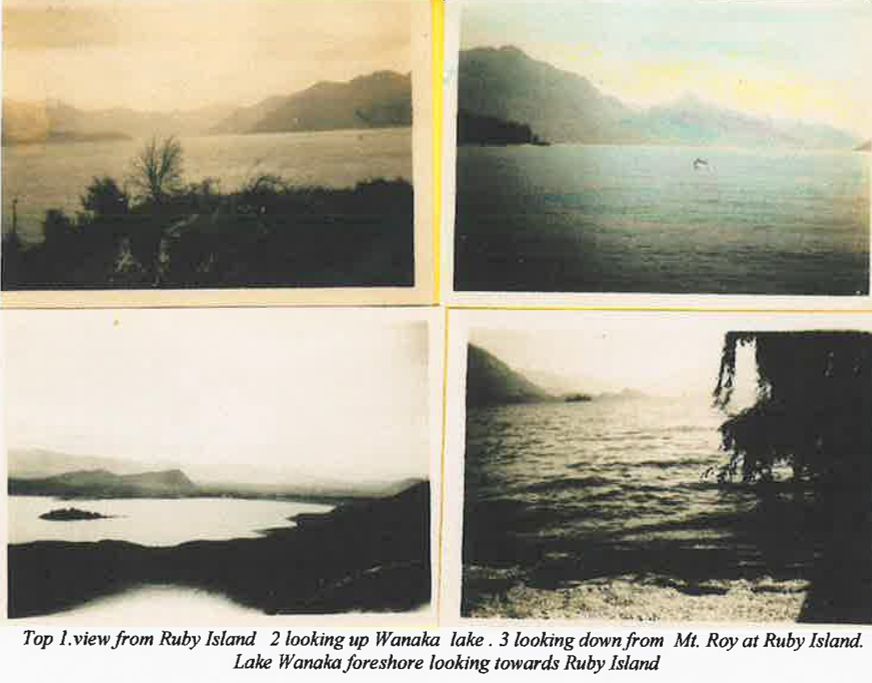
Near Waterfall Creek about 1914, I found a square log about ten foot long, and a foot wide which had been washed off the Tilikum boat. All us kids played on it but kept falling off as it would roll over and tip us into the lake.
One Sunday I decided to fix that, so I got two rails off a post and rail fence, and put one on each side of the log for outriggers to stop it rolling. Then I got a long clothesline prop and stood with a foot on each rail with the log in the middle. It took about half an hour to get to Ruby Island.
In those days there were big lizards there. I caught something that maybe they were tuataras, [but] now I am not sure. They must have been there in the ice age before the glacier melted and formed the lake.
Wild gooseberries and strawberries also grew on the island, but none ripe on this day that I went there.
On the way back to the shore of Lake Wānaka I saw a boat being rowed up from Pembroke.
The people stopped rowing when they saw me, and kept staring at me. If they were religious maybe they could have thought it was the second coming?
But it was Johnston, the policeman, with Matt O'Driscoll, his wife and boy.
"What do you think you are doing?" yelled Johnston once they were in hearing distance.
"Get back home at once, and just wait until your mother hears of this!"
Soon afterwards Mr Johnston went to see my mum and told her that I was not to do it again.
I said to my mum, " At least he cares about me!"
My mum replied, "Don't get that idea as it is because he don't want to be dragging the lake for your body."
Letter dated 21/3/96 to Bob from Daphne
Dear Mr Norman,
First of all we all wish you a very Happy Birthday, and thank you for your very interesting letter, which I have just read to Gracie while visiting her at Ripponburn, and she says that she wishes that she had your wonderful memory. She enjoys hearing the letters over and over again
Gracie could remember William (her brother), and her father getting posts from up the Matukituki River and she thinks that is while Mr McPherson was there?
Gracie could remember the Massey Harris binder, and she loved the story of the little boy tying knots. Could also remember her mother talking about a big flood at Arrowtown, which washed out all the fruit trees.
Last Sunday when Dad was here for lunch, after which I read your last letter, he asked about the high tower that you built near the old house (at Tuohy's I think)?
When we go to Wanaka on Saturday I will read your letter to Auntie Lizzie.
Do have a wonderful birthday.
Best wishes from Daphne, Herman and John
Response from Bob:
The Windmill 5/5/96
Ida has informed me of the floods; there must be a lot of land around Cromwell been covered by water now. I saw where you had an earthquake, could be caused by the water slipping deep down from the artificial lake.
Tell your dad that tower thing I played around with at Tuohys was for a windmill, just higher than the willow trees, as it was a very windy area in that gully. It was to drive some generators to charge batteries for lighting up the house. But when we went to Dunedin to buy everything we wanted, we found it was far.
John Ironside on hearing this commented that in fact the tower had indeed looked like a windmill.
The exhibition was on in Dunedin 1925 and Fred came home from Trentham, Mum took Ida to Dunedin for schooling and in 1927 I left for Aussie, and came back in 1929 to help les to put a sheep dip in for Noel Scaife over the Matukituki River from Barkers. When it was finished I went back to Aussie, and am still here.
Just had my 96th birthday, but my memory is going now, but I still recall the early days of Wanaka.
Boats
I keep seeing Wanaka the way it was when I left in 1921. In those days nobody got killed climbing Mt Roy. Fred (brother) and I climbed Mt Roy [and] that was enough for us.
Trevor Norman took me to Dampier Bay last time I came to New Zealand, and I could see driftwood lying on the beach.
In the old days the Normans and the Ironsides would go there after heavy storms and gather up all the driftwood, which then kept the beach clean and bare. One time at home we had a heap as big as a haystack.
Does your dad remember when his Uncle Charlie Ironside leased Ram Island from the Council? He ran sheep on it.

The launching of the Muratai boat property of the Winders’ Family
Charlie Ironside had the first outboard motor I had ever seen. It had a two-stroke engine, and I used to watch as Charlie mixed the oil with petrol to run it.
One time Ram Island was called Rabbit Island, as there were so many rabbits on it. However, they bred so quickly that all the vegetation was eaten, and then they died of starvation as a result, leaving the Island covered with rabbit bones.
I see that they are going to change the name of Pigeon Island[11], are they also changing the name of Ram Island?[12] I think that it is a shame when they change old names.
Do they still go to Pigeon Island for picnics?
We used to go on New Year's Day either on the Elswick or the Kurow; a Mr Burns ran these boats. I forget what happened to them. The Kurow was built at Wanaka, and the smaller boat the Elswick and was carted there. Once we reached Pigeon Island we always walked up the hill and looked at the little Lake Paradise. When I left Pembroke, Dave Matheson was leasing Pigeon Island to run sheep.
Ask your dad if he remembers Knowles wrecking the boat Tilikum on the neck of the East Wanaka Peninsula over from Pigeon Island, close to the beach where Andrew McDougall beached the Makarora at Rough Gully where later it slipped down into very deep water.
Do they still go to Pigeon Island for picnics?[13]
Neither John nor Elizabeth Ironside could remember the Tilikum boat, but Elizabeth had great pleasure in recalling the wonderful Sunday school picnics that they had a Pigeon Island, going on Captain Burn's boat.
On their return journey Mrs Burns always sang “When You Come to the End of a Perfect Day.” In Lizzie’s early nineties she enjoyed a trip over to the Island and insisted on walking up the hill and down to Paradise Lake again.
Next letter Bob goes on to say:
I can't figure out your Auntie Lizzie and Dad not knowing of the Tilikum boat with a petrol engine which Andrew McDougall ran until the McDougall’s sold the store to Jolly’s. Then Peter and his two sons went up to Paekakariki just over the range from Wellington.
A chap called Knowles, about 25, a relation o f J Perrow then took over running the same service for a year or so. Then one day about 6pm he walked into Pembroke from Albertown direction, and Dave Morris asked as a joke, "Did I see the Tilikum coming down the street?" That happened to be the day that Knowles had run her aground on the strip of land that joins East Wanaka Peninsula to Mt Bourke near Pigeon Island, near the wrecked Makarora.

The launch of the Tinaroa in the 1930s
The steam ship Makarora ran up the lake on a Monday and down on Tuesday for years until the boiler sprang a leak so it was beached at Rough Gully and disappeared about 40 years ago.
I hear that if you are high on the mountainside on a calm day you can still see her wreck.
The paddle steamer, the Theodore that had been fuelled by driftwood was beached near the top wharf and just rotted away. Billy Templeton and I often sat on it watching the eels swim in and out of the hold.
It was 1908 when they built the wharf, or jetty as we called it. A Mr Arthur built it, and then he built the swing bridge over the Matukituki to West Wanaka.
On my recent visit while on the road to Glendhu Bay, I noticed that the rapou around the lagoon that ran a ring around the lagoon has taken over, leaving very little clear water.
We used to catch eels in the lagoon near the clay banks where Mr Ellis was killed about 1918. He was just about to hoist a shovel full of the white Marl (as we called it) when a big piece of the bank fell off knocking him down. His head went over a big sod of dirt, which broke his neck.
Stan Anderson who had been working there, then had to go to the Ironside farm for help. Mr John K Ironside was at the Butcher's shop in Pembroke so Mrs Ironside sent George Gear over to help with the two teams of horses, and the corpse.
I was working for Charlie Ewing at the time.
Letter to Mr Norman about June 1996 from Daphne
Dear Mr Norman,
Thank you for your most interesting letter, which I read to Gracie when I visited her at Ripponburn recently.
Grace said that Billy Ballantyne was 17 years older than her and by now he would be about 107 years old.
Her parents had a mixed farm, growing wheat, barley, sheep and cows, and one year her father won a prize for his wheat. Her father also owned a team of horses.
She recalled the hard work in those days and the lid sometimes flying off the top of the churn when she was making butter.
Bunny Gray gave her the strap at school, which she did not enjoy. Mr Milne was also one of her teachers.
At playtime she played hopscotch and hide and seek, and during school her pony was kept in a paddock nearby, as did several other children. The boys made whistles from sappy willow branches, and fished in the nearby stream and were taught wrestling by Mr Milne.

The island on Lake Wanaka, Pigeon Island with its own Lake Paradise, a very popular place for picnics over the years
Gracie could also remember Mr Johnson, the policeman, and she was rather scared of him, but he tried to explain to her that policemen were there to help people. She had travelled on the Cobb and Co. coach several times, and she could also remember when Bob Walker became the manager of the Wanaka Store.
My Father (John Ironside) asks if you can remember the Fancy Dress Ball that you went to dressed as a Māori, after you dyed your face with Walnuts? Apparently you had a dreadful time getting the dye off?
He said that Fred Norman was dressed as a woman, and was sitting opposite your mother with his legs slightly apart, and that your mother thought it was May and went to tell her off for sitting like that.
J K Ironside shaved off his beard Auntie Lizzie (Ironside) said and nobody recognised him for some time. Unfortunately she could not remember what he wore, and Mrs J K Ironside was dressed in a flour bag.
It must have been a great Fancy Dress Ball as people were talking of it for years!
Gracie remembers the Exhibition really well; at the time it was on she was looking after children at Milton, from where she caught a train into Dunedin where she met her parents.
Auntie Lizzie, Gracie, Herman and I all send their regards and wish you all the best of luck with your Op. And we all want you to know how much we enjoy your letters.
All the best of health,
From Daphne
Ruby Island
Bob's letters were enjoyed by several of his old schoolmates and the feedback was wonderful, as people’s faces would light up when they recalled the past.
But it was the ladies that recalled the cabarets at Ruby Island, the return trip costing 5/-.
Ruby Island had a sheltered landing at a bay on the west side of the island, and paths were made for people to wander around the island.
On New Years Eve there could be as many as 300 folk at the cabarets, which I first heard about from my mother, Edith Ironside née Stephens. Her brother Bill Stephens became a butcher after John K Ironside, and it was when she was staying with him she met my father.
The cabaret was built in a natural hollow using logs from beech trees all the way from Makaroa, which were used as pillars, with a lean-to roof, and the wooden dance floor was sprung on old tyres.
Manuka tables with stools around them, where the supper of tea and biscuits were eaten.
A person would be responsible for winding up the Gramophone and changing the 78 records.
What magic it must have been on a lovely evening lit with old kerosene lanterns.
This was in the 1920s, and perhaps Bob had left by then but there is no doubt that the woman folk of Pembroke remembered those halcyon days all their lives.
[1] Probably Mrs John Anderson of “The Gums”.
[2] But George Edward Partridge was operating a lorry in 1913 (see the UCHS newsletter “Those Were The Days”, No. 13, dated 1 March 2021).
[3] Elizabeth
[4] A younger sister
[5] It is possible that Bob has misspelt Burrendong Station and Macquarie River, which is indeed 250 miles from Sydney.
[6] The correct spelling is MacPherson, but it is a common misspelling
[7] Closed around 1923 as the property was sold in 1924.
[8] This is referring to the Wanaka Hotel
[9] Alexander George Thomson
[10] Robert Studholme
[11] Pigeon Island is now known as Mou Waho
[12] Ram Island has also been known as Rabbit Island and is now known as Mou Tapu
[13] This question was repeated in this section within the original text, and so has been left in this reproduction
