
John McLean
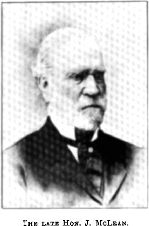
John McLean (“Big John”) was born in relative poverty, about 1818 on the Isle of Coll, Scotland. His father died when he was 18 and he emigrated with his mother and siblings, first to the Australian goldfields at Ballarat and Bendigo in 1839, and then to Lyttleton, New Zealand in 1853.
Together with one or more of his three siblings, (Allan, Roberston and Alexandrina), John leased and/or bought the pastoral runs Ashford - Waimakariri River (1852-1873), Acheron - Coleridge (1853-1854), Lagmhor - Ashburton (1853-1894), Morven Hills - Wānaka (1858-1874), Waikakahi - Waitangi (1866-1880) and Crichton Park - Southland (1892-1902).
John was the first to apply for pastoral land in the Upper Clutha in 1858. This was some 370,000 acres stretching from the northern side of the Lindis Pass and down to Cromwell. The Land Board would not allow him to have such a large acreage, so he arranged to apply for four separate Runs to be in the names of himself and his three other siblings individually. The Station was known as Morven Hills and John employed numerous managers and around 40 shepherds. In 1873 the size of the station was around 370,000 acres, and stocked with 130,000 sheep, 2,000 cattle and 100 horses. Improvements on the station included 200 miles of fencing and numerous buildings, including an impressive stone woolshed. The Runs were broken up after 1874.
John took part in many community activities. He resided at Redcastle at the northern end of Oamaru. Redcastle is now best known as St Kevins College. He was a Director of the Bank of New Zealand, and member of the New Zealand Legislative Council (1867-1872), Otago Provincial Council (1871-1876), Otago University Board (1886-1894), Ashburton Road Board, and a Justice of the Peace and Magistrate in Otago. Additionally, he was associated with local organisations including the North Otago A. & P. Association, Oamaru Caledonian society and Gaelic Society, Freemasons, Ashburton Hunt Club, Waitaki and Waimate Acclimatisation Society, Ashburton Rifle Volunteers, and the Oamaru Hospital Committee. John was also recognised by many as a significant benefactor to unemployed people. He never married.
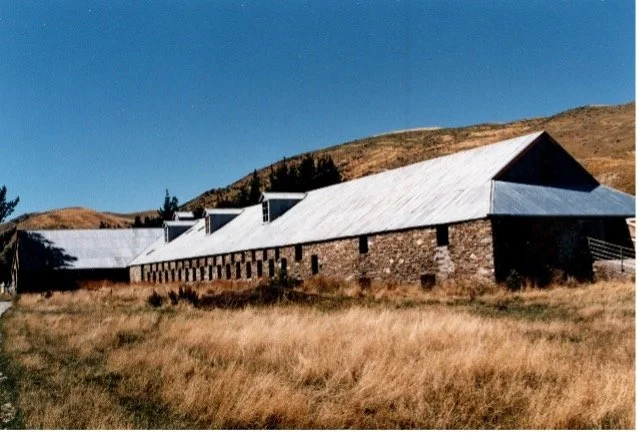
The 34 Stand Woolshed as it is today
He died at his home at Redcastle, Oamaru, on 15 July 1902 at the age of 84, leaving an estate valued at £224,182. John McLean was amongst the wealthiest landowners in the colony in the 19th Century. A nephew, St John Buckley, inherited the Redcastle property and met the cost of the clock and chimes installed in the Oamaru Post Office building, in memory of his uncle.