
Asher Smith
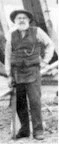
Asher, apparently known sometimes as George (his grandfather’s name), is another of those early pioneers who perhaps have not been given the recognition they are due as the years have passed by. He left no family behind to carry on his name, nor any huge land and business assets. He did, however, contribute a large amount of his energy and time in helping develop the future Upper Clutha.
We know very little of Asher, the man, but I have discovered that he was born in New York, USA in 1834[1] (not about 1829 as suggested in his newspaper obituary). He was the 7th child of Richard Smith (b. 1897) and Elizabeth Davis. They had 10 children in total.
In 1850[2], Asher was living with his parents and siblings in Brooklyn. His father was listed as a Machinist and owned property valued at US$2,000, a not inconsiderable sum in those days. Asher had left school and was employed as a ‘Ship Builder’. That is the last record of him in the USA. In one NZ newspaper, it was reported that he had married in the USA and he had a son named Richard, but the Society has found no evidence of this, nor has his living relatives. Nor have we found evidence of the 90 slaves his father was supposed to have owned.
It is not known when he arrived in New Zealand, though a living relative in the US stated he first went to Australia and thence to New Zealand. The first report on him was as a builder working on the Wakatipu Hospital at Frankton in August 1863.
There is evidence that he was living in a cottage at Queenstown on Block 13. This is between Camp Street and Stanley Street as indicated on the map below. Asher lived here until about 1880 when he then moved permanently to the Lake Wānaka area.
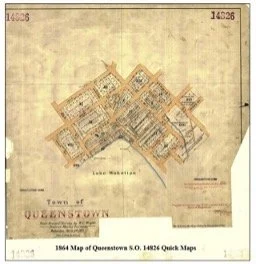
Map provided by the Lakes District Museum
Before that, along came Theodore Russell and Charles Hedditch with the idea of building a hotel at Pembroke in 1867/8. They needed a builder but there were none in Pembroke at the time – not even any residents! It is claimed that Asher was employed to build the hotel, and so triggered, not only the start of development in Pembroke, but development of essential waterborne transport.
Newspaper cuttings from 1880 and 1881 suggest that Charles Hedditch and Asher joined forces to create a ship that would be designed and built by Asher. This coincides with Asher’s move in residence from Queenstown to Lake Wānaka. Whilst it may have been Theodore Russell’s wish to build a sizeable boat, remember that he died in 1877 so despite comments in other publications, Theodore did not start this project.
Asher designed a paddle-steamer with a relatively flat-bottomed hull. It was to be 67 feet in length and with a 16-foot beam and had four berths. The wood for the construction was all obtained by Asher from nearby to where construction took place near the mouth of the Matukituki River. During this time he lived in a nearby hut.
On 9 March 1881 Florence Hedditch launched the boat naming it the Theodore. However, it had no engines and boiler etc. It was towed to Pembroke and there it stayed moored until the machinery finally arrived from England and was installed. The maiden voyage for the public took place on 16 August 1883, nearly 2½ years after the launch! It is thought that lack of finance was the principal cause of the delay, something that continued to haunt the operation of the Theodore until it ceased operation on the Lake about 1905.[3]
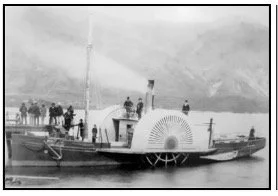
PS Theodore
Asher’s next major project was the SS Makarora which was owned by William Allan, another important early pioneer of Pembroke. The building of the Makarora started about 1894/5 but Asher never saw it completed and launched (in 1901). It was a fine-looking vessel.
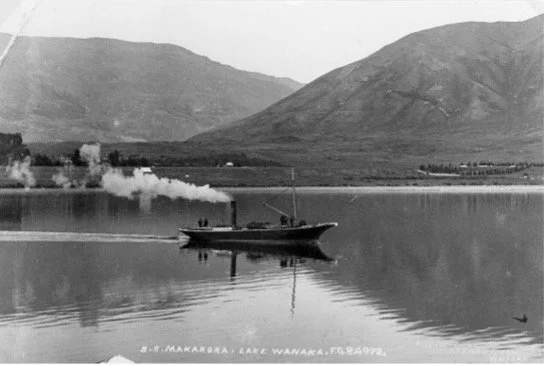
SS Makarora
Asher fell ill in 1899 and he was at the Frankton Hospital when he passed away, aged 65. Such was the respect he was held in, William Monteith, a well-known local Pembroke storekeeper, brought Asher’s body back to Pembroke and he was buried in a grave in the Wānaka Cemetery. It was raining the day he was buried, but the service was well attended by a large number of local residents and was conducted by a Mr. Smith, a retired Wesleyan clergyman from Queenstown.
Asher died Intestate and his estate was valued at £12-15-0. It is stated in his Probate correspondence that relatives were known so perhaps he corresponded with family back in the USA.
Asher’s grave is unmarked and the location unknown (a 1940s fire destroyed the records). His name has not been recorded on the Memorial Wall of known missing gravesites.
[1] www.myheritage.com
[2] US Census July 1850
[3] All the details are too extensive to record here, but they are available in the Records Room at the Wānaka Library.