
Percy Sargood and Lucy Ormond
Percy Rolfe Sargood
Percy Rolfe Sargood was born in 1865 in Victoria Australia, the 4th of 10 children of Frederick Thomas Sargood KCMG (1834-1903) and Marian Rolfe (1839-1879). He attended schools both in Melbourne and the UK. In 1883 he joined the family’s company, Sargood, Son and Ewen, serving a six-year apprenticeship at the Melbourne premises. After working 2 years in England Percy Sargood relocated to Dunedin New Zealand in December 1890 to manage the company’s Christchurch and Dunedin warehouses, and the boot factory. In 1892 he became junior partner and was admitted as a senior resident partner in 1894. In 1902 he took over full control of the now semi-independent New Zealand operation. Following the death of both his father and Mr Ewen in 1903 Percy Sargood took full control of the business in New Zealand. In 1907, the business became a limited company under the name of Sargood, Son, and Ewen Ltd., with Percy Sargood as governing director. He took a keen interest in the welfare of the company employees demonstrated by implementing a staff provident fund, at a time before these were usual company practice.
Sargood Family
On 14 February 1893, at Dunedin, Percy Rolfe Sargood married Lucy Constance Ormond, the youngest of 6 children of Dr Frederick Francis Ormond MRCS (1823–1909) and Charlotte Harriet Watts (1833–1871). Percy and Lucy Sargood had three children (all born in NZ): Cedric Rolfe Sargood (1893–1915), killed in action WW1 at Gallipoli, Gulielma Constance Sargood (1896–1982 NZ) and Huia Sargood (1897–1993 London UK). The family lived in the Dunedin residence Romanoff from 1893-1902. Following 6 months living in the UK, Percy and Lucy Sargood bought the historical Dunedin home Marinoto from Mr John Ross in 1902. The house remained the home of the Sargood family until 1941, following the death of Percy Sargood on 5 November 1940. The residence was bought by the Sisters of Mercy in 1960.[1]
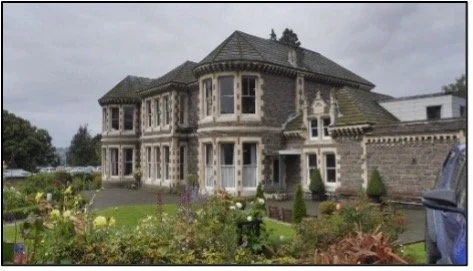
Marinoto in 2025
Wānaka Station
Percy Sargood purchased Wānaka Station in March 1912 from Mr R.M Turnbull, intending to develop the land using innovative agricultural practices. Mr George Paterson from Linnburn station was engaged as the manager who within weeks oversaw relocating the station wool shed to Pembroke from Spotts Creek. Licences for twelve heads from the Cardrona River were issued in May 1913. By the end of 1913 there were 8,000 fruit trees established in the station orchard. During the period of the Sargood ownership, the station homestead was twice destroyed by fire, in June 1914 and May 1931. In 1977 the Wānaka Station Trust gave part of the Wānaka Station to the community. Twenty years later (1997) the land containing the homestead ruins, now known as Wānaka Station Park, was also given to the community by the then owners Jill and John Blennerhassett (Jill Blennerhassett was the grand-daughter of Percy Sargood).

Wānaka Station Homestead
Farming Schemes
Percy Sargood developed a scheme focussed on selecting boys from farming backgrounds in the UK, training them to become the type of farm settlers needed in NZ, and then to assist them to take up land. To facilitate the scheme Sargood bought 3,000 acres of land and leased a further 30,000 acres of land near Wānaka. The planned farming activities included irrigated farming, orchard and sheep management. In February 1915, thirteen boys arrived in Dunedin from the UK under Percy Sargood’s emigration scheme. However, this appears to have been the only intake of participants in the scheme, most likely due to the outbreak of WWI at that time.
In 1914 the Cromwell Development Company was formed to subdivide and irrigate lands, mainly within the county of Vincent. Percy Sargood was the major shareholder owning 2,000 of the 40,000 available shares, and the long-term president of the company. The scheme included a power house located alongside the Kawarau Rapids to enable pumping water from the river to 4,000 acres of area in the Cromwell Flats, with the initial estate called Ripponvale, situated on the foothills of the Pisa range. The second estate, Sarita, comprised 700 acres of land was sold in early 1933, following which it was opened up for gold prospecting. The remaining land owned by the Cromwell Development Company was sold in 1944.
Arts
Percy and Lucy Sargood funded the acquisition of the Logan Park Art Gallery in July 1926 by the Dunedin Council. The Gallery serves as a memorial to their son, Cedric Rolfe Sargood, who was killed at Gallipoli, on August 8, 1915. In 1932 Percy Sargood founded the Empire Art Loan Collections Society in London, with the mission to facilitate the circulation of major art works from British galleries (around 200 in the first instance) to art galleries in the Commonwealth. By the end of 1940, nine exhibitions of paintings, miniatures, ceramics and prints had been organised under the scheme in New Zealand, Australia, Canada, Jamaica and South Africa. The Sargood family also donated paintings to the Dunedin and National Art Gallery. Percy Sargood was president of the Dunedin Art Gallery for a number of years.
Other associations
Percy Sargood supported a wide range of organisations including the Dunedin Chamber of Commerce, Dunedin Rotary Club, Dunedin Unemployment Committee, Expeditionary Forces Committee, Mayor’s Fund for the Relief of Distress, Otago Museum, Otago Provincial Patriotic Council, and the NZ Scouts (presented with the “Silver Wolf” by the Chief Scout in 1937). In 1935 Percy Sargood was awarded a knighthood in recognition of his business and philanthropic activities. Lucy Sargood frequently accompanied her husband to art society events, and civic functions. She was a prominent social worker, one of the founders of the Women’s Club and the president of the Victoria League.
Death of Sir Percy and Lady Lucy Sargood
Percy Sargood died at Dunedin on 5 November 1940, at his residence, Marinoto. He was survived by his wife Lucy and their two daughters. His funeral, was held at his residence on the 7 November and he was cremated at the Anderson’s Bay Crematorium. The approximate £219,000 estate of Percy Sargood included a legacy for a new wing for to the Dunedin Art Gallery and donation of his ethnological collection to the Dunedin Museum. The residue of his estate was left in a charitable trust (The Sargood Bequest) which is still funding cultural activities to this day (2025). Following the death of her husband, Lucy Sargood retired to Hawke's Bay and continued to donate large sums of money to the arts in Dunedin, endowing another wing for the art gallery in 1952. She died in Napier on 8 September 1953.
[1] Most of us living in Otago will now know it as Mercy Hospital.
To read about the Sargood’s involvement in the creation of Edgewater Hotel, click here.
