
John Roy
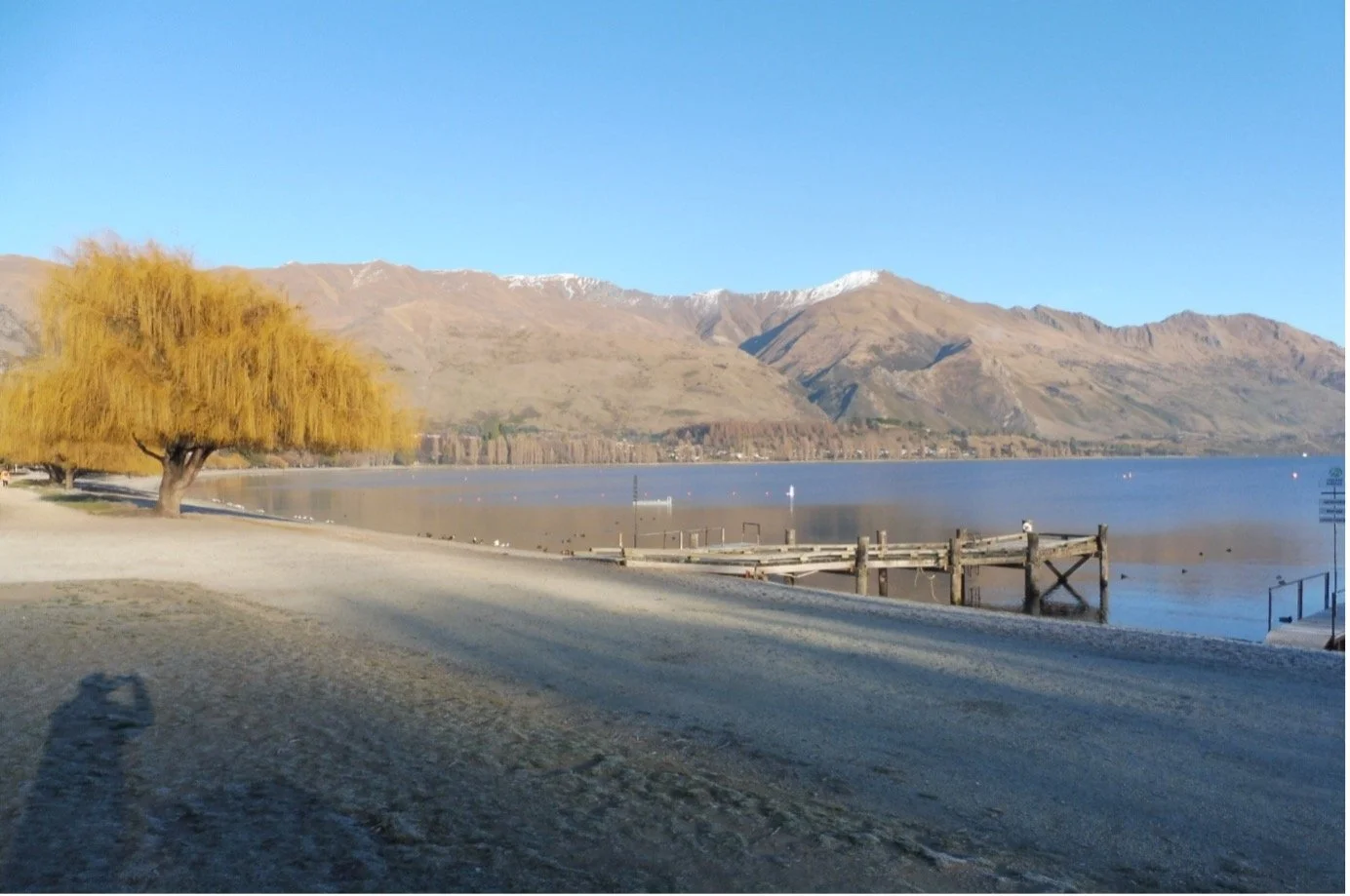
Roys Peak, 1578m, (the one with the snow) taken July 2024. Most of the land mass you see was all part of Wānaka South Run (Roys Run)
As time passes, we are all fortunate that with the advent of the internet and documentary sources of the past, history becomes more available (so long as you do not believe everything you read on the internet!). The history of John Roy, as it principally relates to the Upper Clutha, varies in places from what previous commentators have written. One disagreement is over the naming of the Wānaka South Run as being “Barton and Roy’s Run” instead of “Roys Run”. This will be explained further below.
John Roy left his mark on the Upper Clutha, though really only in respect of the naming of various landmarks. He has not been the easiest person to research.
No known photographs of John Roy exist.
Visitors to Wānaka often remark on the place-names around Lake Wānaka named “Roy”, i.e. Roys Peak (or Mt. Roy) Roys Peninsula, Roys Bay, and little do they know that Ruby Island was once known as Roys Island. The comments are often accompanied with questions along the lines of “Who was he? He must have been an important explorer or resident?”
John Roy was born in Aberdeen City, Scotland, the first child of John Roy and Margaret Brown (married 8 Jun 1822). He was baptised on 21 February 1823. John had 8 siblings though it appears that only 5 had survived childhood.[1]
The surviving children as at 1841 were:
John bapt. 21 Feb 1823
James b. 21 Feb 1826
William b. 27 Mar 1830
Alex b. 5 Aug 1832
Margaret b. abt 1839
In the 1841 Census, John Roy Snr. is recorded as a gardener and John Jnr. as a gardener’s apprentice. It is likely that he was employed by his father.
There are a number of conflicting reports as to when he came to New Zealand. These range from 1842 to 1853. However, it is recorded that prior to coming to New Zealand he worked for Caledonian Railways. If this is correct and that he worked for them as an engineer (not proven), this has to be after 1845 as Caledonian Railways did not exist until 31 July 1845, when the company was established and authorised by an Act of Parliament to connect lines from Edinburgh and Glasgow to Carlisle in England.[2] That line was completed in 1848. For his employment, he would have had to move south to perhaps Glasgow or Edinburgh and left his family back in Aberdeenshire. He does not appear in the 1851 Scottish Census, and his father died on 15 September 1849 in the Parish of Banchory-Ternan[3] which is not far from Aberdeen City.
He actually arrived in New Zealand in 1851. John and his brother William, are recorded as being passengers from London, arriving on 1 June 1851 in Auckland on the barque Stately with a total of 82 passengers.[4] Maybe Auckland might not have impressed them as they left on 3 July, still on the Stately, bound for New Plymouth and thence on to Wellington, arriving on 14 July.[5]
On 19 July he wrote a letter to the Colonial Secretary applying for employment as a land surveyor. He was employed by the New Munster Government in Wellington and was described as “…a Scottish born and trained surveyor and engineer who had spent four years on Caledonian railway construction.”[6]
In 1852 he was described in newspapers as an engineer, but there is a letter requesting payment for expenses on his appointment as Roads Supervisor in the Survey Office dated 15 June 1852.
It should be mentioned that there is no known information of what his brother, William, was doing at this time.
In 1853, the Wellington Provincial Government was formed, and John Roy was appointed Provincial Engineer. This was a job with considerable responsibilities over a very large land area stretching as far north as the Napier area.
But a more important event occurred on 30 June 1853. John married Mary Barton (1833-1922) at St James Church in the Hutt Valley. Mary was the sole daughter of Richard John Barton (1790-1866). It has been reported by her descendants that she was illegitimate and that her mother was Eliza Brown, who died in 1840 (told by two separate sources but neither have proper sources recorded). It is noted that her daughter’s second name is also Eliza, so there is a possibility that Eliza Brown was Mary’s mother. Mary was born at Backies near Golspie which is also close to Brora, all located in Sunderland. Richard was employed at Brora, and it is noted in the 1841 Census that there were a number of people with the surname “Brown” in the area.
Richard and his daughter emigrated to New Zealand on the Oriental, the first of the NZ Company’s emigrant ships to leave England and the second to arrive. Richard, born on the Isle of Wight, had been Superintendent to the Duke of Sutherland’s Estate at Trentham, Staffordshire, England before moving to the Duke’s holdings in Sutherland, Scotland. He had then been sponsored by the Duke of Sutherland to take a party of younger men from the Sutherland Estate to New Zealand, and he had been granted 100 acres of land in the Hutt Valley at what we now know as Trentham. It is stated that Richard was the first European resident of Trentham, Upper Hutt and during his life he became a Justice of the Peace and Member of the Provincial Council. On arrival at Wellington, he became the agent of the NZ Company and may have spent his early time in NZ surveying land areas. He apparently was a surveyor and engineer back in the United Kingdom and maybe this is how John Roy came to meet Richard’s daughter.
John and Mary produced three children:
John Richard Barton Roy born 26 May 1854 at Trentham
Margaret Eliza Roy born 25 Mar1856 at Upper Hutt,
Richard Barton Roy born 14 Mar 1859 at Trentham.
They established a family home in the Hutt Valley.
John’s work took him away from home from time to time as the Wellington Province area was extensive. It could be surmised that his position in the Provincial Government also gave him opportunities to be “in the know” about Crown Land coming up for transfer to settlers and others. Over the period of his employment in Wellington, the records show that he acquired a number of Crown Grants of land. At the time if his death, he owned the following:
3062 acres at Ruataniwha District, Hawkes Bay (Crown Grant)
5 sections in the town of Napier
1 section at town of Clive (Crown Grant)
1 section at township of Richmond, Otago
1 section at township of Rawsonville, Wellington
6 sections in town of Napier*
2 sections in Hutt, Wellington*
3 sections in Upper Hutt, Wellington*
1 section in Lower Hutt, Wellington*
1 section in Wairarapa*
1 section in town of Featherstone*
1 section in Papautanui*
*Indicates these properties had been sold prior to death and settlement of sale proceeds awaited.
But his tale takes another twist and turn when we discover that his younger brother, Alex, was now living in New Zealand. It is not known when he arrived, but the first mention of him in the newspapers is in January 1858 and he is living at Ruataniwha, as a farmer and qualifies as a voter. It would appear from later Probate documents of John Roy, that Alex was managing the Run for his brother.
Whatever the position is, it appears that John Roy was possibly under some financial strain, and there were reported instances where settlers were unhappy with his progress on surveying and building roads. His name is even mentioned in Parliament in April 1858. Certainly, as becomes evident later on, with the number of properties in his name, they will have created some ongoing expenses. Where did he get the funds to acquire the properties? His annual income was £300 per annum, and whilst it only cost about £20 to apply for a Crown Grant, you had to find the annual rental, even if it was a relatively notional sum. When John’s father died, he was owed £249 by John for the purchase of land, but this must have occurred before he came to New Zealand.
On 6 December 1858, John Roy tendered his resignation to the Superintendent stating:
“….I am compelled to tender my resignation as Engineer of Roads. I regret the necessity of doing so, seeing I have always received at your hands the greatest amount of courtesy and consideration, but my own affairs have become so important as to require a share of my attention as to leave me no alternative.”
But if he was facing financial issues, then his continuance to apply for Crown Grants of land is hard to explain. You might surmise that he was endeavouring to grow his assets and copy his father-in-law’s very wealthy position.
The next mention of John is on 5 October 1859 when he travelled by the ship Lord Ashley to Port Chalmers with John Kinross (a partner in the firm of Stuart & Kinross, merchants and pastoralist investors) and with the firm’s employee, H S Thomson, who was the manager. They came with three horses. It has been reported that they came to the Upper Clutha via the Lindis Pass, so they possibly took a coastal ship to Oamaru to start that journey.
The outcome of their journey was that on returning to Dunedin, John Roy applied for a 14 Year Depasturing Licence (DPL) on what was to become Run 334 (Wanaka Run South) – 100,000 acres. The Licence was to take effect from 26 February 1860. Stuart and Kinross got the adjacent Run 333.
There is also a notice in the newspapers of a John Roy having applied for Run 353, Lammermuir Ranges, which was in the Upper Taieri Plains.[7] It is not known, at this time, if that is the same John Roy. That Run was sold in June 1862 (without stock) to Messrs Greig and Turnbull, for £1,250.[8]
During this application process, maybe Roy sounded out the prospects of employment in Dunedin and possibly investigated where his family was to live in Dunedin.
You could surmise that in the intervening period, John Roy had employed the services of Stuart & Kinross to liquidate some of his land assets and reduce debt. The actual story is unknown.
Although no records can be found, it is likely that Roy returned to Wellington very soon after making application for the DPL (Kinross and Thomson stayed in Dunedin until mid-December). Roy would be aware that he had to stock the Run quickly if he was to get a DPL, and for this he turned to his father-in-law, Richard Barton. On 1 November 1859, Barton arranged with the owners of the ship Acasta to transport, over time, 6,000 sheep to Oamaru.[9]
Barton shipped the first 1,500 sheep on the Acasta on 5 November 1859.[10] It is not known what arrangements were in place to receive the stock and move them to the Run.
Further shipments were made on 15 November 1859 (1,400 sheep) and on 2 December 1859, 1,200 sheep.[11] On 2 January 1860, Richard Barton travelled to Otago on the Airedale, no doubt to discover for himself where the sheep he had supplied were going to, and maybe to check on Dunedin itself as a suitable town for his daughter and grandchildren. It is not known where Roy was at the time.
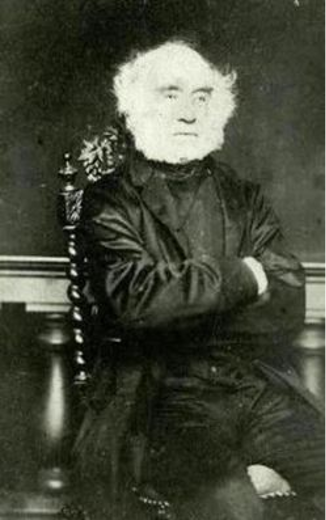
Richard Barton
On 13 February 1860, Barton sent another 1,000 sheep and 16 cattle down to Oamaru bound for Roy’s Run.[12] The landing of the stock at Oamaru was reported in the book, “History of North Otago from 1853”[13] and in Wellington newspapers.
Whilst he was in Wellington, Roy searched for a manager for the Run and he selected Henry Norman. It appears that he also employed two or three men as shepherds. The Norman Family was to become the first settler family known to live in the Wānaka district.
On 26 February, Roy received his DPL for his 100,000 acre Run. It was for a 14-year period starting the same day and the rental was £19-10-00 per annum.
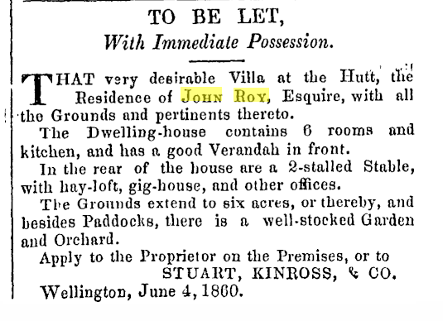
Roy was offered the position of Provincial Engineer for Otago commencing May 1860 which he took up. That meant he was moving from Wellington, and it is noted that in June 1860, Stuart Kinross & Co were advertising his dwelling and grounds for rent. This property was Richard Barton’s original home.[14]
His first job was to organise the road over the Lindis Pass, which just happened to be the main access way to his Run. Is it by coincidence that he was previously involved in creating the road to Ruataniwha where his other Run was located?
On 8 May 1860, Henry Norman, his wife Mary Ann, Richard, their first born son, and the shepherds Roy had employed left Wellington on the Snaresbrook. They landed on the foreshore at Oamaru from surf boats (no wharf then!), together with 1,700 merino sheep, 30 cattle, 2 horses, a bullock dray, poultry, cats, a cow and a calf. From there they travelled up the Waitaki Valley and over the Lindis Pass to arrive in mid-June at Roys Bay on Lake Wānaka, where they set up their first home in wattle and daub huts.
Meantime, Roy arranged to purchase a home at Halfway Bush, Dunedin that was commensurate with his prestigious position in the Provincial Government.
It should be noted that Roy was never a resident on Run 334. He probably initially visited the Run on occasions for a few days, but his job as Provincial Engineer would have taken a fair bit of his time. He did find time to name four geographical locations after himself – Roys Peak (Mt Roy), Roys Bay, Roys Peninsula and Roys Island. The latter is now known as Ruby Island, and it has had a number of names prior to being known as Ruby Island. Research has also indicated that there was a road cutting (location now unknown) named Roys Cutting on a road from West Taieri to Central Otago and there was a Roys Gully[15] in Dunedin not too far from his residence. Maybe Roy had something to do with them as well.
Roy’s name was still occasionally appearing on Crown Grant approval lists. This was unusual in hindsight, as discovered after his death, when all his debts were disclosed.
On 20 June 1861, John Roy wrote to the Superintendent of Otago:
“I have the honor [sic] to tender my resignation of my office under the Provincial Government, and as my private affairs require immediate attention I shall feel obliged by you making the necessary arrangements for relieving me of my duties as early as possible. I have the honor [sic] to be, Your obedient servant, [signed] John Roy.”
The next day he sailed for Wellington and thence to Napier with Kinross, returning to Dunedin in August. There were a number of trips to and from Wellington over the following months, until on 12 August 1862 when Roy signed a Conditional Bill of Sale[16] over the Run, the stock (estimated as 5,000 sheep and 16 cattle) and all the plants, in favour of Richard Barton as a security for a loan of £8,800, which in 2024 spending terms is about £1,240,397 (NZD$2,646,100). This is a sizeable sum. Barton may have become concerned for his daughter and provided funding to repay some of Roy’s debts or maybe Roy has not paid for the stock sent to him by Barton over the last two years. Incidentally, the wording of the Bill is contained in one sentence of about 1,500 words!
It appears that this transaction caused some later commentators to believe that Roy sold the Run to Barton, which is an incorrect interpretation of the situation.
In addition to the Conditional Bill of Sale, Barton was been granted land mortgage securities over Roy’s Dunedin home and some other property.
The transaction also led to the end of Henry Norman’s employment with Roy. Richard Norman, Henry’s son, wrote that in October 1862, his father “bought the ferry boat and also David Robertson’s ...wood and calico shelter at Albert Ferry.”[17] This was located at the junction of the Hāwea River and the Clutha River/Mata-Au.[18] At the time, it was the main crossing point for miners headed for the Cardrona and Arrow goldfields.
Somehow, Roy survived and it is noted that he made a number of voyages to Wellington and Napier during 1863 but matters were coming to a head. He also made a number of trips up to the Run as is evidenced by unpaid accounts claimed by his creditors against his estate. Some of these debts went as far back as 1861.[19]
Whilst he may have been able to make the first repayment of £3369-13-4 that was due to his father-in-law on 1 December 1862, the next payment of £1800-00-0, due exactly a year later, was another matter. It was resolved by Roy selling the Run plus stock and equipment to Robert Wilkin for £20,169-7-0 with settlement to take place on 3 December 1863. Wilkin had to pay £5,042-7-0 in cash and the balance was to be paid with four Bills, payable annually from 1865 to 1868. The cash, plus the payment Roy would have had to have made in December 1862, is very close to the sum borrowed from Richard Barton. The securities held by Barton were released and he declared settlement of the full amount had been made (it had to be, otherwise title could not have been given to Wilkin). Wilkin’s Conditional Bills of Sale were to be deposited with the Bank of Otago as security for the debt John Roy owed to it, but it appears that the contract may not have been documented properly nor registered at the Court at the time. No copy has been located.
John Roy and his brother Alex (manager of the Ruataniwha Run) left Dunedin on 25 December 1863 for Napier on the Lord Ashley - John returned to Dunedin on 28 January 1864, but that was Roy’s last voyage.
On 21 February 1864, John Roy died of Cirrhosis of the Liver. It is clear he was an alcoholic, and this is also borne out by his Doctor’s accounts and family comments afterwards. It goes some way towards explaining his actions over the last few years of his life.
Three days after Roy’s death, Robert Wilkin executed an Indenture relating to his purchase of the Run (a document setting out all the conditions including all obligations relating to settlement of the full amount). This document was immediately registered with the Court. Robert Wilkin did meet all the obligations recorded in the Indenture.
What became of Mary?
Mary was left with two sons to raise (their daughter Margaret Elizabeth had previously died in 1862 in Dunedin) and as a trustee of John’s Estate. It was a complicated and involved financial “mess.” She was ably assisted by the other Trustee and her own solicitor/barrister who was a leading barrister in Dunedin (though not at times without controversy) who also had the surname, Barton (no relation to Richard Barton).
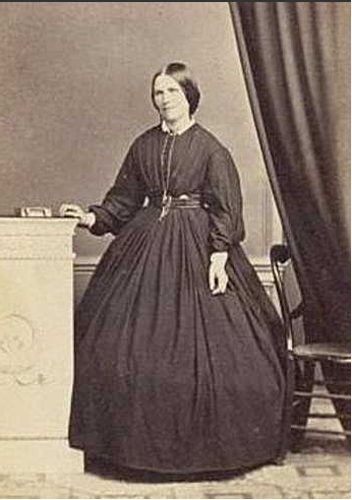
The Estate took some time to settle (exactly when is unknown as the existing records do not extend beyond 1868 and comprise, as it is, about 90 pages of information).
Her father, Richard John Barton died on 20 August 1866.
On 8 November 1866, Mary married William Strachan, a widower, who had emigrated from Aberdeenshire.
Mary died in Hataitai, Wellington, in 1922.
Barton & Roy’s Run - A Myth?
It has been suggested that Roy did not own the Roys Run operation alone, but that Richard Barton was a part-owner. The main sources of this idea originate from George Hassing and Richard Norman, son of Henry Norman. Both men are respected sources for history of the Upper Clutha. George was working at the time in the area, including operating punts at Albert Town and Sandypoint, but the facts speak for themselves. Richard was aged between two and 4 years whilst Roys Run existed, so his information has come from sources later on in life, probably from his parents.
Firstly, all of the legal documents that exist, clearly state that John Roy alone held the DPL to the land. Richard Barton was a very astute businessman of undoubted integrity, who never entered into partnerships with others.[20] In addition, he had loaned £8,800 pounds to Roy and was granted security over the DPL, stock etc. Roy alone executed that security.
It is acknowledged that the source of most of the livestock (sheep and cattle) was Barton and that this was known to others. It is thought that likely, as time passed, the “story” changed to “Bartons and Roy’s livestock” which then created the idea that Barton must also part-own the DPL.
As previously mentioned, the 1862 conditional Bill of Sale from Roy to Barton also caused some commentators to write that Roy had sold to Barton. As mentioned earlier, that is incorrect. When Roy eventually sold out to Robert Wilkin, he was the sole executor of all legal documents and Barton’s only action was to release his security over the DPL, livestock and equipment in return for repayment of the monies still owing to him by Roy.
It is noted that Hassing and Norman’s correspondence on the subject, as published in newspapers between 1900 and 1940 (especially around 1925), both men then claim Barton and Roy being in an ownership partnership, but this is late in their respective lives and their other “facts” on some subjects, are inconsistent with earlier statements they have made.
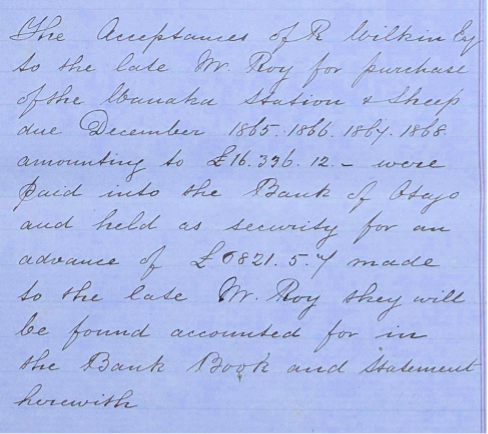
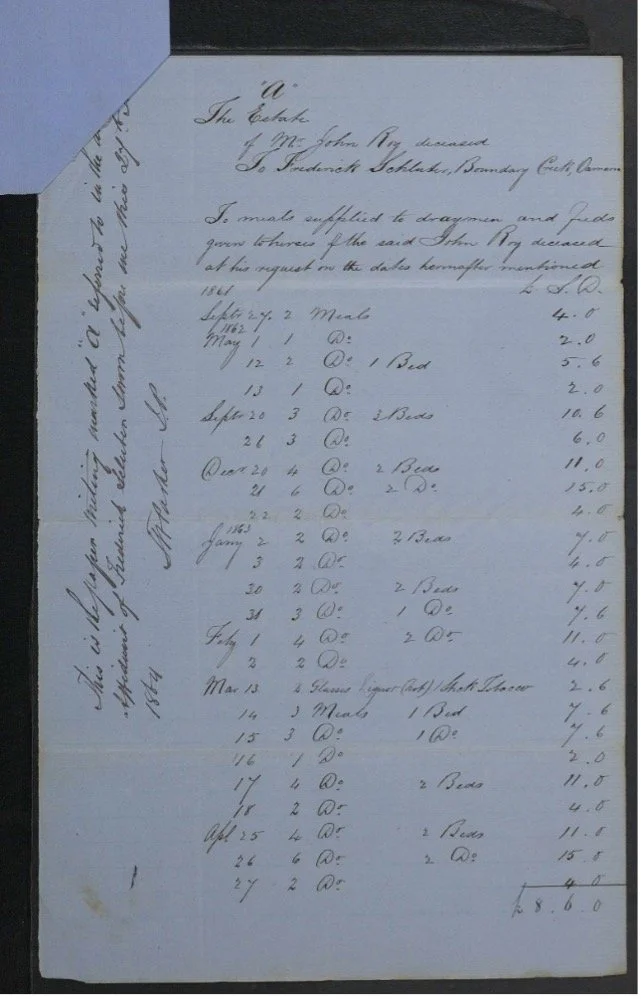
Roy was still incurring debts in his own name that clearly relate to the management of the Run during 1863. Why would he do that if he had sold the Run in 1862 to Barton?[21] See the example that follows on the next page:
Was there confusion with another person with the surname of Barton, as previously mentioned, who was involved in the Estate management after Roy’s death? That is George Edward Barton. He arranged and witnessed Roy’s Last Will and Testament in 1862. Barton advised Mrs Roy as trustee of the Estate.
Some Other Interesting Facts
Roy’s younger brother Alex, had emigrated from Aberdeen and was employed by Roy on his Hawkes Bay Station. Roy owed Alex a large sum for a farm manager, for unpaid/short-paid wages etc. at Roy’s death. Alex paid for a headstone on Roy’s grave in Dunedin (the grave also contained Roy’s previously deceased daughter, Margaret).
At the time of Roy’s death (1864), Roy still owed his deceased father (he died in 1849!) £211-13-2 , the residual balance of a loan made to Roy to enable him to “purchase some land.”
Roys Peak, Roys Peninsula, Roys Bay and ???
As previously indicated, it appears that Roy liked naming places after himself. At one point, Ruby Island in Lake Wānaka was also named Roys Island (and has had a number of other names). What is little known, is that Roy also named a hill in Hawkes Bay after himself. It is not as impressive as Roys Peak but the name survives to this day.
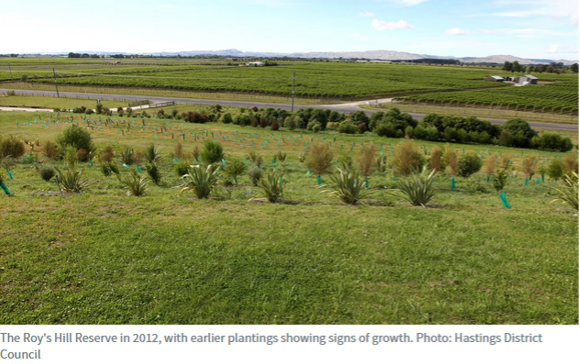
It is currently known as the Roy’s Hill Reserve and is managed by the Hawkes Bay Council.
John Roy is a bit of an enigma, but he surely left his mark on New Zealand during his brief tenure on this land.
[1] Births – Scotlandspeople.org.uk
[2] https://en.wikipedia.org/wiki/Caledonian_Railway
[3] Old Parish Records Deaths 168/A Aberdeen, Page 207.
[4] Shipping Intelligence, New Zealander, 4 June 1851, Page 2.
[5] Arrived, Wellington Independent, 16 July 1851, Page 2.
[6] Letter etc sighted by Ken Thomlinson of Wānaka at Archives NZ, Wellington.
[7] Depasturing Licences, Otago Witness, 26 November 1859, Page 2.
[8] Commercial, Otago Witness, 26 June 1862, Page 2.
[9] Hazel Holmes, “Richard Barton from Sutherland to Trentham”, Published by Author 2023, Page 291.
[10] Shipping Intelligence, Wellington Independent, 9 November, Page 2.
[11] Shipping Intelligence, NZ Spectator and Cook Strait Guardian, 26 November 1859, Page 2; Shipping Intelligence, Wellington Independent, 2 December 1859, Page 3.
[12] Shipping intelligence, Wellington Independent, 14 February 1860, Page 3.
[13] W H S Roberts, “History of North Otago from 1853”, publishing details unknown, Page 38.
[14] Hazel Holmes, “Richard Barton from Sutherland to Trentham”, Published by Author 2023, Page 291.
[15] Mentioned in a number of newspaper articles relating to Scouts over the period 1910 to 1910.
[16] A Conditional Bill of Sale does not mean that the property listed has been sold to the grantee. That would only occur if any of the terms and conditions of the Bill, including repayment of the loan were not met. It is a security. A simple Bill of Sale is documentary evidence of the actual sale of property.
[17] Otago Witness, 1 January 1929, Page 23. The whole article is not entirely factual but remember it was written 60 years after the event when Richard was about 3 years of age. Certainly Henry and his family moved out sometime between September and December.
[18] Refer to UCHS Newsletter “Those Were the Days“ No. 4.
[19] Example is a debt listing for accommodation totalling £8-6-0 to Frederick Schluter of Boundary Creek, Oamaru.
[20] Hazel Holmes, author of “Richard Barton from Sutherland to Trentham” published 2023.
[21] Refer to the records of John Roy’s Deceased Estate held with all his Probate Records.