
NB: In some publications the surname used is “McPherson”. Checking in ScotlandsPeople and Births Deaths Marriages NZ, the correct spelling is “MacPherson”.
Try to imagine yourself in your early years as a child, living in a very remote area, surrounded by mountains and the only access to civilisation was by a long journey by horse and cart with a number of dangerous river crossings. Visitors from the outside world would be few and far between.
There is an account in the Presbyterian Church archives dated May of 1911, written by Rev. A. V. G. Chandler of Wānaka. He had been invited by a Mrs MacPherson to visit her, her husband and children who lived in utter isolation up the Matukituki Valley “right under the shadow of Mount Aspiring”.
Many river crossings later, and a bumpy trip which turned the cream he had brought to butter, Rev. Chandler arrived to a “hearty highland welcome awaited us ... we were soon enjoying a meal in an improvised dining room erected by the children in front of their house with part of a tent.”
He remarks on the beauty of the area we now know as Mt Aspiring Station, better even than the Wye Valley in Wales or the Scotland’s Trossachs. But he also notes, several times, the perilousness of the river crossings. Regarding a short trip to view the Rob Roy Glacier the next day, he writes, “We felt well repaid even for the wetting we got in crossing the turgid river. Indeed, we should have feared to cross without our guide, but we were quite content to follow him who knew the fords so well.” Unfortunately, his fears would prove prescient.
Brothers from Scotland
According to the Clan Macpherson Association Annual of 1956, three brothers, Allan, Hugh and Duncan McPherson (sic), came to New Zealand in 1864 from Ardnamurchan in Invernessshire. Allan settled in Dunsandel, Canterbury, to farm, while Hugh and Duncan headed south after a stint shepherding in Canterbury.
Duncan dabbled in the West Coast gold rush before joining Hugh in Otago, where he was busy with multiple enterprises, including as a hotelier and puntsman. The 16 May 1871 issue of the Cromwell Argus boasts an advert for MACPHERSON'S LOWER FERRY, opposite Rocky Point on the Clutha River: “Open for every Description of Traffic At Reduced Fares! The approaches on both sides of the river are in excellent condition, and the route to Bendigo by this Ferry is the best and most direct that has yet been made available. The New Punt constructed by the proprietor possesses the advantages of great strength, large carrying capacity, and unequalled facility in working.” According to the notice, hotel and stables would soon follow.
For reasons unclear, (although there seems to have been a great deal of rivalry in the bewilderingly-busy world of gold rush-era punts around Cromwell), Hugh moved on to Albert Town, where he ran a punt on the lower crossing, downstream from where the Hāwea River meets the Clutha (the upper crossing was situated where the current Albert Town Bridge is set). Duncan stayed in the Cromwell area and served as the puntsman at Lowburn from 1878 until 1905.
Hugh hoped that business would be brisk at Albert Town. He anticipated “much business during the shearing season and it is expected [the] bulk of [the] wool from the Wānaka district will be sent to Oamaru for shipping”, according to River Punts and Ferries of Southern New Zealand, by A. R. Tyrell. Unfortunately for Hugh, one evening in 1876, a wire tethering his Albert Town punt broke, leaving the vessel swinging free in a strong current with Hugh aboard. He was rescued by a rope-wielding neighbour, but the punt filled with water and sank. Two years later, its replacement was washed away in the 'Great Flood' of 1878. It seems after that, he wanted a quieter life.
A home up the Matukituki Valley
In the Department of Conservation’s Conservation Resources Report for the Tenure Review relating to Mt Aspiring Station, Hugh McPherson (sic) and his wife Agnes, settled up the Matukituki Valley in 1879, far up. His homestead site was located past Glacier Burn, more than a kilometre beyond where two main branches of the Matukituki River meet at Cameron Flat.
According to the DOC report, “he may have been there by grace and favour, earning most of his money by working on the roads.” It was extremely isolated, particularly once Ewen Cameron moved off his nearby run in 1895 (heavy snowfalls had caused the loss of a significance portion of his sheep), and the closest sawmill shut down. Hugh had used wood from the sawmill to build the farmstead, where he and his wife farmed sheep and cattle. In Aspiring Settlers, John H Angus describes it as “a semi-subsistence life - gardening, fetching water and maintaining the fires and a dry supply of wood in the wet climate.” They had no children.

A photo of the MacPherson “homestead”, probably taken about 1900 as there is a small child standing at the gateway.
Meanwhile, a nephew of the MacPherson brothers, also named Duncan, had arrived from Scotland. Born in 1852 in the Scottish Highlands in the country of Argyll, he came to New Zealand in approximately 1881 and married Dunedin-born Jessie Leal in 1898. They would become the “MacPhersons of Mount Aspiring” visited by Rev. Chandler. In his re-telling, he refers to Duncan a “Highlander”, noting that he “speaks and writes excellent Gaelic”. The first nights’ conversations revolved around “Scotch scenery, Gaelic literature, English politics, and New Zealand Presbyterianism till midnight.”
In 1899, Duncan and Jessie settled at a sawmill site near Wishbone Falls, on the West branch of the Matukituki. Three years later, however, Hugh drowned on his way back from Pembroke (now Wānaka). He was asleep when his horses went over a bank created by a recent wash-out and tumbled into the river in the dark.
After his uncle’s passing, Duncan helped his aunt to carry on working the farm, moving with his family to the homestead after she eventually left in 1908. As well as farming, Duncan engaged in road working for the Government, taking him away from the homestead sometimes for weeks. This left Jessie alone, in charge of everything from maintaining the property (she kept a gorgeous flower garden), to educating and feeding the many children. The couple had one son and six daughters: Sarah, Agnes, Ian, Helen, Barbara, Catherine and Jessie. Tragically, Helen died at 22 months of age. Apparently, she had tried to follow her father as he left for work and slipped off a bridge into a swollen stream.
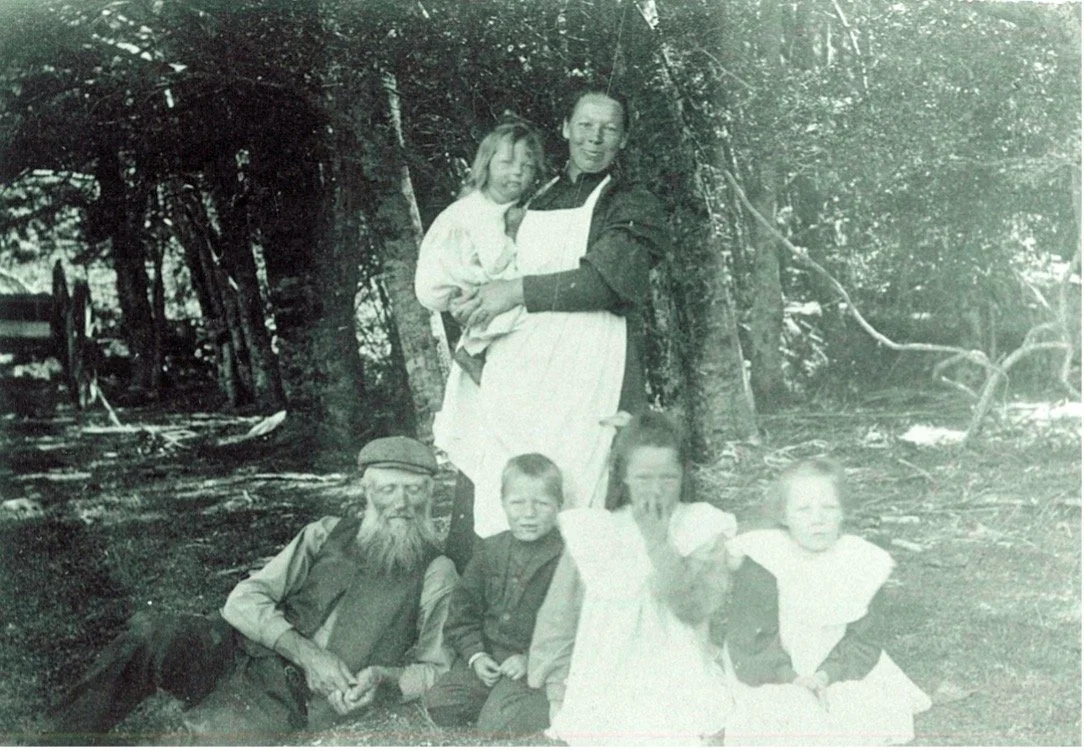
New Year’s Day 1906 – the MacPherson Family at a picnic at the old sawmill.
The Clan MacPherson Annual describes Jessie’s situation: “it speaks well for this courageous woman that one of her daughters later became a school teacher. Isolation and the ever-present threat of the great river pressed upon her consciousness, however, for her son was born there when she was totally alone … the main river was dangerous and often unfordable for days or weeks at a time.”
Rev. Chandler was equally impressed, and his account gives a clear picture of the complexity, and importance, of mothering in utter isolation. “The mother of these back-block children ought to be commended for their intelligence. Appointed by the Education Board, she teaches her children daily the ordinary State school lessons, adding what our State school children often lack, simple Bible lessons, so that they may know the story of God's redeeming love. We were glad to leave a Shorter Catechism with each child to help them in their Scripture lessons.”
Educational challenges were equalled by the challenge presented by rabbits. Rabbits were everywhere, and so numerous they not only made intensive farming difficult at the site, they caused some culinary complaints. One account describes an encounter between Duncan and an acquaintance as they passed through Cattle Flat with his five children on a dray. “My, McPherson (sic), that is a bonny looking family of daughters you have. What do you feed them on?” the acquaintance asked, to which a daughter replied, “Rabbits hot, rabbits cold, rabbits young, rabbits old, rabbits thin, rabbits tough, my goodness we’ve had enough.”
The location of the MacPherson’s home would also cement Duncan’s place in mountaineering history. Duncan had an interest in running guided tours in the local backcountry, and in 1907 the MacPhersons hosted the traveller Maud Moreland and her party for several weeks. They went camping with Duncan as their guide. Two years later, Duncan provided support for the first ascent of Tititea | Mount Aspiring, when the peak was first climbed by Major Bernard Head, assisted by legendary guides Jack Clarke and Alex Graham.
Sadly, in 1919 the river again took a toll. Jessie drowned near Phoebe Creek on her way back to the valley on election day in December of that year. She was buried in Wanaka next to Helen’s grave.
In 1920, the land passed on to John Aspinall, while Duncan later settled on a farm at Tumai near Waikouaiti with his unmarried daughters. He was killed in a train accident in 1931. A handwritten note on the back of the Leal family history stored in the Society’s records tells the tale: “Duncan McPherson (sic) was stone deaf in old age. On January 22nd, 1931, after crossing a paddock to collect a cream can from the station, he walked out between two railway tracks into the path of a train going to Oamaru. He was badly hurt, put on the train, taken to Palmerston, attended by Dr Thomas but died soon. He was buried at Waikouaiti Public Cemetery aged 78, having lived in New Zealand fifty years.
Rev. Chandler’s account finishes with a description of his trip home, and serves as a fine postscript to this memorable family. “The return journey was delightfully bright, though “the shades of night were falling fast” when Wanaka’s manse appeared in sight. That night we thanked God in our lines were fallen in such pleasant places, and wished that many of city minister, overburdened with a multitude of duties, could occasionally pay a similar three days’ visit to a hospitable Highlander amid the glories of rivers and lakes, glistening glaciers, and rugged, snow-capped mountains.”
