
A Golden Anniversary - 50 years of Treble Cone
On 14 August 2026, Treble Cone Ski Field celebrated 50 years since it was officially opened to the public by the Minister of Lands, Venn Young. It had actually opened for public use on 3 July 1976 when some 200 skiers arrived on the field.
The story of Treble Cone starts a little while before 1976 however! One hundred and fourteen years previously, the peak was named by the surveyor, James McKerrow. His ascent of Treble Cone, (accompanied by assistants John Goldie and James Bryce), is the first recorded ascent of the mountain and took place on 26 March 1862. He used the peak for his triangulation survey work.
Moving on to the late 1950s, the attraction of skiing on Treble Cone formed in the minds of some enthusiasts, some of which actually skied there on a casual basis. Principally, they were Rod Aubrey, Murray Raffills, Ralph Markby, Don Ross, Tim Wallis, and Ray Cleland. Others like Alan Kane, Eric Thomas, and Ken Harliwich followed. In August 1967, they even built a rudimentary “A” line hut using a dismantled hut from Cattle Flat Station, that was transported by Tim Wallis’ helicopter up to Saddle Basin.
It soon emerged that the Saddle Hut was the wrong location as it was too difficult to access and was some 400 vertical meters from the top of the mountain.
It was decided by the group of enthusiasts that they needed to organize themselves if progress was to be made in developing the ski field. A committee was formed – Rod Aubrey (Chair), David Ross (Secretary), Ray Clelland, and Tim Wallis, but it became obvious that to establish the ski field properly, money was required. To start the ‘ball rolling’, a private limited company was registered, Treble Cone Wanaka Ski Field, with Rod Aubrey, Murray Raffills, Ralph Markby, Don Ross, Tim Wallis investing $200 each in share capital. This was incorporated on 15 August 1968.
Access to the skiing area was achieved from Aubrey’s Cattle Flat Station (Treble Cone was part of the Station land) but it was obvious that something better had to be found other than climbing or relying on Tim Wallis’ helicopter. A ‘pilot’ track was created by Colin Nolan but that only got as far as the bluffs. It caused a review of the location of the home base and it was decided to use the location now in use.
In July 1969 the first rope tow was installed using parts and equipment obtained from other dormant ski fields. A new ‘A-frame’ building that could sleep up to 25 persons (bring your own sleeping bag!) was also built that year. It should be noted that skiing on the field was by invitation only until the field was opened in 1976 to the public.
In 1970, the directors were Neil Hamilton, Gordon McLaren, Ralph Markby, Ken Paterson, Eric Thomas and the world famous, Sir Edmund Hillary. Even Tenzing Norgay and his family visited the skifield in 1971 guided by Sir Edmund. About this time, Eric Thomas built a short rope tow alongside the ‘A’ frame for the learners area.
In 1973/4 a “4wd” pilot track was formed and extended to the base, but this was a rough ride according to some passengers. Transport was by Rod Aubrey’s Landrover and it was reported to be a hair-raising ride at times.
Any number of attempts were made over the 1970s to obtain sufficient finance to develop the field and there were many rebuffs. They did however, get a five-year lease from the Department of Crown Lands to test the viability of the project in 1971. But in 1975, what with the cost of ropes and a proper access road etc., the company was converted into a Public Company (24 October 1975) with an authorized capital of $500,000. That did not mean they had money in the bank! Ken Harliwich’s company obtained a contract to form the new road up to the base area and that absorbed about $57,000 except at the end of the day, 50% of the cost had to be converted to share capital. Construction started in November 1975, was in place in time, but it was a monumental task and the bluffs created a few issues. A decision was made to convert the road to two lanes and with help from Doug Hood, John Bishop and many others, this was achieved but at a greatly increased cost.
Finally, fortune smiled. A second-hand chairlift was to be auctioned at Roundhill and Allan Kane and Bob Wallace managed to obtain all the gear needed for two rope tows for just $6700.
Matt Burke accepted the Manager’s position in 1975 and agreed to live in the original ‘A-frame’ hut with his family until the planned replacement, an ‘A’ framed base building was for the winter opening. This was built in January 1976.

The view - 1976
The period through to mid-1976 had been a battle but they succeeded. In January 1976 a twin “A-frame” building was built at the base but that had limited facilities. That had the office and accommodation for a manager and family. Toilets were what we know as “long-drops”. The two new rope tows were installed to join the small Learners and Access tows on the lower slopes.

The rope tow, 1976
And what did it cost the skiers in 1977?
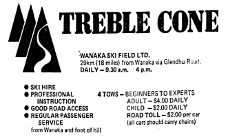
But don’t forget that the average wage was between $140 and $150 per week back then![1]
This short story does not do justice to the time, effort and “deep pockets” of many people who worked extremely hard in difficult conditions to bring this wonderful asset to the Upper Clutha district. Many are un-named and the story goes on as further developments took place in the following decades.
In 1976 the committee consisted of Murray Raffills, Ralph Markby, Alan Kane, Ray Cleland, R J Walker and Ken Harliwich.
References: There were many sources. The principal ones were (in no particular order):- Stan Kane’s handwritten notes on the Skifield history (1989), Alan Kane’s recollections recorded by our Oral History group, Paperspast articles and advertisements, various items on the Internet, and the book, “Treble Cone” written by Matt Conway, published 2014 by Clean Green Press.
[1] ‘The 1970s’, www.nzhistory.govt.nz/culture/the-1970s/overview (last accessed 25 July 2026)
