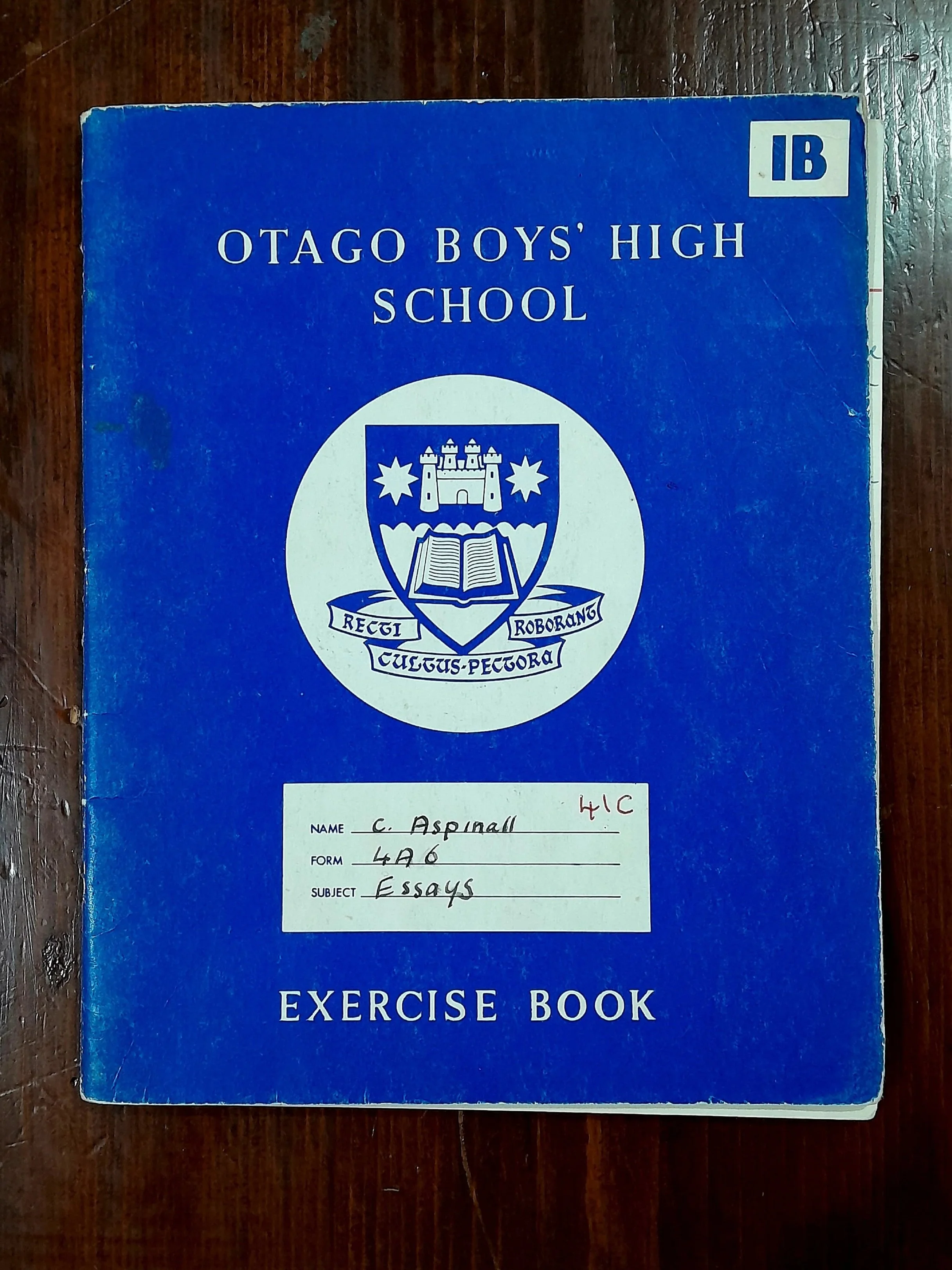
The following accounts are excerpts from Chris Aspinall’s English schoolbook from 1970. At the time, he was 15 and attending Otago Boys’ High School and living in Campbell House. Many entries are stories from his weekend adventures and offer an insight into what boyhood was like in those days.
The entries have received minor edits.
26 February 1970
An Adventure
Thursday morning of 4th April 1969 was an exciting day for me because it was to be my first time home after going to boarding school, and within a few days we went to have a cattle muster, which I had been looking forward to since Christmas.
The day before had come. It was the Saturday of the Easter vacation for me when everything was packed up into boxes; food, sleeping bags, and then fishing rods and rifles were loaded into the trailer. Finally, at about two o’clock in the afternoon we set off. After crossing the river twice, we drove up the flat and through some trees to the comp we were to stay in, to find it had been pulled down by cattle. So the first job was to tidy it up and do a little bit of make-shift work before we could move in ourselves. When this was done, Dad set about cooking the tea while some of us went fishing and the rest of us went to see if any deer were on the flat. Not long after dark our tea had been cooked so we all sat around the warmth of the fire for some jokes and our tea. That night everybody went to bed early because of an early start next morning.
At three o’clock next morning, I was woken by the rattle of tin plates which meant breakfast was ready, so I got out of my sleeping bag into the cold morning air and immediately asked what the time was.
Fifty minutes later we walked out of camp and headed for the ridge high above us, hidden by the darkness. After we had been climbing by torchlight for half an hour, the leader decided it was time for a rest. Lindsay Alderton took off William’s ammunition belt and went to sleep because he was so tired.
Just before daylight we walked out of the bush and onto the open country where all the deer are. By the time it got really light we were well above bushline, after a half an hour more climbing we sat down to look for deer and cattle when some keas came over so we shot four of them and skinned them on the way back because you can sell the skins.
Later on as we were going to and down into the valley we spotted four deer just before us, so William shot two of them. By nine o’clock we were at the junction when the helicopter appeared above the ridge. Within a few minutes it had landed just beside us. So Dad asked the pilot to go and see where the cattle were so we could use the men we had more usefully. William and Lindsay went up the right hand branch and John & John Wilson went up the left hand branch while Dad and I stayed at the junction to count the cattle as they came around the hill below us.
All went well on the way back and we found William’s belt still safe. By four o’clock the camp was being pulled down and everything packed up ready to go home which we did. This was the second year we had done this same muster in exactly two hours to the nearest quarter hour.
5 March 1970
I’ll Remember it Always
Dad and I had to go to Roxburgh to collect some new rams which he had bought earlier in the year. It was a fine hot sunny day, typical Central Otago weather, and we were driving through the Cromwell Gorge when the road took a fairly bad corner, and another small truck came around the bend towards us. Dad thought he was a bit too close to the inside bank and steered away from the other truck but it was too far! After we went down into the gorge, but our luck was in that day and it so happened the railway line was underneath us.
My first reaction once I realized where I was would be to follow Dad out of the truck, but he was trying to climb out the window on the driver’s side of the truck (upside down). This method seemed too slow for me so I got out the passenger’s side where the door was open.
After I had been out for a while three men came running along the line, I don’t remember for a short while what happened. But next thing I remember was one of the men asking me if I was alright, I told him I was and he sat me down beside the truck. Then one of them asked who we could ring as next of kin so I told him it was my Grandparents in Wanaka, so they went to a house down the road and rang for a doctor and my grandparents.
After a bit more waiting an ambulance arrived. I was put in the front and Dad was put in a stretcher in the back and we went back to hospital for one day, then we were allowed to go home.
That accident hasn’t really given me any real fears or effects on going in similar places, but I know Dad was because he has only had the truck on that road once since then. Which was a good idea.
12 March 1970
First Time on the Moon
It was one day in that winter month June when Dad came home from work and announced were to live on the moon. This was in seven months time we were to shift. For the next few months we were busy in sorting through our possessions to see what we would need to take with us and what we had to sell or give away. After we had to tell all our friends and relations that we were leaving earth.
Finally, after many sad farewells, the day had come we were about to leave on a spaceship which you could sleep on and was more comfortable than the most modern of houses. After much running about since early in the morning all our luggage was on board and we were to leave in three hours which gave us time for our last meal on earth for some time. Three hours later we were climbing into our space-ship and with a last wave to my aunt I disappeared into it then we were told to fasten our seat belts because the take off could be quite rough. Finally, we were airborne and heading towards the moon.
Three days later after our most comfortable journey we had landed. All this time I had been nervous about the whole thing, anyway we landed safely and were all to get off. First thing I saw when we stepped out was a great plastic dome over the whole landing area and the buildings surrounding us. After we had been greeted we were given a snack and then were taken in a big bus with a glass dome on a roof to a big metal cylinder which went down into the ground. This I supposed we were to live in. On our way from the space port (landing base) I noticed great big craters beside the road, and very tall pinnacles of rock which stuck out against the sky. For my first few hours on the moon I thought it was a great place.
16 April 1970
The End of a Mile Race
At the beginning of the fourth lap of the intermediate mile race at St Leondards High School annual sports day, the pressure was put on by the seven strong team. Soon we were round at the start of the fifteen-hundred-metre race. Then to the two hundred metres mark. By this time we were really sweating it out. Just past the one-hundred-metres mark we all broke into near sprint. Slow but getting faster and faster. Everybody was doing his best. The crowd was cheering us all on. Soon I noticed there was nobody in front of me and there was only about thirty yards to the tape. As I breasted the tape there were several blinking flashes from both sides of me. Suddenly, I felt very tired and all my muscles ached. I noticed I was very exhausted and had to lie down for a rest on the grass beside the all-weather track. It was then I fainted and the worst thing I remember was waking up in a hospital bed to see my parents sitting on either side of me. All they could say to me was, “Congratulations.”
28 May 1970
Hunting
Last Saturday I managed to talk my brother John into taking me and a friend goat shooting. So we started getting the gear ready, rifles of all calibres, a coat in case it rained, a knife, sharpening stone and, of course, ammunition. Just before we were to leave home Graham Smith and a friend arrived so they decided to come too. When everything was ready six of us climbed into the car and drove about four miles up the West Branch.
Within an hour we found ourselves climbing up the sunny face behind Raspberry Hut. After we had climbed about three and a half thousand feet above the valley floor, we came upon William who had gone on ahead of us. He said he could see some goats but they were a long way off. Soon afterwards some more appeared on a skyline - they also were a long distance away but that didn’t stop him, he set off up a narrow ridge across a creek. Later we saw him on top of a bluff.
“There are two chamois on the top ledge,” he called out. So from there John Wilson took the lead. After we had been climbing for about twenty minutes, John suddenly but calmly said, “There are some goats, one-two-three-four of them.” So he immediately took the lead until we were only a few yards away from the goats.
We all lined up on the ridge above them, they didn’t realise we were there until I fired the first shot. Then about eleven goats poured out from behind a big rock. Fortunately for us they ran towards us, by this time five riffles were getting hot barrels and goats were nearly knocking us over. Goats were dying all around us. But even though two of us chased some they were too good for us. I saw one with its head sticking out over the snow grass so I fired at it and it rolled down the hill. In the meantime the others were shooting away at two more in the opposite bluffs. John asked me if I could see the only one left through the telescope sights but couldn’t because of the sun so he shot it. It fell head over tail two hundred feet down the hill. The next job was to count our kill which totalled up to six, plus one which we later found out William had shot. Then an hour before dark, John Wilson decided he wanted two skins to make a coat for skiing in. This meant going down the hill in the dark. While they were skinning these two goats, I went to have a look at the one I thought I had killed. After walking along for a while there he was twenty yards in front of me staring at me. “Bring a twenty-two there is one still alive here,” said I. Graham Smith came walking along and the goat started to run away. He fired and it kept going. He did this several times and after about the fourth it fell over a bluff dead. We went back to the others to find them nearly finished. When ready we all set off down the track to the car. On the way home we did some hare shooting and saw one and shot on not far from the house.
6 August 1970
The Unexpected Trip Home
While our new home was being built we worried what could be done with the old one. Several suggestions were made but none seemed to solve our problem. Finally, we struck up with a worthwhile cause. It was decided that Dunstan District High school and O.B.H.S. [Otago Boy’s High School] could use it for nature study and geography trips for boys and girls.
After a lot of work – planning, painting and organising the house was made ready for use. When Dunstan had used the place and found it a great success it was our turn to find out what it was like.
Just after Easter this year, the first group of boys left and were away for four days. During this time I asked Mr Fraser if I could go up with A7 and he said he would think about it. The day before the fourth form class was to leave I went to the staffroom to ask him of what he had decided. After I had discussed the matter with the Rector for a short while he said I could go. With great excitement that night I packed up all the gear that was here which would be needed.
At eight o’clock the next morning the Otago Road Services bus pulled away from the entrance just outside the McInroe building, after loading all the food and all the needed equipment plus 29 excited-schoolboys. The trip up was nothing exciting because the boys got tired of singing and making a lot of noise before we had travelled far.
By about one o’clock in the afternoon the bus pulled up at our gate and let me off.
Just as I stepped in the doorway Mum said to me, “I was just sorting out the name of the house-bay I was to give a letter for you when John said not to worry about it because Chris is at the gate.”
After I rushed about the house collecting up gear we set off on the tractor and trailer for the hayshed where the gear of our party was waiting to be taken across the river to the house. When we arrived at the hayshed we found Mr McMillan and two boys waiting for us to come and take them and most of the gear to the house. After the bumpy ride across the river we stopped at the house and eager helpers unloaded the gear off the trailer. Then Mr Fraser took us for a walk to fill in time. That night was rather noisy until midnight when we finally got to sleep.
Next morning at 9:20 we set off down the flat for a walk up the West Branch of the Matukituki River. After walking for about three hours we found a safe place to cross the river. Then after we had done so and walked another two miles it was lunchtime. At 12:45 there was great excitement because someone could see two chamois sitting on a sunny face. Then our not so noisy group walked another two miles to the Wilsons Camp Bluff where we could see the Cascade Hut a mile or two away from the Aspiring Hut.
Then came the long return walk of nine miles back to the house where we arrived at six o’clock; just on dark.
The next day we didn’t set off so early because the place we were to walk to was not so far away but it was up the East Branch of the Matukituki River. This walk was mostly through native beech forest. Occasionally along the way there was clearing on the track and it was at one of these we stopped for lunch. I lead the group back through the bush because my brother had carried on up the track.
On arrival back at the house we found Mum, and Dad and some friends. Dad was to give the boys a talk about some history and some interesting stories.
The next day we walked into the Snowy Creek – a tributary of the East Matukituki. This involved a climb of about six hundred feet then a steep downhill slope. When we walked out of the bush were faced with one of the most breathtaking views you could get anywhere in New Zealand - it was the Avalanche Glacier, you could see the thickness of the ice would be hundreds of feet. Afterwards we walked on up the small valley for lunch and a better view of the glacier. In an hour we were all walking back down the valley on the hot trail of some deer which some of the people near the front of the line saw.
Within a few hours we were back at the house and were sadly getting ready for our last night at the house. Just on dark, Dad came over and asked Mr Sinclar if Bill and I could go over to the new house for the night and told Mr Fraser he would listen to the weather report and would tell him on the walkie-talkie radio if the boys would have to cross the river in case it rained and the river could go up and they would be stranded.
By nine o’clock the tractor and trailer was at the river crossing ready to go across and carry the boys and their gear across the river.
By ten o’clock I was comfortably warm in my sleeping bag on my own bed. The other boys had to sleep in the woolshed for the night. The next morning everybody was walking around outside with nothing to do so I showed some of them how the power-house worked.
At one o’clock that afternoon the bus arrived back at the gate and there was a mad rush for everybody to get their gear on the bus. By half past everyone was ready to go and the bus left. Not much happened on the way back to Dunedin and we arrived back at 9:20. I (think and) went to sleep thinking I’d had a most pleasant and enjoyable weekend at home and I’m sure all the other boys who went felt the same.
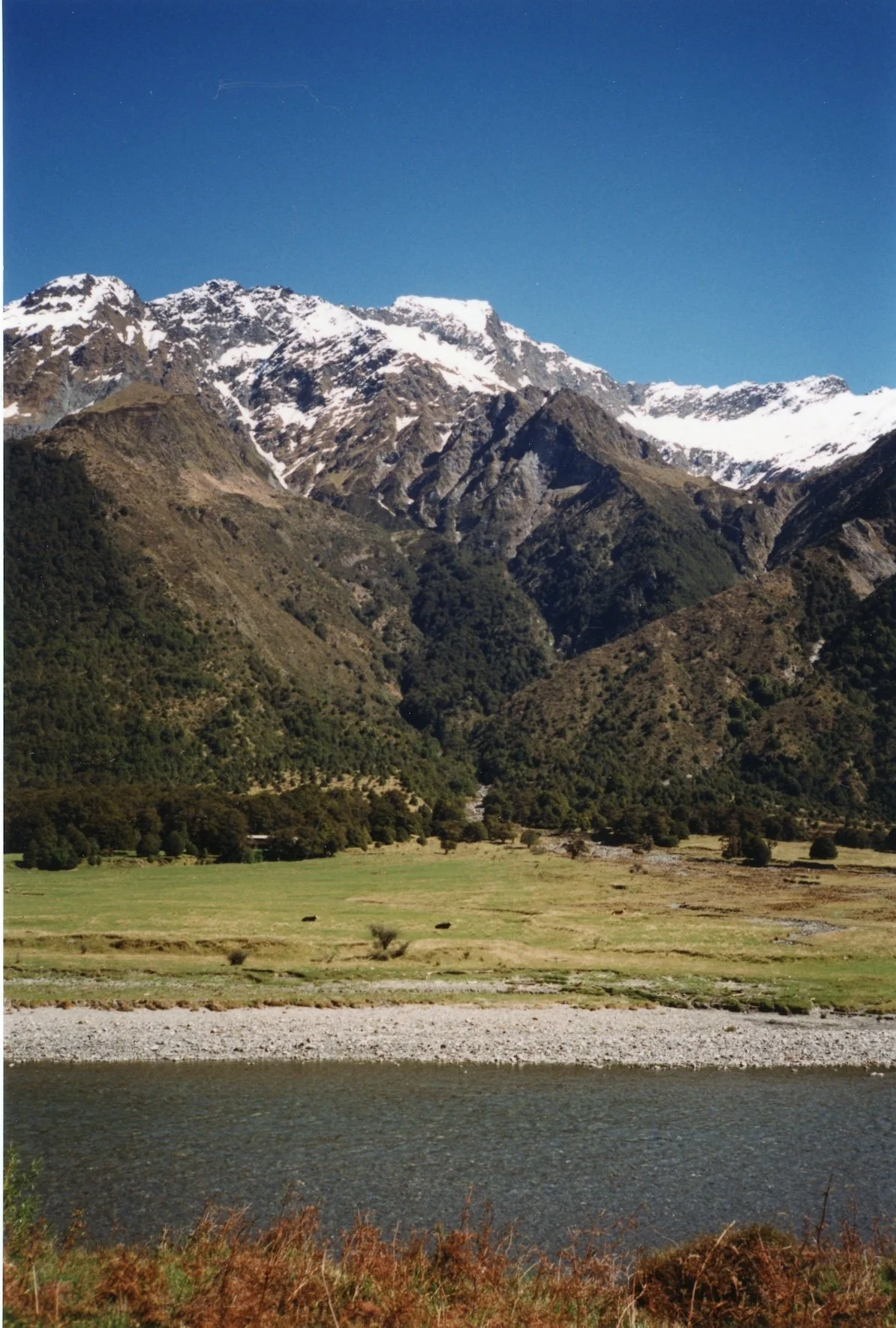
Site of the Otago Boy’s High School hostel in the Matukituki Valley.
1 October 1970
Class Trip to Mt Aspiring
At 6:00am on Sunday the 20th of September I was woken up by someone shaking my shoulder. I got out of bed and had a wash. Then we went into the kitchen to get our lunches and our breakfasts which consisted of a couple of pieces of toast.
By 7:25am we were on our way, the bus went up Stuart St slowly almost hardly moving it seemed. In about an hour we arrived at Milton and turned inland. At Alexandra we stopped for some refreshments and McLeod dropped a full bottle of lemonade on the footplate, much to his disgust. When we arrived in Wanaka everybody rushed down to the lake which was over the wharf while I went away to collect our mail.
After we had travelled about 13 miles from Wanaka, the bus suddenly sank down into the road and wouldn’t go any further forward. After the driver and Mr Porter discussed the matter they decided we had all better get out and push the bus out backwards, then fill the rather large hole with stones. Finally, we arrived at Cattle Flat Station homestead I went up to ask what the road further up was like. A few minutes later we were knocking on the door for a second time, after some discussion with Mrs Aubrey it was decided that the Cattle Flat Station tractor was to be borrowed so that if the bus were to get stuck we could pull it out. Or if the bus couldn’t get through to our homestead we could on the tractor. When we arrived at a slip I knew would be bad, the other class was there waiting for us.
It turned out that four inches of rain had fallen in three days. Dad had realised the bus couldn’t get past so he had brought the other class (4A2) down in the truck and we were to carry all our gear about 300 yards from the bus to the truck. Then most of the class except for a few lucky boys who travelled on the truck started walking for our hay shed about six miles away.
After I had eaten some lunch and collected some gear that was required, I drove the tractor up to the river-crossing where we loaded the packs and food on the trailer then all of us except me and Mr McMillan waded the river.
When all the boys had gone to their rooms and got their beds the Campbell House group prepared and cooked the tea. That night the lights were turned out at 10:30pm.
At 7:30am the next morning I woke up to hear someone say, “It must have snowed before it froze last night.” It turned out that it was just a rather heavy frost.
By a reasonable time that morning we were about two miles away from the old homestead.
At twelve o’clock we crossed the river in front of the Raspberry Hut and then we kept walking until we were just past the view you get of Rob Roy Glacier. While we were having lunch there some boys had a swim in a narrow small warm pool beside us. We arrived at 4:30pm back at the house where we then made ourselves comfortable for the night.
Tuesday morning I didn’t get up until 7:50am because I had to operate the walkie talkie radio to our new home in case we had to know something and the weather report. That morning Dad came over to shift the generator from beside the house to a concrete slab in what used to be the lawn.
That afternoon we went up the East Brach. When we got to Snowy Creek, Mr Carter split us up into several groups and we had to work out a way to get across without getting our feet wet. Finally he decided that building a bridge out of logs sounded the best idea so, we set to work, several boys I were put across with much difficulty and then some rocks were thrown in to help a little bit but finally he decided that the bridge idea wasn’t going to work.
Then we tried boulder-hopping and since it was my idea I had to go first, I luckily got across with dry feet. We continued up the valley for another one and a half miles before we decided time was running out so rested for a while and turned back.
On Wednesday morning there was much activity because our class was to leave. By 10:30 everything was clean and tidy, so we walked down to the river where we waded across. Some of the lucky boys got a ride down to our place where we had lunch and I had a shower. At 1:30pm just as we were going to leave for the slip the bus arrived. Within half an hour my class was on its way back to Dunedin and I was going back to the old house for another three days.
8 October 1970
Straggle Muster
It was while I was working at Orari Gorge Station that I experienced my first real sheep muster.
I had been working on the station for a week, when Mr Tripp told Tom the Lincoln student and me to go muster the Ravine Block. It gets its name because there is a big ravine on a very steep face where some merino ewes with their lambs had been left behind in the main muster.
At dawn the next morning we were in the cookhouse making ourselves some breakfast and lunch. After that was done we went to the stable and saddled up a horse each and rode away. It was twelve miles to the place where we would tie up the horses and start climbing.
The ride on the horses wasn’t very exciting with no unusual incidents occurring. When we arrived at the foot of the face we looked over it with the binoculars to spot where the sheep we were to muster were and how to get them out safely.
Finally, we set off up the face. The pace was slow because we had to climb about 6,000 feet above the valley floor. We had been climbing for what seemed hours before the first small bunch of sheep had been spotted. Our next job was to find the rest and last small mob then set off back down the hill, but suddenly the sheep were frightened and bolted across a shingle side. When they got halfway across they started to slide away down the hill and into the ravine. Tom and I almost ran down the hill holding very little hope for the sheep. When we looked over the edge and slightly to our relief the sheep were alive but on a big ledge about 100 ft from the top which was halfway down the edge of the ravine.
There seemed to be no way to get them out so we sat down and tried to think of what to do. After we had been thinking about it for half an hour or so we decided there was nothing we could do about it so finally we decided to go back to the homestead and get Jack to help us. In three hours time we had arrived back and found Jack the head shepherd and told him what had happened. He scratched his chin and said, “Can’t do much about it tonight. Just forget about it and we will go up in the morning and see what we can do about it.”
The next morning we were away just as early with a rifle hoping we wouldn’t have to use it. When we arrived on the unfortunate scene of the day before Jack agreed there was nothing much we could do about it so we had to shoot them so they wouldn’t die of starvation.
That night Tom and I felt very sorry about our rather poor mustering effort of the day before. Jack just gave us a pat on the shoulder and said, “Don’t worry about it too much, they were only good for dog tucker.”
22 October 1970
A letter to the Editor of the Otago Daily Times
Campbell House,
Stuart Street,
Dunedin.
22 October, 1970.
The Editor,
Otago Daily Times,
Dear Sir,
I am writing to complain because very often you see a picture of a person looking very distressed because of an accident or something like that.
I noted at the beginning of the year when Jennifer Beard was missing at the Haast area, there was a photo of her boyfriend looking very worried and distressed on the front page.
Another time there was a picture of a boy from the St Clair Lifesaving Club crying because one of his friends had been killed by a shark. What’s more, the person who took the photo won a photographic award with that photo.
Yours faithfully,
Chris Aspinall