
Short of cash? Make your own!
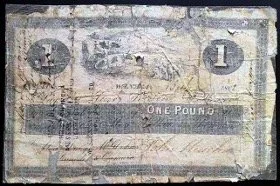
Sometimes known as the Wanaka Pound, it is extremely rare and likely to be the only one surviving. It appears to be the forerunner of what was known as a Stock and Station Agent’s order, i.e. the farmer wrote out an order (a bit like a cheque) drawn on his Stock and Station Agency firm account, to pay a debt.
It is in poor condition, but was drawn up on 1 July 1862 by John Heuchan, manager of Wanaka Station, on behalf of the partnership of Robert Wilkin and Archibald Thomson. It was payable to Henry Sefton (or Sexton) or bearer, at the merchant firm of Young and McGlashan, Dunedin and Oamaru, but has been over-stamped “payable at Christchurch, Messrs Miles & Co, Lyttleton and Messrs Cargill & Co”.
Despite the activity of the major Dunedin banks, they could not provide the full banknote requirements of the Otago community. Thus in 1861-1862 at least three Otago merchant firms issued their own promissory notes to aid trade. The first of these was Dalgety, Rattray & Co., established in Oamaru in 1860.
Wānaka , at the time, was a very isolated location and certainly there were no merchants or banks anywhere near the Upper Clutha. The first bank branches/agencies were opened at Cardrona sometime after gold was discovered, but had all closed by 1880.
Some mystery surrounds this note with regard to the wording of payment “on demand”. Payment “on demand” was a status which banknotes from chartered banks enjoyed but which promissory notes were not permitted to include. The merchants involved, had no charter from the Governor and the law of the day would have prevented them from using those words. Perhaps the only solution to this riddle lies in the fact that the notes were signed, dated and released in Wānaka and it would have physically taken 3-5 days on horseback to reach the merchants in either Christchurch or Dunedin where they could be redeemed with payment in sterling. Although payment “on demand” is written on the note, the remoteness and travel time guaranteed and ensured that this financial instrument could not be immediately paid out “on demand”. Hence in a roundabout way it did not contravene the law of the day.
Acknowledgement: New Zealand Numismatic Journal No.92, December 2012