
The great sheep court case
When:
1862 and then on appeal, 1863
The Main Players:
John McLean from Morven Hills Run
Alfred C Strode (sometime policeman, magistrate and land owner) and William H Teschemaker (runholder)
James Macandrew (businessman, Superintendent of Otago)
Judge Gresson and a Special Jury (1862)
Justices, Gresson, Johnston and Anor of the Supreme Court (1863)
2,000 missing ewes
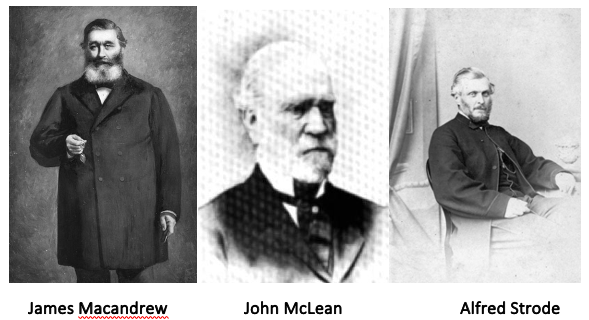
No photo of William Teschemaker has been found. He lived near Maheno on what was then named the Kauroo Run. He did have previous dealings with Macandrew.
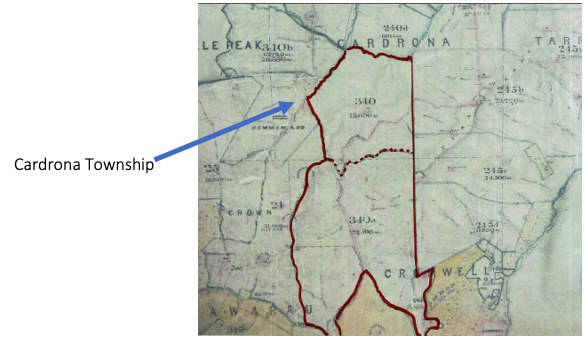
Early 1860 was when most of the leases to the Upper Clutha Run applicants were documented, Run 340 was recorded to be leased to a William Mills of Dunedin (Pastoral Lease for 14 years). Maybe he was a speculator who sold his rights to the Run before a lease was signed, as Macandrew is named as the vendor in 1859. It was recorded that in September 1859, James Macandrew of J Macandrew & Co sold the Run to Messrs Strode and Teschemaker.[1]
Macandrew’s manager, Fred Greer, deposed in Court that he was managing for James Macandrew & Co, Macandrew being the sole partner (sic) and he signed a ”sold note” for £3,750, under Macandrew’s instructions covering Run 340 and 2000 ewes deliverable on 1 January 1860. Payment was by £1,000 in cash and two acceptances for £1,000 due 31 Jan 1860, and 31 Mar 1860 and one of £750 due 31 May 1860.
This is a map showing most of the boundary of Run 340 and its location:
All the bills were paid on due date by Strode and Teschemaker but when it came to collect the 2,000 ewes, none were forthcoming from Macandrew. Instead, on 12 March 1860 he gave the purchasers a written order on John and Allan McLean of Morven Hills for “2,000 ewes to be driven across to their run”. It very strongly suggests that Macandrew had no sheep to settle the sale and purchase contract, which comes to little surprise given his apparent financial position at the time.
Strode and Teschemaker presented the note to a brother of John and Allan McLean, Robert, on 12 March at the Morven Hills Station, but delivery of any sheep was declined. Strode and Teschemaker naturally went back to Macandrew on 12 April, who according to the evidence in Court, stated “there must be some misunderstanding”. Subsequently there was a lot of “backwards and forwards” activity, endeavouring to resolve the issue of non-delivery. In January 1861, the McLean’s again declined to deliver any sheep that caused Strode and Teschemaker to make other arrangements to stock the Run so as to avoid it being forfeited.
Strode and Teschemaker then, out of frustration, decided to sue McLean for the non-delivery of the ewes, subsequent lambs delivered by the ewes and costs. This was heard in Court on 29 January 1862. There was much argument on legal matters. The Jury’s verdict was in favour of the Plaintiffs and awarded £4,081-5-0.
The McLean’s appealed and it was heard in the Supreme Court in October 1863 and judgement given to McLean with costs.[2] The written verdict is extensive[3], but put simply, it held that McLean was never paid for the sheep by Macandrew in the first place so had no ownership of them. McLean could not deliver until he was paid.
Reality is that Strode and Teschemaker probably sued McLean as he had assets, whereas it was well known that Macandrew was in in a dire financial situation. That is confirmed on 28 January 1861, the very day before the first Court hearing mentioned above, Macandrew was arrested for debt by one Nathanial Chalmers.
He was jailed but immediately on arrival there, issued a proclamation (under his powers of being the Superintendent of Otago) which stated that “in consequence of the overcrowded state of the gaol and the want of suitable accommodation for the debtors,” his own residence, Carisbrook House, was to be a prison of the Province of Otago. On appeal to the Governor, he was brought back to the gaol on 21 March 1861 and removed from office as Superintendent.[4] Financial irregularities had been discovered beforehand and it was found that Macandrew had misappropriated £1,012-14-5 for his own use that was never repaid despite supports claiming it had been, in the years following.[5]
Macandrew did gain back popularity and for a time served as a member of Parliament. Sometimes people in political power turn out to not actually be, what they appear on the surface to be.
Shortly after the Appeal, Wilkin and Thomson purchased the Run.
[1] Court of Appeal, New Zealand Spectator and Cook’s Strait Guardian, 31 October 1863, Page 3.
[2] Court of Appeal, New Zealand Spectator and Cook’s Strait Gardian, 31 October 1863, Page 3.
[3] Ibid
[4] The History of Otago, Otago Centennial Publications 1949, A H McLintock, 1949, page 435.
[5] Ibid, 436.