
Banks in the Upper Clutha
Finding a bank that is open to public access these days can be a bit of a battle, but consider what the early settlers and miners had to put up with – there is only so much gold you can carry in your back pocket! Like the actual existence of the early banks, information is very sparse.
The first official bank in New Zealand started operating in 1839/40 and unsurprisingly, it was an Australian bank.
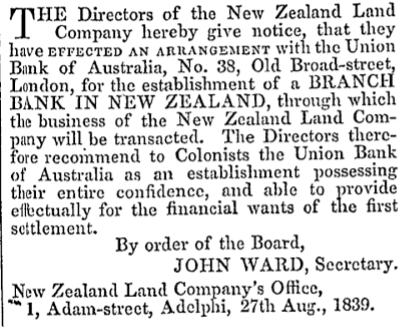
Advertisements, New Zealand Gazette and Wellington Spectator, 9 May 1840, Page 1
The Bank of New South Wales (BNSW and now known as Westpac) opened an Agency at Dunstan in February 1863. But before that, where did the miners dispose of their gold to? It was a long trip by horse in the middle of winter! They also opened an agency at the Arrow (Arrowtown) but rapidly closed it when the Bank of New Zealand (BNZ) had opened a branch there in February/March 1865.
It was a long wait for the Upper Clutha to get an official bank! The “trigger” was the discovery of gold at Cardrona in 1862, but even then, it took until 1872 to get a bank operating in the Upper Clutha, at Cardrona. The Bank of Otago was incorporated in London in 1863, but it was not until November 1872 that an Agency was opened, situated next to Willoughby’s forge and over the road from McDougall & Sons Store.[1]
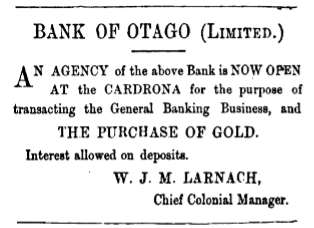
Advertisements, Lake Wakatipu Mail, 4 Dec 1872, Page 2
On 1 July 1973, a new bank was established (incorporated in London), specifically to operate in New Zealand, and it purchased the Bank of Otago Ltd. That bank was The National Bank of New Zealand Ltd (NBNZ).[2] Mr W C McDouall was the manager at Cardrona at that time and it continued to operate in the premises built by the Bank of Otago Ltd. Shortly after the takeover, the branch was converted to an Agency of the NBNZ branch in Queenstown.
Like all goldfields, it wasn’t only miners who were attracted to the money to be made. In addition to banks sending staff or agents over from the Arrow or Queenstown, and maybe from Dunstan, to purchase the miners gold, there were individuals buying the gold and transporting it to maybe Dunstan or even Dunedin to sell for a profit. Banks were even known to operate on Sundays until there was a ‘hue and cry’ from Wellington.
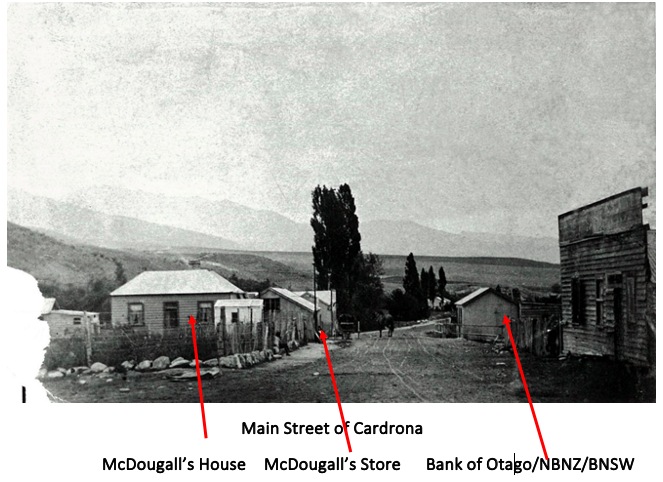
It is known that McDougall & Sons purchased gold from the miners and then on sold it when the bank agents came through. So did a local publican or two. In effect, they were acting as unofficial bankers. Some may recall Mrs Jane McCallum, a resident on Wilkin’s Wānaka Station at Albert Town in the early 1860s, who looked after gold for miners. Jane wrote, “…..as they were afraid to keep it themselves. Sometimes I had as much as £300 worth.”[3]
Banks came and went. NBNZ sold their Cardrona business to the BNSW in 1876 for £175.
Of interest, in the UCHS Archives Room there is a typewritten note that states that “The National Bank of New Zealand and the Bank of New Zealand both had branches in Cardrona. In 1876 when the gold boom was over, both banks agreed to close their doors and not re-open at nearby Pembroke”. No evidence of that arrangement has been found, let alone if the BNZ did have a branch in Cardrona, but in any case, roughly 70 years on, the agreement had been forgotten about when the BNZ started operating an Agency of their Cromwell Branch at Pembroke.
The 1878 Great Flood put paid to a lot of miners claims and associated businesses. Like other parts of the Upper Clutha, much was destroyed. With the lack of gold, the banks also moved on. In Cardrona, the McDougall’s were the postmasters and maybe operated the Post Office Savings Bank after it was formed, for the locals and/or exchanged gold for cash or credit.
There is a gap in the history of banking in the Upper Clutha until 1947, though a Post Office and Telegraph Office was opened on 7 October 1889 in Pembroke (known as Wānaka from 1940). A Post Office Savings Bank was opened 2 months later. The area population was quite small and farmers, if they had an association with a Stock and Station firm, they could issue Orders (for further reading, click here).
The Head Office of the BNZ must have seen some potential for more business from the Upper Clutha and an Agency of their after 1975 Cromwell Branch was established on 5 May 1947. The Agency operated for two hours every Monday at the Wānaka Hotel. It would have been staffed by two members of the BNZ Cromwell who would have travelled up by car.
Then on 9 January 1950, NBNZ started an Agency between the hours of 10am and 12 noon (in those days full branches opened at 10am and closed at 3pm to the public). It initially operated from Wānaka Stores (1944) Ltd.’s premises (now known as the Four Square shop in Ardmore Street).
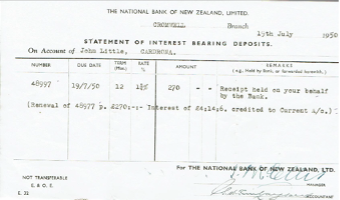
John Little (of Cardrona)’s Term Deposit Slip from 1950. Note the interest rate of 1.75%pa for a 12 month period! The author also noticed the signature of the Accountant, Graham W Finlayson who 16 years later employed him in the Bank.
Strange as it may seem, the BNZ and NBNZ staff shared transport. On “week 1”, they would all travel to and from Wānaka in a taxi paid for by the BNZ. On “week 2”, they would all travel in a car owned by one of the NBNZ staff. The NBNZ staff member would have to apply to Wellington Head Office for reimbursement of “mileage money” which was at a set rate. These sort of travel arrangements lasted for many years, strange as they may seem in today’s world. One day, the car broke down during the trip and the BNZ and NBNZ staff had to wave down the NZR bus heading for Wānaka and on arrival sent a mechanic down to fix it. Eventually, BNZ Head Office supplied them with a car owned by the Bank.
An ex BNZ manager recalled that the BNZ initially operated from the Private Bar at the Wanaka Hotel, “which was of great interest to tourists who… used to call in just to see this phenomenon.” However, after the Wanaka Hotel burned down in 1958, they had to move to the Committee Room, across the road at the Wanaka Hall. By then, the NBNZ were also operating out of the Hall in a room next to the Committee Room. It was reported that they all had plenty of ‘foot traffic’ as Wānaka only had one public toilet at the time and that was behind the Committee Room. The arrival of a tourist bus could result in a queue stretching from the toilet door out into the entrance porch of the Hall.
Hereinafter, the histories of the individual banks are recorded separately.
BNZ
In 1971, Doug Pedlow built the shops on the corner of Little and Ardmore Streets. There he opened the first Wānaka Pharmacy in the corner shop and leased the middle shop to the BNZ.
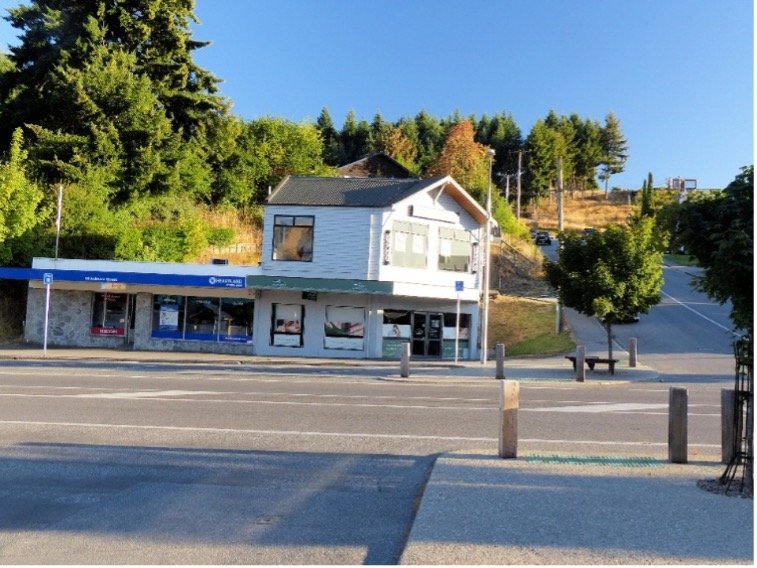
Doug Pedlow’s building (photo taken 2023). BNZ ended up occupying all the building now occupied by Heartland Print. In 1994/5, ANZ occupied the corner shop.
Expansion was afoot in July 1982 when the well-known resident of Hāwea, Richie Hewitt, transferred from the BNZ Invercargill, as Officer in Charge. BNZ took over the next door premises occupied by Fisken’s Real Estate and operated with 5 staff. 1985 brought an expansion into a Service Centre just prior to moving down to 123 Ardmore Street on the lakefront (the premises now occupied by One NZ). On 2 March 1987, the Service Centre became a full branch with its own resident manager, Mr P J Wasley.
The next major move was in 2013 to new premises, still on Ardmore Street, but between the Speights Ale House and Relishes.
NBNZ
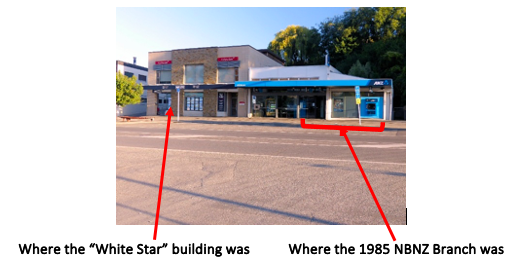
In 1967, NBNZ moved from the Wanaka Hall to a more permanent at location in Ardmore Street in what was the White Star Hotel in the 1930s.
On 1 November 1971, NBNZ converted their representation in Wānaka to what was known as a Sub-branch of Cromwell. This meant full banking hours were provided. The BNZ initially reacted by extending their hours to 2 or 3 days a week in summer and two days a week in winter and opening for 3 hours on those days. Eventually longer hours were introduced.
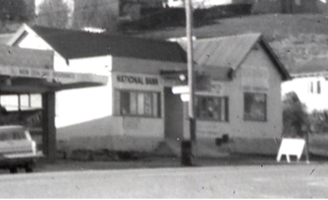
What was the White Star Hotel building occupied by NBNZ from 1867 to 1985
In January 1975, John Spittle came to Wānaka as Officer In Charge of the NBNZ sub-branch. Later that year, new premises at 56 Ardmore Street[4] were ready for occupation. John can recall receiving instructions from his Regional Manager that at the opening there was “to be no booze – tea and coffee only”, so what the staff had “accumulated” was hidden in the branch safe and the cash placed in front of it to hide the liquor should the Regional Manager want to inspect the safe. When the time came to move the safe, a local contractor with a forklift was employed to do the job. Getting the safe out of the old premises (the old White Star Hotel building) was difficult and took longer than expected. The contractor managed to get the safe out, moved it onto Ardmore St and happened to look at his watch. It showed 12.15pm! Lunch time! So, he lowered the safe to the road, turned off the machine and went to lunch. He came back about 1pm to a much-relieved team of bankers and the safe was then placed inside the new premises. Little did the locals know they had a small fortune sitting on the road under their noses!
In 1988, NBNZ Wānaka became a full branch with a resident manager and no longer reported to the Cromwell Branch.
In 2003, the Australia and New Zealand Banking Corporation (ANZ) purchased the NBNZ for just over Australian $4.9billion. The NBNZ branches continued to operate under the NBNZ banner until 2012. But this was the second time the ANZ had operated a branch in Wānaka.
Trustbank Otago and Westpac
On 27 September 1971 another banking competitor opened a branch. That was Trustbank Otago. Ross Jefferson was the first manager, John (Jack) Scurr was the first customer to open an account and Louise Trevathan was the youngest account holder to open an account on the day. The premises were in Helwick Street where Westpac now operates from.
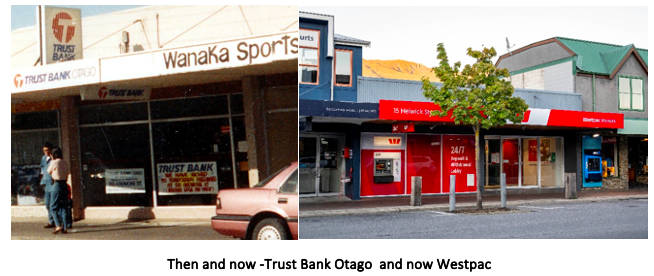
Ultimately, Westpac purchased Trustbank Otago in April 1996. It rebranded the expanded business as Westpac Trust, but then phased out the word “Trust” in 2002.
Bank of New Zealand
As previously mentioned, the BNZ started operating an agency on 5 October 1947 from the Wānaka Hotel. There is no mention anywhere if they operated from any other location until after Doug Pedlow, the pharmacist, built three shops on the corner of Little Street and Ardmore Street (the lake side). Doug registered his company, Wānaka Pharmacy Ltd in 1971 (that company still operates in Helwick Street but under different ownership).
The Wānaka Pharmacy operated out of the corner shop and the BNZ Agency in between that and Bruce Barnett Electrical. The BNZ continued to operate as an Agency but by now (1973) had extended the days they attended to 3 days per week (still only for 2 hours). In 1982, the BNZ took over the lease Fisken Real Estate office (previously Bruce Barnett’s). In 1984, The BNZ changed the status of their representation in Wānaka to that of a Service Centre operating 5 days a week. The well-known Richie Hewitt moved from Invercargill as Officer in Charge.
Business was expanding but also the BNZ considered the then location to be unsuitable, and they moved to the Mall at 123 Ardmore Street down on the lakefront on 11 March 1987. This is now occupied by One NZ. Along with a new status as a full branch came a Branch Manager, Mr P J Walsley and they eventually had 12 staff.
In 2013, the branch moved to its current location at 93 Ardmore Street, in between Relishes and the Speights Alehouse.
ANZ Bank (Australia and New Zealand Banking Group)
The ANZ’s first attempt at setting up representation in Wānaka was on 1 June 1995. But we first have to take a couple of steps backwards to 1987 when NZ Post Office was broken up into three separate entities, one of which was PostBank. In 1989, Postbank was purchased from the NZ Government by the ANZ. Postbank was dis-established and branches rebranded, but in Wānaka there was no separate branch to close. It is presumed that the NZ Post serviced the needs of ex POSB customers in the interim.
On 1 June 1995, ANZ opened a branch that apparently was mainly to service ex POSB customers. They leased the corner shop that had been built by Doug Pedlow (the pharmacist), but it only lasted until February 1996. There was insufficient business for the ANZ to continue in Wānaka.
Then in 2002, Lloyds TSB Bank Ltd, a UK bank that had owned NBNZ since 1876, decided to sell NBNZ. On 1 January 2003, ANZ took over. In Wānaka, the Bank continued operating under the NBNZ brand (the “Black Horse”) until 2012 when all branches were re-branded ANZ. The ANZ now operates out of the premises that had been built by NBNZ but subsequently extended into the premises next door.
Post Office Savings Bank
As youngsters, this was the first introduction to banking. An account would be opened at the POSB and every week at school, a POSB clerk would arrive to take our savings and enter the records into our Passbook. Remember that? The POSB was created in 1867 to “encourage thrift by ordinary people and it was immediately successful.”[5]
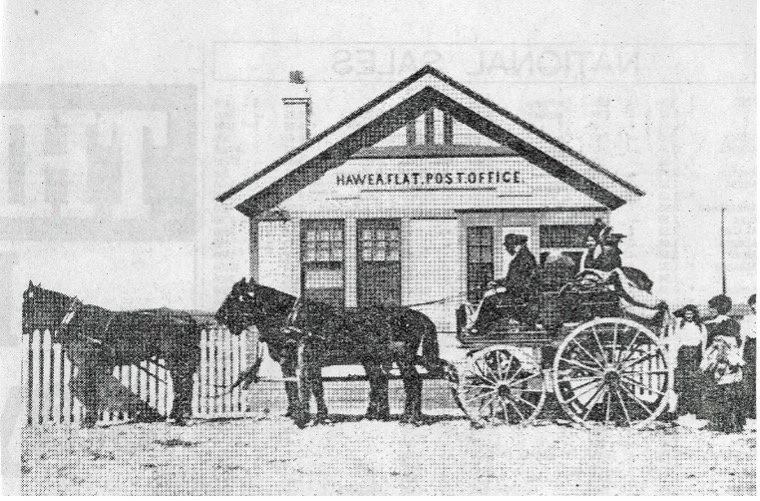
Post Office, Hāwea Flat - 1912
Everywhere there was a Post Office, you could deposit or withdraw money.
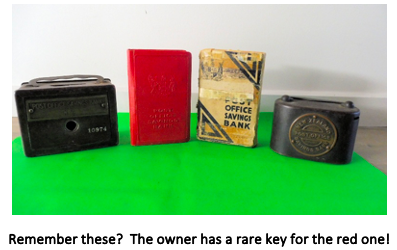
In Wānaka, the Post Office opened October 1889 and 2 months later the Post Office Savings Bank commenced business. It should be noted that most other settlements in the Upper Clutha had Post Office facilities well before Wānaka.
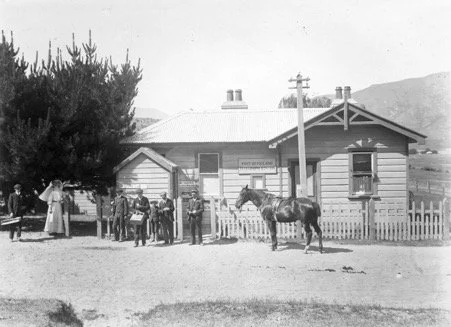
Post Office, Pembroke 1908
Kiwibank Ltd
Kiwibank Ltd was established by the fifth Labour Government of NZ in 2001. Initially, it was a subsidiary of NZ Post and most branches, Wānaka included, and ended up operating out the NZ Post branch offices. That was until 2022 when the NZ Government sold 25 percent to the NZ Superannuation Fund and 22% to ACC. In Wānaka, Kiwibank is still stationed in the Post Office building opening in 1946, but on its own.
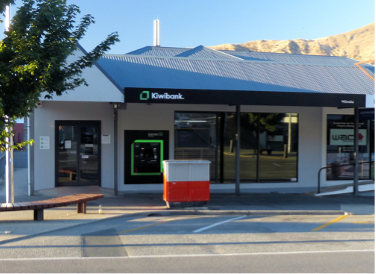
Kiwibank Ltd, Wānaka - 2023
Summary
Banking has changed markedly since it was introduced to the Upper Clutha. I can still remember Monday 16 May 1966 when I stepped across the threshold at NBNZ, Oamaru (heavens that’s nearly 60 years ago!) to become the office junior on a salary of £560pa plus a ten shillings 6 monthly bike allowance (I had to use my bike to make deliveries etc). I had to survive a probationary period of 6 months before I could become a permanent employee. No computers back then and £sd[6], but that is all another story.
Disclaimer: some of the information in this article is from contributors memories that may be 3rd hand and there is no way of checking the veracity. The Banks that were contacted also had little information.
[1] Back then it was known as McDougall and Smith’s Store Nov 1872- Lake Wakatip Mail 13 Nov 1872 Page 3.
[2] Advertisements, Evening Star, 7 August 1873, Page 2.
[3] In 1862, the price of gold was about US$18.93 per ounce. On 1 May 2025 it was US$3,322 – source GoldPrice.org
[4] This is the part of the current ANZ Bank promises at the eastern end. It was very small.
[5] “Untitled". Wellington Independent. 13 April 1867.
[6] Pounds, shillings and pence for those born after 10 July 1967 and have only experience decimal currency (dollars and cents).