
Albert Lafranchi and his Wristwatch
This article has come about by the acquisition by the horological historian, Terry Sutcliffe, of the World War I period wristwatch that has a very relevant inscription to a highly regarded Upper Clutha family member. It is also tinged with the good fortune that the owner, Albert Lafranchi, did return from the Western Front and lived a long life.
Albert Lafranchi was born at Cardrona in 1879. He was the fourth child of Gioachimo and Anna Maria.
The Lafranchis who were both Swiss nationals who independently emigrated to firstly to the Victorian Goldfields in Australia, and the New Zealand in the 1850s. They met and married in Australia in 1861. They moved to Macetown, Otago in the late 1860s.
They finally moved to Cardrona in 1873, where they immediately started the construction of their residence and the All Nations Hotel, which was opened on 5 December 1873. There is this wonderful early photo (below) of the hotel taken approximately 1883 showing the then six-year-old Albert standing next to his mother.
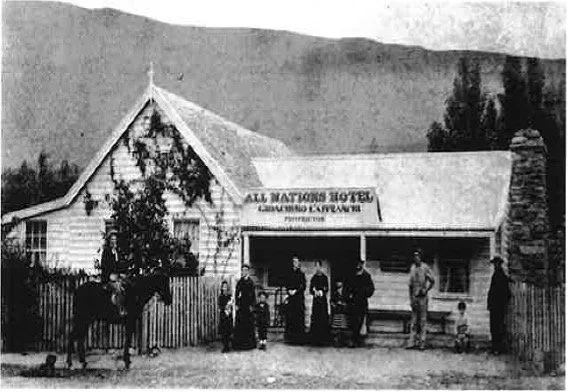
The Lafranchis sold the hotel in 1887 and moved into the mining business. This included Gioachimo and Anna, and their eldest son Alfred. In 1889 Gioachimo had an untimely accidental death.
As Albert grew up, he naturally moved into the mining business. In the early 1900's he had a one-acre ordinary alluvial claim at the Cardrona Creek. In 1907, Albert went into partnership with his older brother Alfred in the ownership of a dredge. This appears to be a last-ditch attempt to strike gold, however they abandoned it and eventually, in 1916, the dredge finally sank into the pond where it had been working.
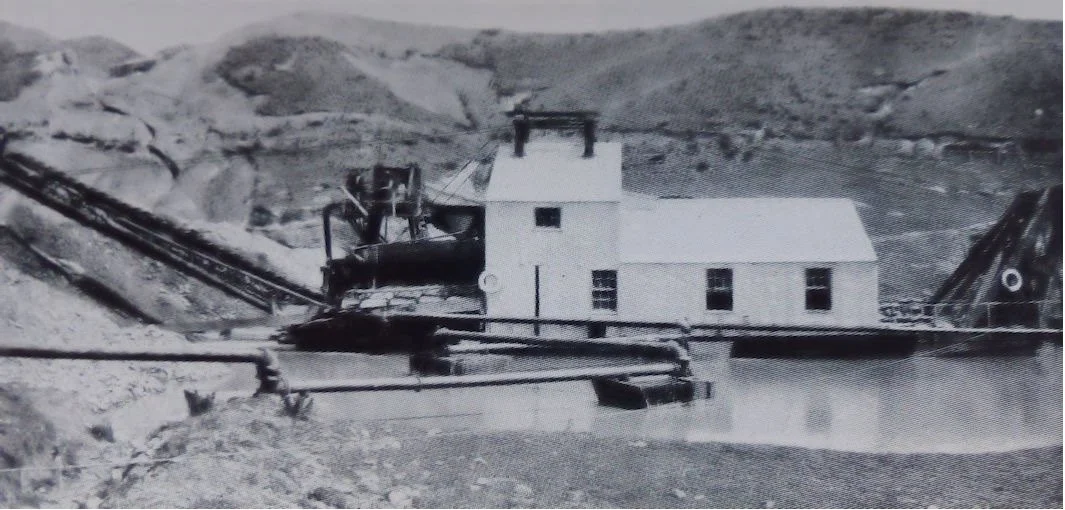
Lafranchi’s Dredge
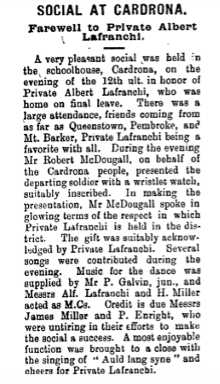
In November 1916, Albert's name was drawn in the ballot to enlist in the New Zealand Army, and after his military training, he was transferred overseas in 1917. It is at the time of this pending posting overseas, that the story of Albert and his presentation wristwatch begins. The article that follows below records the social event that was held at Cardrona in honour of Private Albert Lafranchi on 12 May 1917. There is a reference to the presentation of a suitably inscribed wristlet watch on behalf of the Cardrona people. It is very apparent that Albert was well liked as "Mr McDougall spoke in glowing terms of the respect in which Private Lafranchi is held in the district. The gift was suitably acknowledged by Private Lafranchi." And rightfully so!
[1]
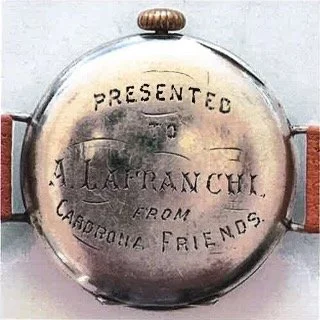
This elegant sterling silver gent's wristwatch has got a jewelled Swiss lever escapement, with a white porcelain dial and radium filled Arabic numerals. The hands are cathedral style, filled with radium for night-time illumination. Inside the back cover are the U.K. sterling silver hallmarks, with the London Assay Office import make, and the year stamp 1916, as well as the casemakers stamp G.S., and watch serial number 636638.
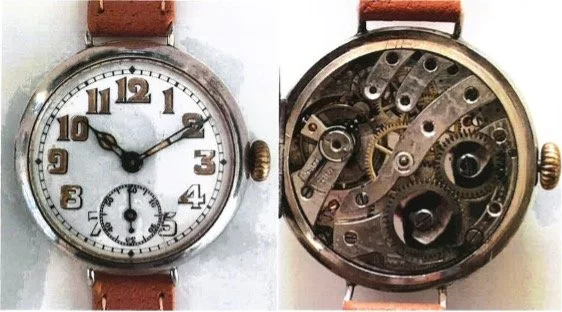
This type of wristwatch is the conventional trench watch that developed for the soldiers fighting in World War l. The precise hand-engraved inscription on the outer case back reads, "PRESENTED TO A. LAFRANCHI FROM CARDRONA FRIENDS."
106 years on, the watch still runs.
So the War went on, and it took just over half a year for Mrs Lafranchi to receive word that her 40 year old son Albert had been wounded in action in France on 23 January 1918. The Cromwell Argus (30 June 1919) records in the "Wanaka Notes" the return of Pvt Albert Lafranchi to his (Cardrona) home. Albert, and his trusty wristwatch, returned on the troopship S.S. Maunganui, and it is recorded in the Wanaka Notes “that Private Albert Lafranchi of Cardrona looking fit and well after his campaign." What a relief for all that one of Cardrona's "favourite" sons returned home.
By 1923 Albert married Margaret Jane Rose, (née Torrie) who also was a Cardrona resident. They then moved to Gore where Albert died in 1958.
Terry lives in Christchurch but regularly visits Wānaka. He is an historian researching the social history of horology in New Zealand. He is particularly passionate about the importance and relevance that military timepieces record and evoke of a soldier's, sailor's, airman's or nurse's wartime experiences and stories. A watch was a companion that was at the serviceman's side through the horrors of the battlefield, the remoteness of the oceans, the vulnerability of the skies or the bloody conditions of a field hospital. This attachment often continued into civilian life and has given much sentimental relevance to an often now long dead relative.
[1] Social at Cardrona, Lake County Press, 7 June 1917, Page 5