
Robert Wilkin
Robert Wilkin was one of the early leaseholders of Runs in the Upper Clutha, his best known being the Wanaka Station (based then at Albert Town). There is a small monument on the berm in front of 2 McLelland Place, Albert Town to his name, claiming he built the first dwelling in the Upper Clutha in 1858, but more about that story shortly.
There have been any number of articles written about Wilkin’s life history and it is unfortunate that a number of them have errors of fact in them. Most relate to his investments in the Upper Clutha. He contributed much to the Province of Canterbury where, in his time, he was a community leader, but that was where he lived – not in the Upper Clutha.
Wilkin was born in Tinwald, Dumfriesshire, Scotland in 1820, into a well-to-do farming family. He was well educated and attended Edinburgh University for a period, studying aspects of farming. This set him up well for his future life.
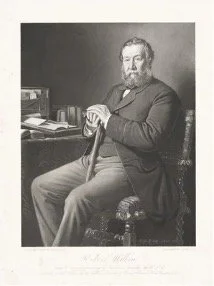
Robert Wilkin – painting by Norman Macbeth
He emigrated to Australia when he was 19 and became a sheep-run manager and eventually a run owner. He was in partnership at times with the Barker family (bankers from Dumfries) and married Agnes Barker in 1850. Her uncle, Archibald McMurdo Thomson, was also one of Wilkin’s partners, both in Australia and in New Zealand.
Robert and Agnes had two children whilst in Australia, John and David Ann (known as Anne). Robert was held in high regard and was appointed as a magistrate at Port Phillip, Melbourne. In 1855 the family took a journey back home to Scotland. Whilst there, another son, James Barker Wilkin, was born in 1856. They then returned to Australia, landing at Sydney in February 1858. Unfortunately, their son James died about a month later.
Maybe it was the past acquaintances they had whilst living in Australia, who had moved to New Zealand already, that encouraged them to move to Canterbury. For whatever the reasons, they sailed on the Dart along with Robert’s brother James, and arrived in Lyttleton on 25 July 1858.
Robert’s first large transaction after he arrived in Christchurch was to purchase a home. This was the 30 acre property known as Avonbank in the Fendalton area.[1] It was here that he and his wife, who incidentally was almost stone-deaf, lived for a number of years. The residence was known as Holmbank.
Robert was clearly of wealthy means and using his connections in Christchurch, purchased other farming properties in his own name and later in partnership with the Rhodes family. When he left Australia to come to New Zealand, he still owned a Run in Australia, yet he still had access to cash to purchase Avonbank and not long after, other properties.
In his diaries he claimed to know the likes of John McLean and his brothers and it was through John that he learned of the opportunities in the Upper Clutha. When exactly this was is open to debate, but research indicates it was unlikely that Robert journeyed to the Upper Clutha in 1858 as some have claimed. In fact, the majority of articles written about Wilkin wrote that he arrived in the Upper Clutha in 1859.
In his own words written in his diaries:
“….we were riding south on the same route as John McLean and learned he had already taken possession of his block and stocked it, had already named it Morven Hills and had installed a shanty on the Lindis River for his first married couple, the Wilsons…‘AT’[2] and I stayed the night with them and pressing on next morning up a great hill now known as Grandview… To the west and south were lakes, rivers, mountains and glaciers: down at our feet innumerable valleys and flats… ‘A.T.’ and I therefore drew a rough map locality plan which seemed to embrace as big a scope of country as Morven Hills and, turning our horses round [sic], recrossed the Lindis Pass and made the best way we could down the Waitaki River to its mouth. Here we struck the Dunedin track and, turning south along it, were in the township of Dunedin itself within 5 days. Our application was only just in time, but when we studied the rough maps of the period and learnt that our lease included country you know as Mount Pisa, the Criffel Range and the flats around Lakes Wānaka and Hāwea, we realised that on this 300,000 block we should be able to run – without fencing, mind – up to 50,000 sheep. We fairly hugged ourselves!…”
There are a few problems with this statement as written by Robert. It certainly was written well after the events described, perhaps in his latter years when he was apparently quite ill:
1. The Wilsons (Richard and Margaret) did not arrive at Morven Hills until mid-December 1858 at the earliest. When the Wilsons left Morven Hills in September 1867, it was reported they had been there for 8 years, which means a start year of 1859.[3]
2. Well before Robert and Archibald viewed all of the land, it had been allocated and leased to other earlier applicants (leases were approved in September 1858) so it was not available. They would have had to put an application in for it by 5 June 1858 and as John McLean discovered, at that time, the Wastelands Board would not lease such a large area to one applicant.
3. Run 239 and Run 240 (to be known later as Wanaka Station) were sold by the first leaseholders in April 1859 and only after that did Robert Wilkin purchase them in turn. For example, Run 239 was not officially transferred to Wilkin until April 1860.[4]
The only logical conclusion can be, that Wilkin did not arrive in the Lindis/Upper Clutha until 1859. He returned to Christchurch and at some stage encouraged his wife to travel to Albert Town in a horse and buggy to erect a whare.[5] Wilkin wrote that he brought his wife to the Run “"…before the sheep” and will have time to superintend the building of a whare.” This could only mean during the period October 1859 to December 1859. It may have been the first residence on the Run though probably not where the current memorial stone sits.[6] The McCallum family (Oswald McCallum was a shepherd) became resident in the whare about 1863, described by Mrs McCallum as “Mr Wilkin’s first temporary residence… near the garden.”
Another factor in all this, is that John Heuchan, the first manager of the Run, did not arrive in Lyttelton until 11 October 1859 having emigrated from Dumfriesshire, Scotland, near where Wilkin was born. A widower, he brought with him his seven children and a nephew, Thomas Anderson (who later built the Queensberry Inn and the Luggate Mill). Wilkin was very likely there to meet Heuchan as the first job was to take a flock of some 5,000 sheep from one of Wilkin’s properties to the Run.[7] Wilkin was certainly in Christchurch in late September as he judged sheep for the Canterbury Pastoral Association, first show.[8]
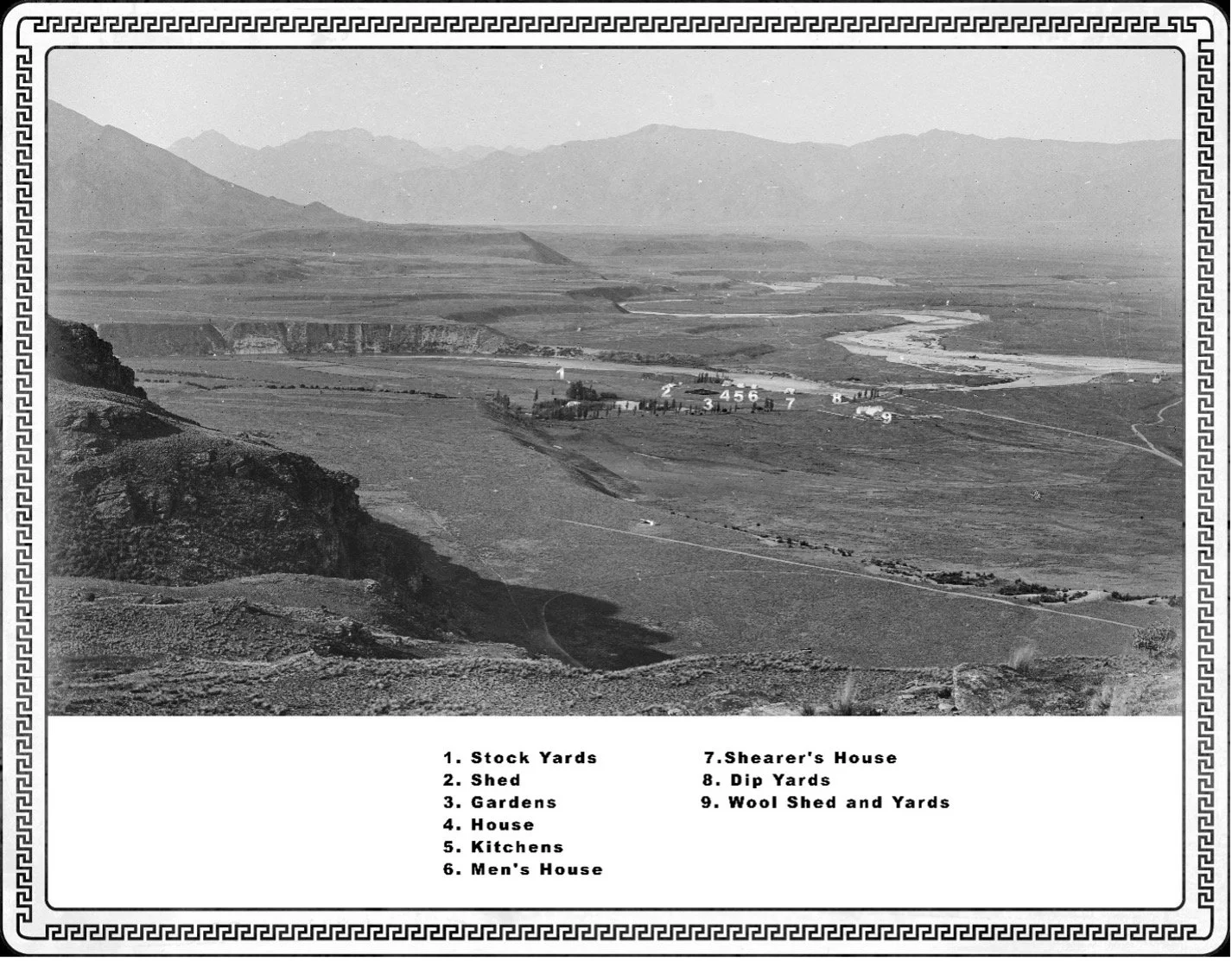
Photo probably taken about 1880s and noted locations are from O’Connell’s survey 1866.
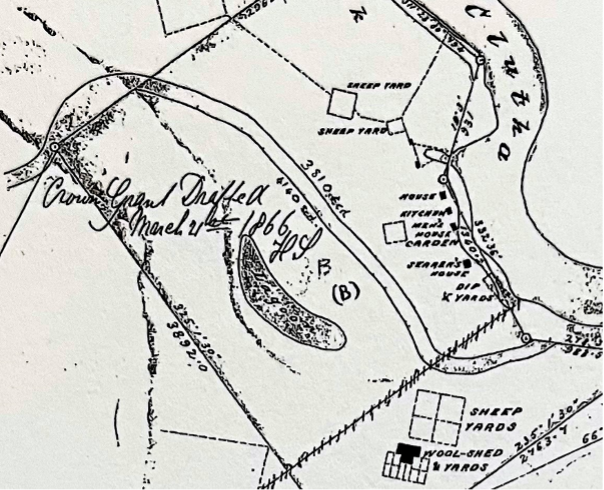
Wanaka Station clipped from O’Connell’s 1863 Map updated in 1866 as part of the sale process to establish the boundaries of the Station area.
It is most probable that Wilkin’s first purchases were Run 240 and Run 239 (both had J T Brown as one of the vendors).
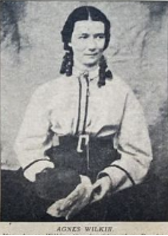
Agnes Wilkin
Wilkin’s last purchase in the Upper Clutha was Run 334 (Roys - Wanaka South) that was contracted earlier on in 1863 and settled on 3 December 1863 for £20,169-7-0 with Wilkin paying £5,042-7-0 cash and the balance plus interest (10% pa), due by a series of five bills (Promissory Notes) payable over the following five years. There were supposed to be 6,600 sheep and lambs, 200 cattle, eight horses and 11 working bullocks. Roy died on 21 February 1864.
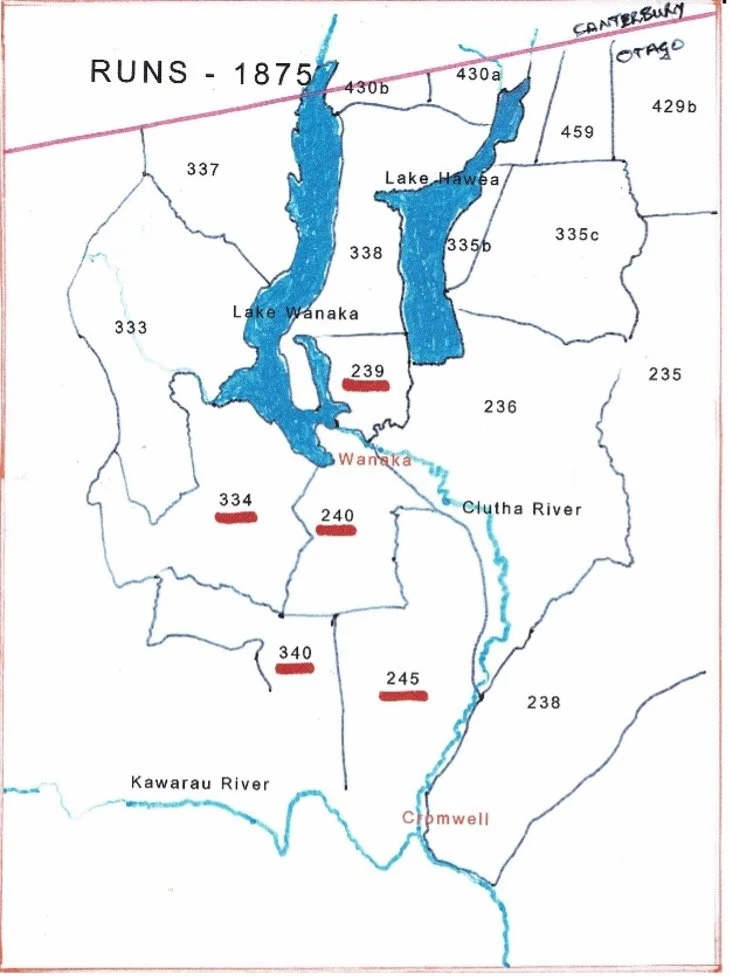
Underlined Run Numbers show the extent of Wilkin’s and Thomson’s Run holdings over the period 1859-1866.
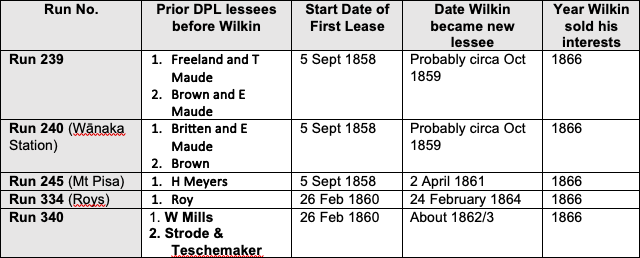
The following is a schedule of the land purchases/transactions:
Notes:
1. After Wilkin purchased Runs 239, 240 and 245, ownership was transferred to the partnership of Wilkin and Thomson
2. Runs 334 and 340 were purchased by the partnership of Wilkin and Thomson
You will note that Wilkin was not the first proprietor of any of these properties and some properties were sold before DPL’s were issued.
By early 1866, Wilkin and Thomson had sold their properties in the Upper Clutha and so ended his association with the area. In Wilkin’s own words relating to 1862, “…. But I am going ahead too fast and giving you the idea that I was closely identified with Wānaka myself. I hadn’t the time.” That statement, and the fact he lived all that time (and later) in Christchurch, indicates he was not what is known as a settler of the Upper Clutha. In fact, he is recorded as only visiting the area maybe once a year for a short period each time.
He was a land speculator, but just like many others of the time. The real settlers were the shepherds, managers and others who looked after the land, built houses and farm buildings, farmed the livestock, started businesses etc. and stayed in the area.
Robert was very much an important part of Christchurch society almost from the time he arrived there. He was the instigator of the Canterbury A&P Show and the first President, a member of the Provincial Council representing Timaru, and held a number of other offices. He had a strong interest in racehorses, breeding, importing thoroughbreds and stud sheep from overseas and was generally held as an expert in the field. He was also the first importer of hedgehogs (8 of them)!
Wilkin died in 1886 in somewhat embarrassing financial circumstances. Relatives of his wife had agreed to purchase a property for £50,000 and whilst they were overseas pending settlement, they had asked Robert to look after the funds. He deposited the funds in his own name on the Bank of New Zealand who on his death, seized the funds to offset his considerable debts to the bank.
[1] Wilkin of Fendalton, New Zealand Freelance , 5 August 1953, page 34.
[2] Archibald Thomson – his wife’s uncle. Note that some reports stated that it was William Thompson (Thomson), the Auditor for the Canterbury Provincial Council, who was Wilkin’s partner. This is incorrect as evidenced by land transaction records.
[3] The Oamaru Times and Waitaki Reporter, North Otago Times, 8 October 1867, page 2.
[4] On the reverse of the original Run 239 Deferred Payment Licence is written that it was “Trans to J T Brown and T W Maude; 15 May 1860 to Robert Wilkin; 6 June 1861 to Thomson and Wilkin.
[5] Wilkin of Fendalton, New Zealand Freelance, 5 August 1953, page 34. They had to swap to horses alone on reaching the Waitaki River.
[6] The location of the “gardens” is drawn on J A Connell’s Crown Grant Map drafted 31 March 1866 and is much closer to the Clutha River than the Memorial Stone.
[7] They Came From Dumfries in 1859,Thomas Maginness, Self Published 2014, page 88.
[8] Canterbury Pastoral Association First Show of Sheep, Lyttleton Times, 24 September 1859, Page 4.