
Tom Anderson
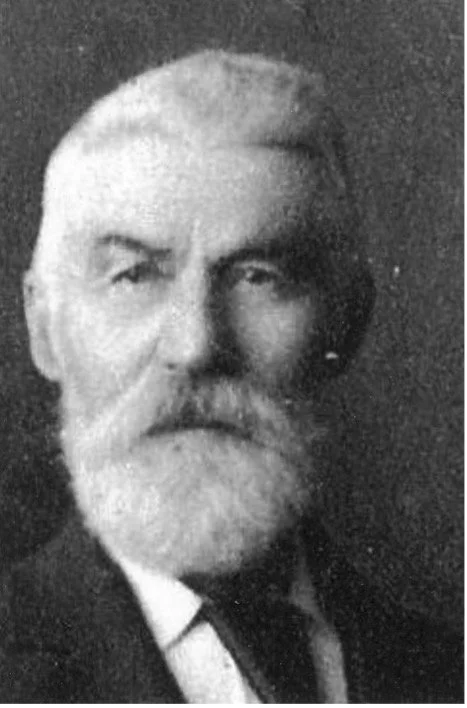
Thomas (known as Tom) was born in 1844 at Downs Bank near Dumfries, Scotland. He was the eldest son of Robert and Isabella Anderson (nèe Heuchan). He was 16 when he left Scotland with his uncle, John Heuchan (a widower) and John’s seven children. Little would he have realised where he was going, nor what he would find in his new homeland.
It was 1859 when Tom boarded the Cashmere bound for New Zealand.
Robert Wilkin, like John McLean of Morven Hills, had sought farm hands/managers to man his large sheep run. One of those men was John Heuchan, who was to be employed as manager by Robert Wilkin. Wilkin apparently favoured workers from Dumfriesshire when he himself came from (Tinwald).
Tom and the Heuchan family landed at Lyttleton on 11 October 1859. No doubt Tom lived with his uncle and family until the Heuchan’s left in 1863 to move to Pleasant Point in South Canterbury. It is not known if Tom went to Pleasant Point with them. Maybe he stayed on with Wilkin or tried his luck in the goldfields on the other side of the Clutha from where Queensberry now is. Whatever occurred, George M Hassing wrote that Tom was a capable teamster before he built the Queensberry Inn.[1] Descendants also have commented that they think he may have made some capital from gold mining at Poison Creek.
He did have access to capital as he went on to build an accommodation inn at what is now known as Kidds Gully, on the side of what was then a basic track from Cromwell to Albert Town. This was roughly halfway between Cromwell and Albert Town and an ideal place to offer accommodation house for travellers taking the two-day (and sometimes longer) journey. Tom built the house (as inns were called in that period) from earthen/clay sods and presumably an iron roof. He is said to have started building it about 1864 and named it the Way-Side Inn. No references have been discovered relating to Tom having any consent to use the land on which he built the house (inn), nor any consents to run it as a publican and/or accommodation house. It is presumed that he had consent from Robert Wilkin to build on the site, which would be in Robert’s interest, as getting his wool etc. to Cromwell was at least a two-day journey and there were no other accommodation houses available.
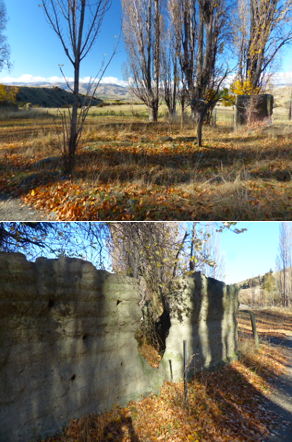
An 1870 survey reportedly indicated that there were at least three structures where the Way-Side Inn was built – a shed, stable and a house alongside a large garden.[2] To date, no information has been discovered as to what happened to the Way-Side Inn after that. It might appear from the survey mentioned, that the house was occupied for a period after Tom had moved on to his new business. The ruins can still be seen. It is unlikely that he sold the Way-Side Inn as a business as it would be in direct competition to his new inn he was to build, just along the road.
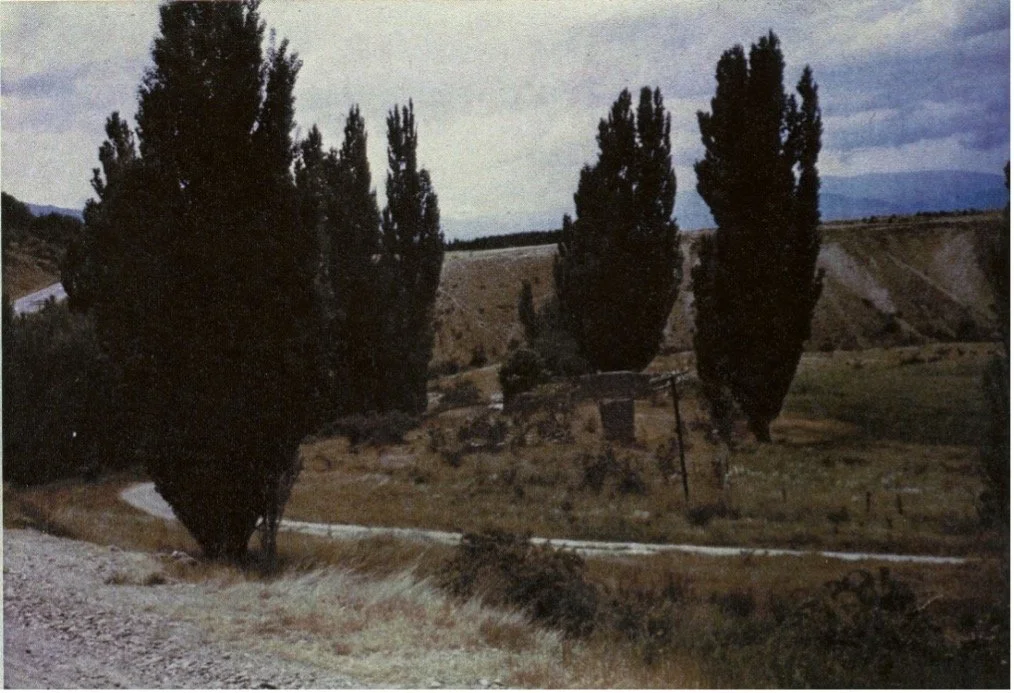
Way-Side Inn remains literally in Kidds Gully on Wānaka-Cromwell Road. The road between the Poplars is the original Wānaka-Cromwell Road before it was re-aligned.
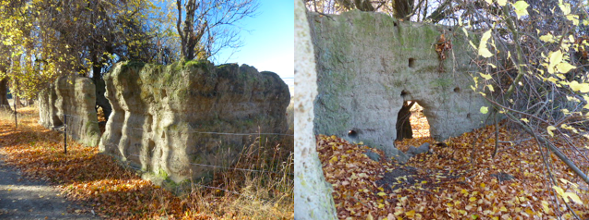
Other Views of the Wayside Inn remains - 2022
Just past Nineteen Mile Creek (now hard to find), Tom built a new house that he named ‘Queensberry Inn’. He had obtained a title to one acre of land and the house opened for business about 1867. No references can be found recording that Tom obtained the necessary licences to run this Inn either. That is not to say he did not obtain them, just that they cannot be found, if they existed. When finished, Tom’s one acre site boasted the Inn, Stables, Outbuildings, Store and much later, a Post Office. It was in effect a “halfway house” between Cromwell and Albert Town and the property became the overnight stop-over point for supply wagons, Cobb & Co, Craig’s and Kidd’s coaches, wagons carrying produce (e.g. wool), to Cromwell and Clyde.
Tom’s brother, John, left Scotland and arrived at Queensberry, but it is not known exactly when. The Anderson family descendants suggest it was between late 1860s and early 1870s.
He obtained Section 28 just north of the Queensberry Inn which became known as “The Gums”. He married Elizabeth Connor at Cromwell on 27 August 1877, and they went on to have seven children.
About the time Tom had set out to build the Way-Side Inn, a young lady, born in 1844 in Embasy, Yorkshire, England, was planning to sail to New Zealand. Jane Metcalf worked in a cotton mill in Burnley, Lancashire, the biggest cotton producing town in the UK, but the American Civil War had caused a shortage of cotton. This put many cotton mill workers out of work, but the New Zealand Government offered free passage to New Zealand. Jane Metcalf sailed with her godmother from London on the Victory, a 579-ton barque sailing on 28 June 1863, and arriving 119 days later in Lyttleton, New Zealand on Tuesday 20 October 1863. On board were 240 immigrants from the depressed county of Lancashire. Jane then travelled with her godmother to Albert Town where she commenced work for Henry Norman in the Albert Town Hotel.
It took a while, but almost nine years later, on 29 June 1872, Jane married Tom at his Queensberry Inn home where they lived until 1881. Two children were born before they formally “tied the knot.”
Tom had also acquired Section 2 of 320 acres across the road from the Inn, which he proceeded to farm and stand horses from. It is believed he was using this land well prior to the area being surveyed as it was not put up for application in May 1880, but Sections 3 through to 8 were.[3] We know this from advertisements in local newspapers as early as 1874 for horse agistments, and that in 1877 he applied for and permission for a water-race running from “19 Mile Creek to his farm.”
When the Government announced the release of land sections that included Section 3 down to Block 8 at Kidds Creek, applications were invited for individual Sections under a Deferred Payments Licence on 6 May 1880. As previously mentioned, Tom already held Section 2 under a DPL, but shortly after, in August 1880, he applied for this land to be converted to an Agricultural Lease which was approved. This probably increased the value of the land and would have also got around the limitation of owning a maximum of 320 acres of land under DPL, as he had other plans afoot. This could have been in preparedness to sell the Inn and the farm property as Tom and an associate, Peter McIntosh, shortly afterwards began the planning and construction of the Luggate Flour Mill which was opened in 1882.
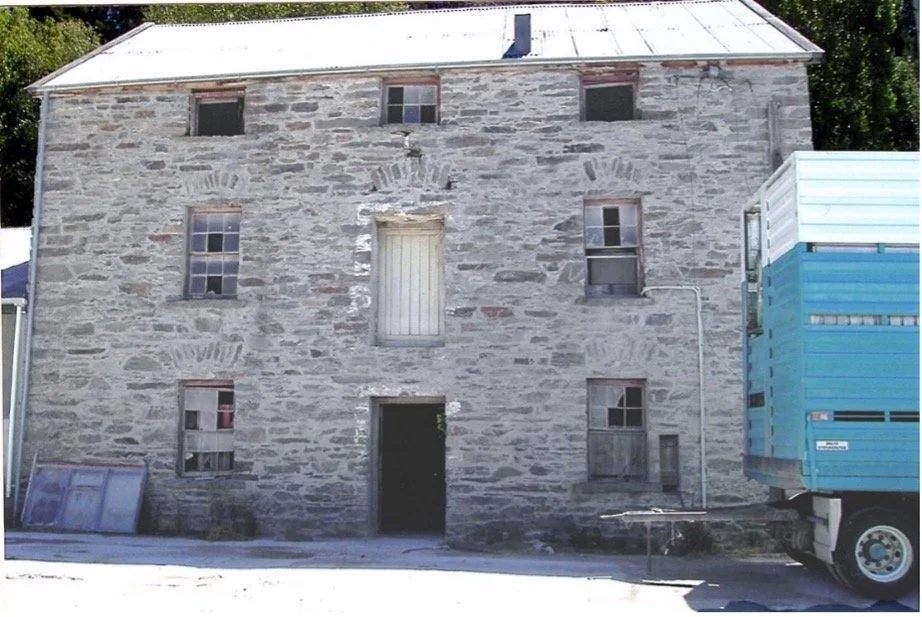
Luggate Flour Mill opened in 1882 by Tom Anderson and Peter McIntosh.
Tom did not always “cover himself in glory”. A man named John Taylor was found by the Coroner’s Court to have committed suicide on Tom’s property where he was a guest. Tom’s behaviour in the matter caused the Coroner to issue a stern public warning and said he had a “lack of humanity.”
The Inn and the farm property were transferred to Henry Tobin in 1881.
Thomas and Jane then moved to their Luggate Farm where he became a very well-respected and successful farmer. They had an area of 1013 acres. In 1903 the Mill was sold to a consortium of farmers.
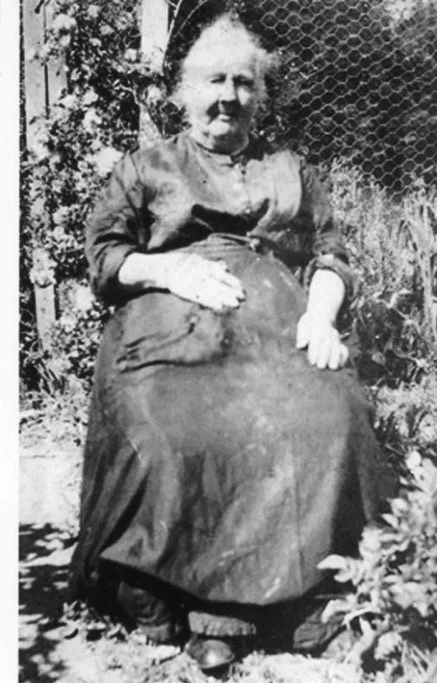
Jane Anderson in her later years
The Otago Witness reported on 2 March 1903 that Tom bought the Dunrobin Homestead farm of 800 acres near Mossburn. His health deteriorated and he and the family moved to Wyllies Crossing (near Mosgiel).
Tom passed away in 1917 in Dunedin, and Jane in 1923.[4] For a 16-year-old when he arrived from Scotland, he achieved a lot and was an important contributor to the history of the district.
[1] Early Wānaka: Worker Pioneers (The Memory Log of G M Hassing) page 55
[2] Source: Rosina Adair’s photo book “Our Family Story”, 2013.
[3] Survey by J Campbell of Part of Block IX, Tarras District, dated May 1879.
[4] Information, in part, has been resourced from “They came from Dumfries in 1859”, Thomas Maginness, 2013.