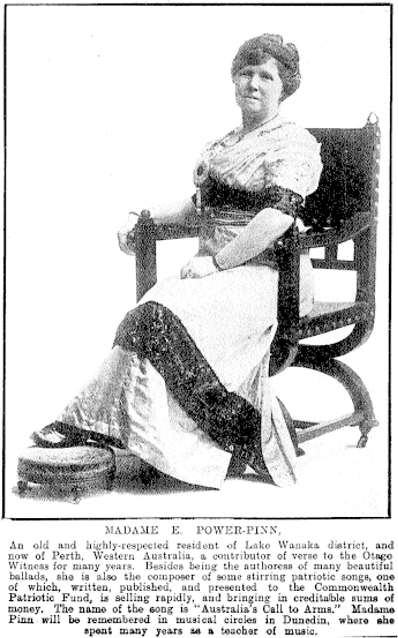
Alfred Pinn & Elizabeth Power
The Professoress of Music and the Shipwright
It may be a surprise to some, but Wānaka had its own resident who, away back in the early days, was to become a professional opera singer, teacher of music etc. and composer. But let us start off with the story of her husband to be.
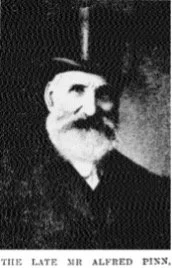
Alfred Herman Pinn (nicknamed ‘Black Tom’) was born 5 September 1838 in Sidbury, Devonshire, to Alfred Richard Pinn and his wife Sarah nèe Hood (or Wood). Records suggest he had two siblings, Mary Ann and Edwin. Some local historians have suggested that he had a brother, Thomas Pinn who lived in Pembroke, however research (undertaken by Ken Allen of UCHS) failed to discover such a person in the records in England and here in New Zealand. It is thought probable that the error has come about through the use of the nickname “Black Tom” given to Alfred.
According to Alfred’s Obituary in the Perth Sunday Times, Alfred served a shipbuilding apprenticeship at the Plymouth Dockyards before he came to the Victorian Goldfields in Australia, and thence to New Zealand. It mentions that he came on the French barque – St Jane – in 1862.
He has been described as a “miner-cum-sawyer” like many others of the time who arrived in the Upper Clutha. We do know that the infamous Henry Hill employed him building boats to move timber down the Clutha River. This had to be before 1865, as that is the year Henry departed for South America in a hurry and never to be seen again, and with 75% of the payments due on a telegraph-pole contract in his back pocket. Unfortunately, Henry left without paying his sub-contractors, who included George Hassing. George chased after him to Dunedin, but Henry had too much of a head-start and had already disappeared.
Alfred established a cottage on Pigeon Island (now Mou Waho) about 1863 and gained a reputation as a boat builder. He also ran some 200 Merino sheep on the island. In 1868 he laid the keel for a schooner to be named the Eureka and contracted the man of many skills, George Hassing, to help him on that project. The Eureka was followed by the Nun. Alfred laid the keel for the Nun about July 1873 and the vessel was launched on 2 February 1874. The story in the newspaper, was that it was named the Nun to commemorate a visit by the Lady Superior of a Dunedin Convent a few days earlier.
During Alfred’s time at Lake Wānaka he built the Isabella and a number of other small craft.
Alfred also traded with the Nun on the lake until 1877 when he sold his interest to Messrs Miller and Barrett (known as “The Boys”).
But before that event, Alfred met and married Elizabeth Magdela Power on 3 March 1875 at the home of Theodore and Celia Russell, owners of the Wanaka Hotel. Elizabeth was the daughter of John and Julia Power (nèe Shehan) and was born on 12 March 1857 at Ballygunner, which is just on the outskirts of Waterford, Ireland. It is not known when she came to New Zealand.
Alfred and Elizabeth established a home at Albert Town, and they had four children:
· Alfred Richard born 1877 (Like his father he may also have been known as Tom)
· David born 1880
· Herman Stephen born 1881
· Sarah Julia born 1884
· Pauline Letitia Theresa born 1886
Unfortunately, their son David drowned on New Years Day 1885. He had slipped into the Clutha River just below Campbell and Mclean’s Punt (the Upper Punt at Albert Town). Alfred searched for him down the river as far as the Lower Punt and on retracing his steps, found David’s body in about four or five feet of water opposite the Albert Hotel. A sad start to the year.
Returning to Alfred’s work. He had indicated after he sold the Nun that he intended to leave the district, but was still around when disaster struck the Nun about the end of November 1877. It had not long been in the possession of the new owners when it sank at anchor just off Pigeon Island due to a high wind blowing water over the gunwales. It appeared to be a total loss which was of great concern as it was carrying a Mr Henderson’s new steam engine for his sawmill. However, Mr Henderson arrived at the scene a few days later and discovered that his engine lay on the deck in just 15 – 18 feet of water. He acquired a diving suit and an air pump and Alfred donned the suit to explore the wreck after which he reported it as being in sound condition. The Nun was duly raised using empty casks and then taken to Pembroke. Mr Henderson was much relieved – as were the owners of the Nun! Repairs were affected to the Nun, but it was felt the name was now inappropriate, so it was re-launched as the Saucy Kate.
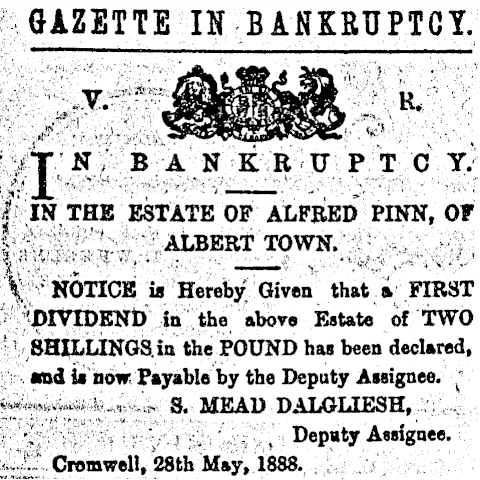
It seems that Alfred and his family did not leave the district as previously announced by Alfred. They had moved to a house near the outlet of Lake Hāwea, which unfortunately burnt down in 1882. He had taken up gold mining and was still working at that occupation in 1887 when his children were enrolled at Albert Town School. His address was then given as “Criffel.” The school records then indicate that in 1888/9 the family moved to Dunedin. This move was probably triggered by Alfred’s bankruptcy petitioned for, by himself, on 15 September 1887.
He had fallen on hard times and the following notice suggests that his net assets had been minimal:
The Stones Directory 1888-93 lists him as a ships carpenter living at Maori Hill, Dunedin, but by 1895 he was living in a less salubrious part of town in South Dunedin. Elizabeth must have entered the employment field as in 1896 she is listed as a “Teacher of Music.” Until this point there have been no official records discovered of her talent in the musical world, but the later newspapers have recorded positive comments about her skills. But then the Pinn’s moved to Albany in Western Australia and this rather grand advertisement appeared in the Albany Advertiser on 10 December 1898:
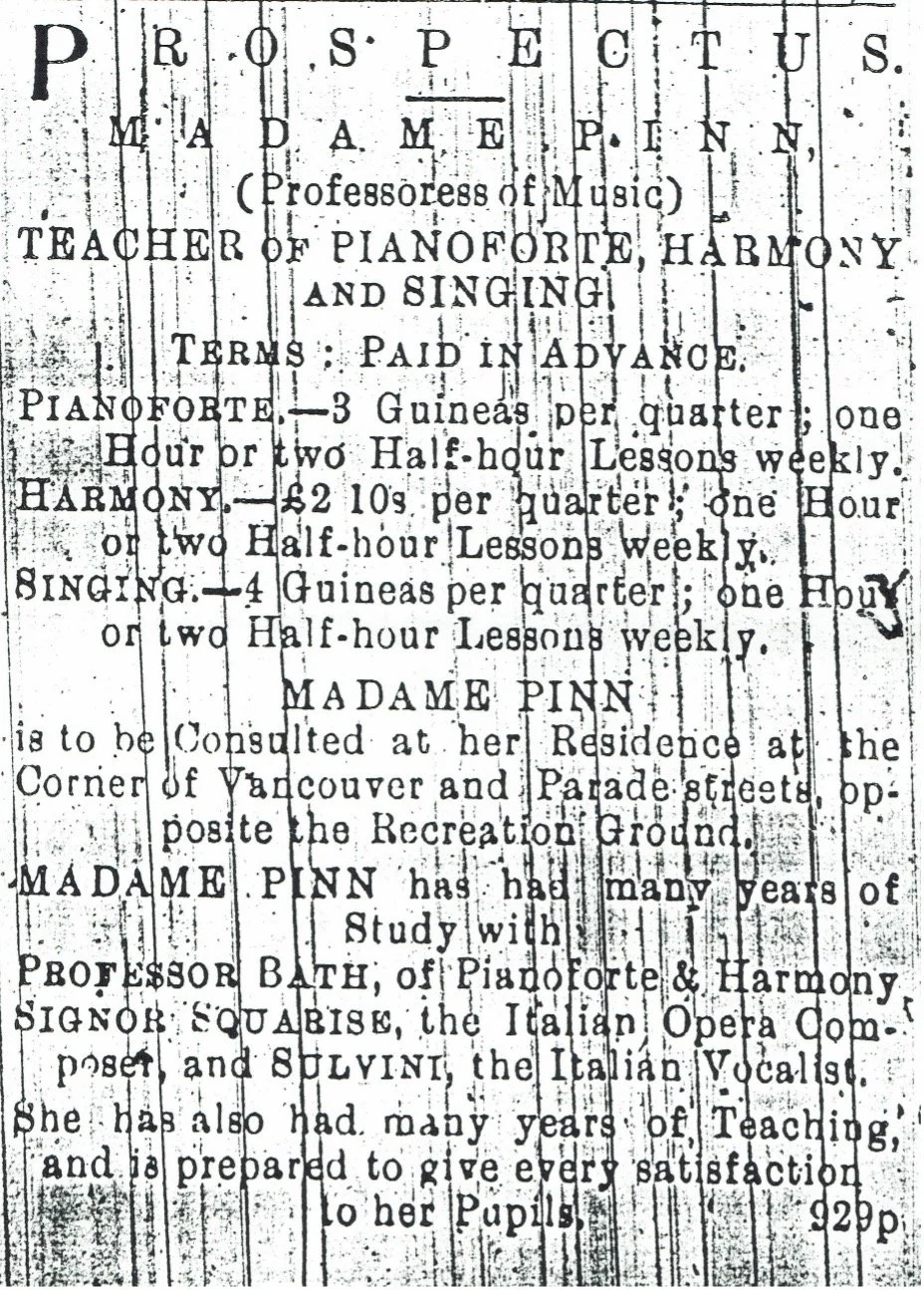
Sulvini, “the Italian Vocalist” certainly existed in England, but it was an Arthur Salvini who sang and taught in Dunedin. A bit of “artistic licence” perhaps? It was not his New Zealand birthname according to the Otago Daily Times. Raffaello Squarise was certainly in Dunedin from 1889 onwards and taught music. Becoming a music teacher in the 1890s was a growth industry!
Elizabeth became a composer of some skill and wrote a number of patriotic songs during World War One which were published in New Zealand. Her praises were sung in both the Otago Daily Times and the Otago Witness newspapers.
Her eldest son, Alfred, became a proficient violinist as well.
Alfred and Elizabeth moved from Albany to Drummond in Victoria where Alfred died sometime between 18 and 29 May 1923, aged 94. Elizabeth moved again, this time to Broken Hill, New South Wales, where she passed away on 19 November 1947, aged 90.
It is probable that there is more to be told of this couple’s history, and we welcome any additional information you may have – including a better photo of Alfred and/or Elizabeth.