
Henry Maidman & Fanny Cole
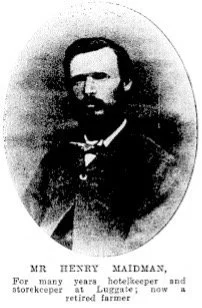
Henry was born on 21 November 1831 at Bermondsey, London, England. His birthname was Alexander but as we shall learn a little later, he became known as Henry (and sometimes Harry). To make it simple, we will call him Henry for the purpose of this story.
A lot of what follows was told by Eva Harris to her granddaughter, Robyn Radke-Cooper and backed up with subsequent research. Eva was Henry’s granddaughter.
Henry’s parents were Charles John Thomas Maidman and Frances Habens and they christened their new child, Alexander, at St Mary Magdelen Church in Bermondsey on 6 November 1831.
Bermondsey is in the borough of Southark on the south side of the Thames River and about 4km from Charing Cross. In 1841 the family was living in Chatham Place Road which is on the northeast of London in Hackney, and the father’s occupation was given as a carpenter. Apparently, Henry was also to become a carpenter, but by the 1851 Census he was no longer to be found in any records. Eva stated that he had joined the Merchant Navy as a seaman in the late 1840s (and though he cannot be found on the registers, that is not to say he was not a sailor). Eventually he sailed from England bound for Australia and after sailing around various ports he arrived in Lyttleton, New Zealand about 1860.
As was common within the Merchant Navy of that era, many seamen "jumped" ship at various Ports due to the extremely poor wages and harsh working conditions. When seamen jumped ship, they would often change or alter their names to avoid detection by the local authorities. Alexander dropped his first name and became known as Henry Maidman. He was not the only Upper Clutha settler to jump ship in New Zealand and change his name!
Henry did undertake a voyage back to Australia on 19 October 1860 on the Mountain Maid from Lyttleton and then returned to Port Chalmers on the Barnett from Sydney on 26 November 1861. It is not known what the purpose of the voyage was.
Henry was one of the head drivers to lead bullock teams through the Lindis Pass to the Upper Clutha in the early 1860s. Most of these bullock teams would have come from Oamaru and Timaru, and Henry’s presence in these towns in the early 1860s is borne out by his name appearing in Unclaimed Letters lists published in newspapers.
He met Frances Maria Cole, known as Fanny, at Cardrona and married on 16 October 1864. This is claimed to be the first marriage of European settlers in the Upper Clutha. His marriage certificate lists his name as Henry Alexander Maidman, but from 1870-onwards, the New Zealand Electoral Roll records his name solely as ‘Henry Maidman’.
Henry and Fanny left Cardrona and appear to have moved directly to Luggate, which was perhaps a more central hub for bullock teams etc. Whilst there, and using his carpentry skills, he built the first hotel and store at Luggate which was opened in 1869. Henry advertised the hotel on 1 December 1869 under the name “Luggate Creek Hotel” but four weeks later, was calling it the “Albion Hotel and Store”, a name that remained for quite some decades thereafter under different licencees.
Some early historians have suggested that the current hotel building at Luggate was the one built by Henry, but this is incorrect. Henry sold the original hotel and store to Tom Trevathan in November 1881 and in April 1884 Tom advertised for tenders for “the building of a Stone Building for a Hotel at Luggate Creek”. On 26 August 1884 and 9 September, he advertised an “Application for a Removal of Publican’s Licence”. See the copy of the advertisement below. Note the words, “the Removal of the licence for the aforesaid house and premises to a house situate at Luggate about 20 yards distant from old house.” The “old house” he refers to was Henry Maidman’s hotel and store.
To add to the evidence, on 12 August 1884, he advertised an invitation for one and all to an “EVENING PARTY on FRIDAY EVENING, August 22 1884 to Celebrate the Opening of his new Building”.
So what happened to Henry’s hotel and store building? Well, it became the Luggate School House for a while. An article in the Cromwell Argus of 23 June 1885 describes the local School Committee having “…been put to considerable expense in lining, flooring, and fitting up a School House (Mr Trevathan’s old hotel) ….” The above is clear evidence that today’s “Luggate Hotel” was not built by Henry Maidman and is in actual fact, the second hotel built and operated in Luggate. Notwithstanding, it must be said that Henry and Fanny had considerable foresight in establishing their hotel and other business activities at Luggate.
During Henry and Fanny’s time at the Albion Hotel, Henry undertook a voyage back to England (date unknown but likely about 1872/3). This was presumably to meet up with his siblings as his parents passed away in 1869. On 2 October 1873 he departed London and arrived in Port Chalmers on 2 January 1874. In between times, a John Mace had sued Henry for £50 for breach of contract on the part of Fanny. This related to the purchase of oats which suggests that Henry did not restrict himself just to hotel business. The Judge ruled in Henry and Fanny’s favour because there was no evidence of the original contract existing and in any case, the contract was conditional on an event taking place which did not occur.
The other big event during Henry and Fanny’s sojourn at Luggate was the marriage of their adopted daughter, Sarah Ann to Fred Collings on 27 April 1881. Sarah was born to James Chin Chee and his wife, but when his wife died, Sarah was placed with Henry and Fanny. After a lot of to-ing and fro-ing, Sarah’s adoption was documented (adoptions as we know them today did not occur back then). Sarah had a sister called Letitia who was placed with another family, but after a dispute she joined her sister Sarah with the Maidman’s. Letitia married James Davis on 2 June 1884. These two sisters are progenitors of the Collings and Davis families here in the Upper Clutha and now spread around New Zealand. Fifteen children were born to Sarah and fourteen to Letitia.
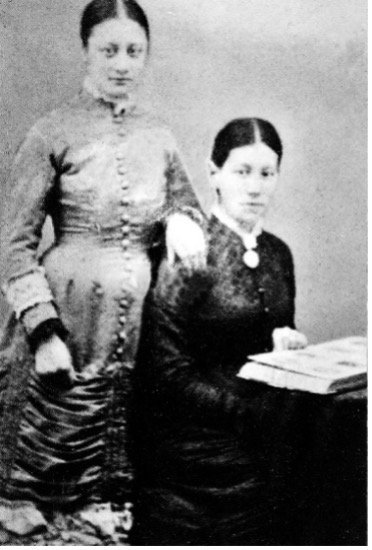
Letitia and Sarah
In 1878 Henry applied for and got leases to Block 1 Sections 31 and 32 (Cromwell Argus 10 Sept 1878), and probably also Block 1 Sections 17, 18 and 19 at Mount Barker at the same time. They were subject to what were named Suburban Deferred Payment licences (a form of lease with a right to buy, in simple terms). Suburban allotments could not exceed 20 acres and were supposed to be for no more than 5 years. Henry renewed the leases for another 10 years in 1885. Henry may have subsequently purchased the land as freehold sometime after 1885. He built a two-bedroom house on Ballantyne Road (Sect 17-19) and when it was renovated in relatively recent times, it was discovered that the foundations were made from stones carted from the Cardrona River.
Henry was a man of many occupations. As mentioned previously, he was trading with oats but not always successfully. In 1877, whilst driving a two-horse dray laden with oats across the flooded Cardrona River, he lost the lot when the dray was swamped. He also successfully operated a pig-drum threshing machine for oat crops back in 1882.
Whilst being an astute businessman, he was once taken in by a fraudulent lottery which he apparently won first prize – the vessel Eureka, but the organiser (reportedly a Catholic priest from Taranaki), left for Australia just before the raffle was drawn. This was in the 1890s.
Eva Harris’ clear recollections of her great grandfather was of a very gentle quietly spoken old man, and Fanny was an elderly lady who had a disability in later life and unable to walk. Eva clearly remembered Fanny being pulled around the farm in a wooden cart and she passed away in Dunedin on 16 April 1917. Henry never spoke of his early childhood or family life in England over 70 years earlier. He passed away on his farm on 13 December 1919.
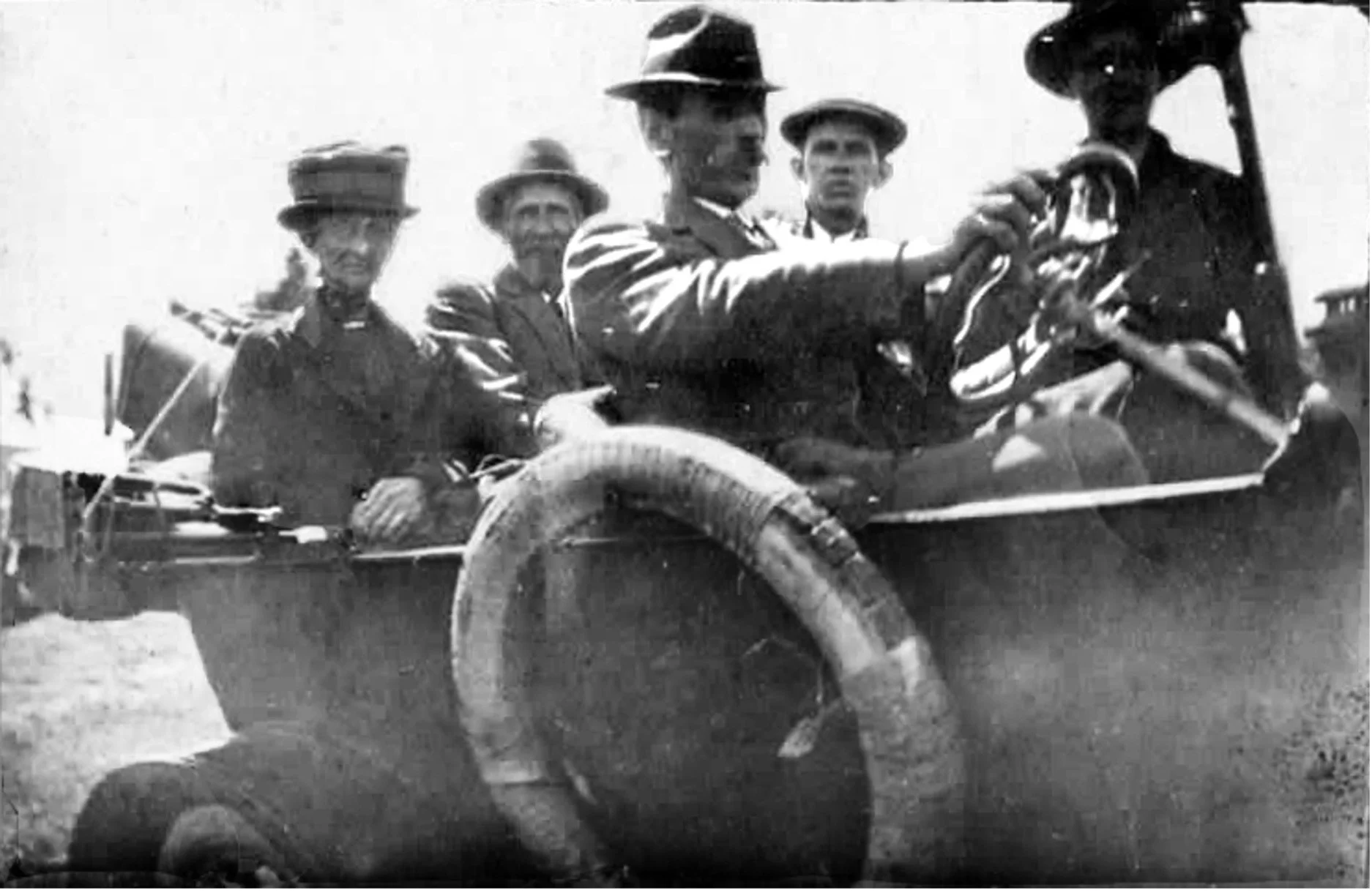
We think that the following photo is the last one taken of Fanny. It was only In November that the two people in the back seat of the car were recognised as being Henry and Fanny. It is believed that it was taken in 1917 when their son-in-law, Fred Collings, drove them to Dunedin so that Fanny could be treated for her cancer. The young man in the photo is believed to be Henry and Fanny’s grandson, Arthur Gladstone Collings, and the back-lit soldier is most likely to be another grandson - Cecil or Herbert. Until recently, the photo had been recorded as “Fred Collings in his car”!
It transpires that Henry did have other relatives here in New Zealand. His sister Elizabeth, with her husband Francis Connor, emigrated in September 1875 to Dunedin with their two daughters, Louisa and Elizabeth. Was that the result of Henry’s trip back to England in 1873?
So, when you next sojourn down to the Luggate Pub for lunch, just remember the building was not Henry and Fanny’s, but the walls have listened to many stories over the years.
References:
https://www.wikitreee/wiki/Maidman-38
Lake County Press 19 Sep 1873 Magistrates Court
Otago Witness 3 May 1905 Chin Chee’s Little Game
Dunstan Times 13 Jan 1871 Resident Magistrates Court, Clyde
Cromwell Argus 29 Apr 1884 Advertisements 2nd Column – Trevathan Tender
Cromwell Argus 12 Aug 1884Page 2 Advertisements - Trevathan invite to opening of new Luggate Hotel
Cromwell Argus 26 Aug 1884 Page 3 Advertisments – Application to move licence from old Luggate Hotel to the new one
Cromwell Argus 23 Jun 1885 Luggate School Entertainment
Cromwell Argus 7 Jul 1885 Page 2 Advertisements – Notice to renew lease
Otago Witness 7 Sep 1872 Shipping – Arrivals at Port Chalmers
Otago Witness 10 Jan 1874 Shipping page 14 Port Chalmers Arrivals
Otago Witness 3 Apr 1890 Lake Wanaka
Cromwell Argus 1 Dec 1869 Page 2 naming of new hotel
Cromwell Argus 29 Dec 1869 Business Directory = hotel name changed
Cromwell Argus 30 Nov 1886 Lake Wanaka – Luggate school.
Addendum: Subsequent to writing the above, information came forward that Henry built a home somewhere opposite the Wānaka Airport after leaving the Hotel. Then he built the Ballantyne Road home.