
The McCallum Family
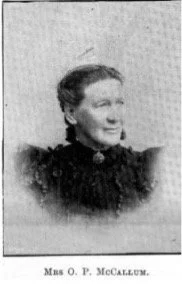
Jane was born on 13 February 1843 to Robert Watson and Jane Swan in the parish of Kirkmichael, which is about 8 miles north of Dumfries in Scotland. The family lived at Shawfoot Cottages.[1] She married Oswald Pagan McCallum (1839-1902) at Kirkmichael on 4 January 1861, aged just 17, in the full knowledge that shortly thereafter, she and Oswald were to emigrate to New Zealand – specifically Wānaka. Whilst waiting to emigrate, they lived with Jane’s parents and siblings.
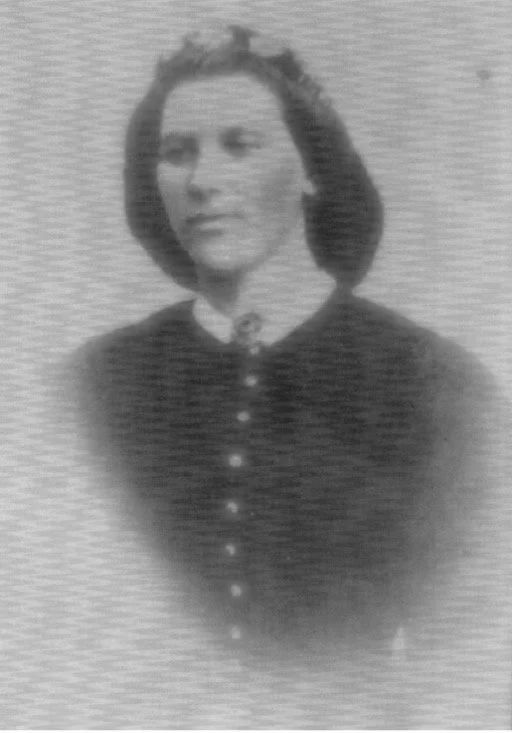
Jane McCallum (Snr). Photo possibly taken about 1880s
Photo provided by Gaylene Morrison, a Great Granddaughter of Oswald and Jane
From here on, it is best to let Jane tell her own story covering the period 1861 to 1875. In 1922, the year before she passed away, Jane wrote a letter to George Hassing who then passed it on to Richard Norman. Richard arranged to have it printed in the Otago Witness on 2 January 1923 as part of one of his contributions to the newspaper and it was discovered, by accident, by the Editor when researching another person mentioned in the letter. Some of Jane’s facts are not quite right, but footnotes have been appended with the correct information.
“I was married in the first week of January, 1860[2], in Dumfries, I being in my 17th year at the time. My husband, Oswald Pagan McCallum knew then we were going to New Zealand, and on to Wanaka.[3] When we landed from the Stormbird[4] the diggings had broken out; Tuapeka first. We went down from Christchurch in the PS Geelong to Oamaru,[5] on our way to Wanaka, but we had to stay in Oamaru owing to winter and snow for three months (with Mr Hassall at Cave Valley[6]), until Yorkey[7] came down with the bullock team from Wanaka to take back stores for the shearing.[8] The two brothers Merrilees came up with us, also one Docherty, also one named Joseph B. Ewing, aged about 15 years. I thought him a smart boy; he had sawmills afterwards. So there was 10 of us. Mr Robert Wilkin, Wanaka station owner, sent with Thos. Anderson, afterwards the flourmill owner at Luggate, down from Christchurch, a horse and side saddle for me to ride to Wanaka station – it was a 150 mile journey – and so we were a very happy company going to the land of our adoption. I well remember when we got to the Upper Clutha River.[9] Mr John Heuchan[10], also from Dumfries, the first station manager, and some other men came to take us across the river, and I was very much afraid. There was no Albert Town at this time. Then, when we got to the station, I had to stand a lot of remarks when Mr H. S. Thomson and his cousin Mr McAlister, came from West Wanaka station for their mail. They all had come to hear me speak, as I was young and very Scotch. Mr Candy, of East Wanaka station (father and uncle of the Canterbury Candys) called to see me, also Henry and Mr Norman from Roy’s Bay.[11] He said he did not know a word I said.[12] When the shearing was over we were sent to a sod hut up the Cardrona Valley until Jimmie the Mason Dewar built the stone thatched hut for us in the Cardrona Valley, the walls of which now only remain. We were flooded out of this in the middle of the night in ’62, and had to ride across the flooded stream and take shelter in a digger’s tent. I had a baby then.[13] One day I was standing outside the house when a man came, and after talking to me awhile, he took a pound note out of his pocket and gave it to my little girl, and said he always liked children. I felt rather afraid and distressed, as I did not know him. I afterwards found out that was the first time I had seen Henry Maidman, who, with his wife, threw in his lot with Wanaka until they died.[14] Then we went to live at Roy’s Bay. There was no Pembroke then[15] but two thatched cottages built by Mr Norman.[16] Mrs Broughton lived there. Her husband was formerly a lieutenant in the Royal Navy, and she was formerly a governess. We always spent the evenings in my house, as our husbands were always out in the hills nine months of the year, keeping the sheep from straying. One night we found my house was on fire. We took out my two children and tried to save something.[17] When the house was burnt down I went away out into the darkness and found my horse, and then rode over to the homestead to tell them what had happened. It was twelve o’clock then. Six months after that, Mrs Broughton’s house was burnt down and they lost everything. When I lived in the Cardrona Valley they gave me a loaded revolver and told me to use it if needful, but no one interfered with me. When we left the lake we went to the Wanaka homestead and lived in Mr Wilkin’s first temporary residence, a thatched wooden whare near the garden.[18] When I was living there, the men I knew used to bring their gold for me to keep, as they were afraid to keep it themselves, and I never let on. Sometimes I had as much as £300 worth. They told me to just put it in the big box I brought from bonnie Scotland.[19] There was just one compartment. Anyone could have come down the sod chimney quite easily. Sometimes I tied up a kangaroo dog[20] at the door. Everyone was kind to me. I like to look back on the early days when we travelled up first. We stayed a few days for a rest at the Lindis. A digger named McDonald gave me a nugget. When I lived at the whare, Docherty and Merrilees came to me one Saturday and asked me to bake them a batch of bread. I got it ready for them on the Sunday afternoon. I have never baked on a Sunday since. They went away in haste to look for Hartley and Reilly’s claim down the Clutha River. One time it blew a gale for two days, and I was very much afraid the whare would blow down. In the evening A. E. Farquhar (late Stirling) called, and recognising the situation, persuaded me to go to Albert Town to Mr Norman’s[21], and he would help me with the two children. I stayed here till my husband came home. The whare fell down eventually. I had three trials – flooded out, burnt out, and last blown out. Then we shifted to one of the three stone houses with iron roofs. These have since been pulled down: the whole homestead, in fact, abandoned. For two seasons, Mrs Norman and I went to Wanaka West, per whaleboat, to make Mr Thomson’s jam. Once we had a head wind, and had to land and camp until the weather moderated. After being at Wanaka fourteen years, we left for Temuka, and went to Dunedin on Peter McIntosh’s ten-horse waggon. We had six children at the time.[22]”
Clearly it was a hard life in the Upper Clutha and subsequent research has elicited some more information about Oswald and Jane (some of it with the help of the South Canterbury Museum).
But let us now return to 1861 to give some background information to Jane’s letter. Oswald and Jane left the Clyde, Glasgow, on 3 May 1861 bound for Dunedin, where they arrived off the Otago Heads on 26 June 1861.[23] Their names appear on the list of Steerage Passengers and there were 322 other passengers on board.
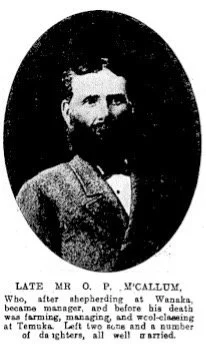
A Photo of Oswald McCallum, perhaps about 1880s.
Oswald had been employed by Robert Wilkin as a shepherd for Wanaka Station. Many of the shepherds were from Dumfriesshire where Robert also came from originally (a village called Tinwald, a short distance south of Kirkmichael). Eventually Oswald became the Head Shepherd for the Wilkin and Thomson partnership.
Oswald took part in the very first Sheep Dog Trial held in the World on 18 April 1867. One of his competitors was his friend and workmate H Broughton, who had lived in the adjacent house previously owned by the Norman’s. Both men had two dogs in the trial, but it was Oswald who came on top with his dog, Keilder, in 2nd place.[24]
Although we have no records, it is probable that Jane (Jnr) was a ‘first day pupil’ at the Albert Town School (opened 1868) and that that her siblings, Mary, Annie and maybe Oswald (Jnr) also attended the school. Oswald (Snr) was a member of the second school committee for the school at Albert Town.[25] In 1872 the average attendance was 25 pupils.[26]
It is reported that his last seven years at Wānaka were spent as manager of the property for the subsequent owners, Holmes and Campbell before the family moved to the Arowhenua Station, just outside Temuka about 1874/5. There, Oswald acted as Manager for J T Ford & Co until he left in 1880 and went farming on his own account at “Hazleburn” in the Totara Valley until he died in 1902.
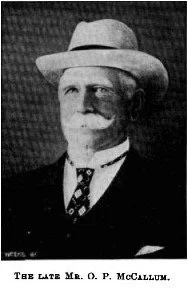
A photo of Oswald in later life.
Only two references can be found in local history books relating to Oswald and then they are limited to just his name and occupation. As it transpires, Oswald and Jane were amongst the very first European settlers to live in what we now know as Wānaka at a time when there were perhaps only 20 to 30 people in the Upper Clutha.
Jane and Oswald’s children were (source is principally Melinda Wiggins, NSW, Australia, a relative)[27] :
Jane born 7 June 1862 at Wānaka – died 1932 (see also the next section)
Mary Ann born 9 March 1864 at Wānaka – died 1918
Annie Borthwick born 3 April 1866 at Wānaka – died 1938
Oswald Pagan born 2 February 1868 at Temuka – died 1946
Robert John born 14 August 1870 – died 1970 (his birth was not registered)[28]
Jessie Agnes born 5 November 1875 at Temuka – died 1952
Katie Isabella born 14 January 1878 probably at Temuka – died 1950
Alexandrina Florence born 18 January 1882 at Temuka – died 1939
Eneas William Mackintosh born 1885 at Temuka – died 1888
[1] Scottish Census 1861
[2] She was actually married on 4 January 1861 at Kirkmichael. The date ‘1860’ could well be a transcription error interpreting her handwriting.
[3] Early settlers spoke of “Wanaka” in describing the area, just as we now describe the area as “Upper Clutha.”
[4] In actual fact they travelled on the Storm Cloud.
[5] She is mistaken here. The Storm Cloud landed at Dunedin direct from Glasgow and Jane and Oswald travelled on the Geelong to Oamaru on one of its regular “every Tuesday” voyages up the coast , stopping at Moeraki, Oamaru, Timaru and sometimes to Christchurch then return. Passenger records are clear on this matter.
[6] John Lloyd Hassell was a well-known early settler (1859) to North Otago. His farm (house built in 1860) was about 8km inland from Oamaru harbour.
[7] Nickname for Thomas Primate.
[8] Oamaru was the main supply town for the Upper Clutha in the early days. The Lindis Valley route was frequently unable to be used in winter.
[9] Originally named Mata-Au, then Molyneux by the European settlers and then to the current name Clutha River.
[10] Uncle of the previously mentioned Thomas Anderson.
[11] It is suspected that there is a transcription error here and it should read “Henry and Mrs Norman.”
[12] The Normans emigrated from the south of England in 1859.
[13] Jane McCallum, born 7 June 1862 but did this flood event happen in 1862 or 1863? Jane (the baby) was certainly born as stated, but the sentence, “I had my baby then.” can be interpreted two ways, i.e. she already had the baby or it was born at the time of the flood. In addition, Jane’s dates in the early 1860s have proven to be one year out (too early). It is more likely that it was the flood that occurred in July 1863 (the “Old Man Flood”). The timeline still indicates that Jane (Jnr) was born whilst they lived in the Cardrona Valley.
[14] The Maidmans initially lived at Cardrona before moving to Luggate where they built the first store and then the Albion Hotel opened in 1869. Henry and his wife Fanny could not have children of their own but did adopt two Chinese girls, progenitors of two large Upper Clutha families.
[15] Pembroke was the name given to what was to be the town in 1863. The town name was changed to Wanaka in 1940.
[16] These were built in 1860 by Henry Norman for his wife and their first child, Richard, when they first arrived to work for John Roy.
[17] Jane and Oswald’s second child was Mary Ann who was born on 9 March 1864.
[18] “Whare” is the Māori word for a house.
[19] Could this be the first bank and banker in the Upper Clutha?
[20] A Kangaroo Dog was an Australian breed of rough-haired dogs that resembled greyhounds and that were used for hunting kangaroos (but you would not find any kangaroos in the Upper Clutha!).
[21] Henry Norman operated a hotel, store and post office at Albert Town, a short distance from the Wanaka Station – about 1km.
[22] Their seventh child, Jessie, was born at Temuka in 1875.
[23] Otago Witness.
[24] Trial of Sheep Dogs, North Otago Times, 30 April 1867, Page 3.
[25] Albert Town, “Wanaka Story” by Irvine Roxburgh, Page 111. The surname is given as ‘MacCullum’ but no one of that surname spelling can be found.
[26] “Our Public Schools”, Cromwell Argus, Page 5, 3 May 1873.
[27] https://www.ancestry.co.uk/family-tree/person/tree/169105200/person/222360889863/facts
[28] Birth was reported in the Cromwell Argus on 24 August 1870, Page 4. Place of birth given as “Wanaka Terrace No. 3”.